
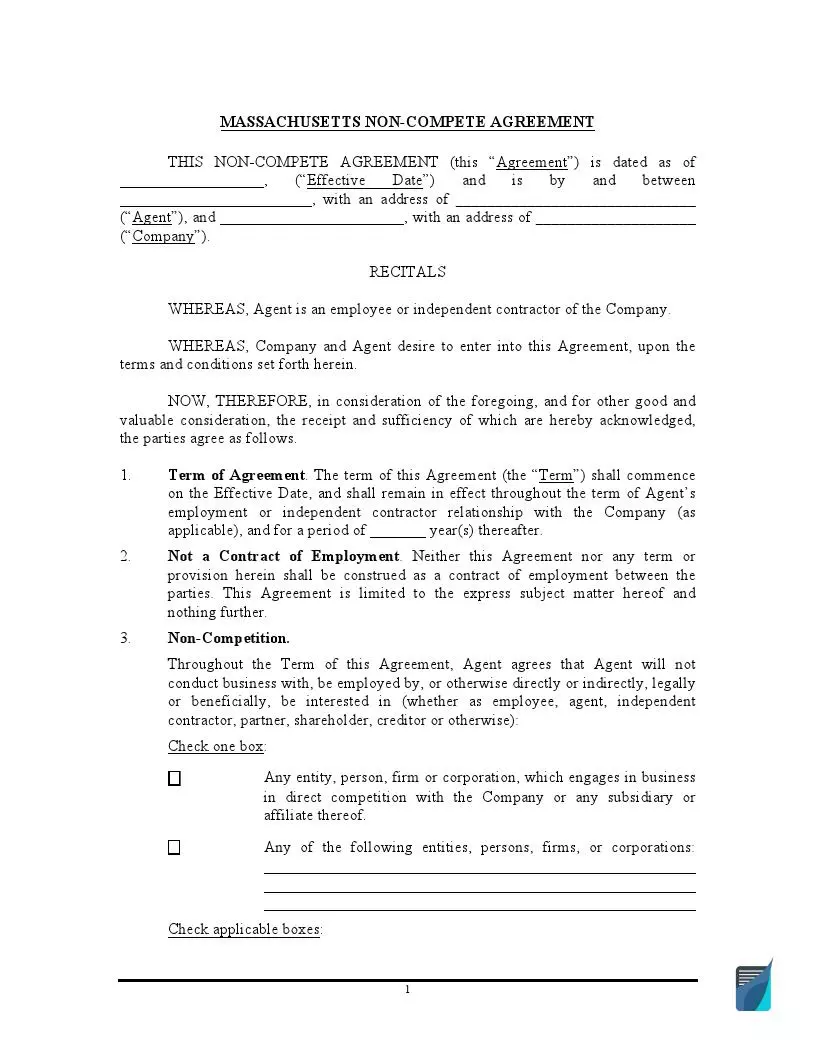
A Massachusetts non-compete agreement is a written contract in which an employee promises not to compete with an employer for a set time after the job ends. The employee also promises not to use its confidential information. In Massachusetts, a non-compete must meet the minimum requirements of Mass. Gen. Laws ch. 149, § 24L to be valid and enforceable.[1.2] Fill in our free template online or download it as a PDF.
Last Updated: October 2026. This guide is reviewed and updated regularly to reflect current Massachusetts law. If you notice an error or outdated information, please contact us.
Build Your Document
Answer a few simple questions to make your document in minutes
Save and Print
Save progress and finish on any device, download and print anytime
Sign and Use
Your valid, lawyer-approved document is ready
A non-compete agreement lets an employer protect its confidential business information. The employee agrees not to use or share that information, and not to compete with the employer, for a set period and within a set area. Both sides sign it. That way each side knows what is restricted and for how long.
A typical agreement covers these points:
Massachusetts regulates non-compete agreements by statute. To be valid and enforceable, a noncompetition agreement must meet the minimum requirements of paragraphs (i) through (viii) of Mass. Gen. Laws ch. 149, § 24L(b).[1.2] The statute also sets rules on pay during the restricted period. It also sets rules on how long and how far the restriction can reach, and on which workers it cannot bind.[1.1]
An agreement made when employment starts must be in writing and signed by both the employer and the employee. It must expressly state that the employee has the right to consult with counsel, meaning a lawyer, before signing.[1.1]
The employer must provide the agreement to the employee by the earlier of a formal offer of employment or 10 business days before employment begins.[1.1]
An agreement signed after employment begins, and not in connection with separation from employment, needs more. It must be supported by fair and reasonable consideration independent from the continuation of employment. Consideration means something of value in return for the promise. Notice of the agreement must be provided at least 10 business days before the agreement is to be effective.[1.1]
A Massachusetts non-compete must be supported by a garden leave clause or other mutually agreed consideration. The agreement must specify that consideration.[1.1]
To qualify as a garden leave clause, the agreement must provide for payment on a pro-rata basis during the entire restricted period. The payment must be at least 50 percent of the employee's highest annualized base salary paid by the employer within the 2 years before the employee's termination. Except when the employee breaches the agreement, the employer may not unilaterally discontinue the payments or refuse to make them.[1.1]
The agreement must be no broader than necessary to protect one or more of these legitimate business interests of the employer:
The agreement must also be consonant with public policy, meaning in harmony with it. It must be reasonable in the scope of proscribed activities in relation to the interests protected.[1.1]
A restriction on activities is presumptively reasonable if it protects a legitimate business interest. It must also be limited to only the specific types of services the employee provided at any time during the last 2 years of employment.[1.1]
The agreement must be reasonable in geographic reach in relation to the interests protected. A geographic reach is presumptively reasonable if it is limited to only the areas where the employee provided services or had a material presence or influence. The statute looks at any time within the last 2 years of employment.[1.1]
The stated restricted period may not exceed 12 months from the date employment ends. In two cases, the duration may not exceed 2 years from the date employment ends, instead of 12 months. The first is that the employee breached a fiduciary duty to the employer, meaning a legal duty of loyalty. The second is that the employee unlawfully took property belonging to the employer, physically or electronically.[1.1]
A noncompetition agreement is not enforceable against these workers:
Under the statute, noncompetition agreements include forfeiture for competition agreements, which take away a benefit if the employee competes. They do not include:
No choice of law provision that would avoid these requirements is enforceable if the employee was a resident of or employed in Massachusetts, and had been for at least 30 days immediately before employment ended. A choice of law provision is a clause that says another state's law governs the agreement.[1.1]
All civil actions relating to these agreements must be brought in the county where the employee resides or, if the employer and employee mutually agree, in Suffolk County.[1.1]
Signing a non-compete does not guarantee that it will hold up. Check it against each rule above, and have a Massachusetts employment lawyer review it before you rely on it.
To be valid and enforceable, a noncompetition agreement must meet the minimum requirements of paragraphs (i) through (viii) of Mass. Gen. Laws ch. 149, § 24L(b).[1.2] Check your agreement against each rule above before you rely on it.
It depends on whether the agreement meets the statute. A noncompetition agreement must meet the minimum requirements of paragraphs (i) through (viii) to be valid and enforceable.[1.2] It must also be no broader than necessary to protect a legitimate business interest of the employer.[1.1]
In Massachusetts, a noncompetition agreement is valid and enforceable only when it meets the minimum requirements of § 24L(b).[1.2] The statute also limits how long the restriction can last and which workers it can bind.[1.1]
Under Massachusetts law, enforceability depends on meeting the statute's minimum requirements.[1.2] Even then, an agreement is not enforceable against some workers, including employees age 18 or younger.[1.1]
General information, not legal or tax advice.
Popular Local NCA Forms
Non-compete contracts are recognized and enforced to a varying extent by most US states, making them fairly popular among a large number of businesses. Find out more about the most popular states searched by our visitors with regards to non-compete agreements.

