
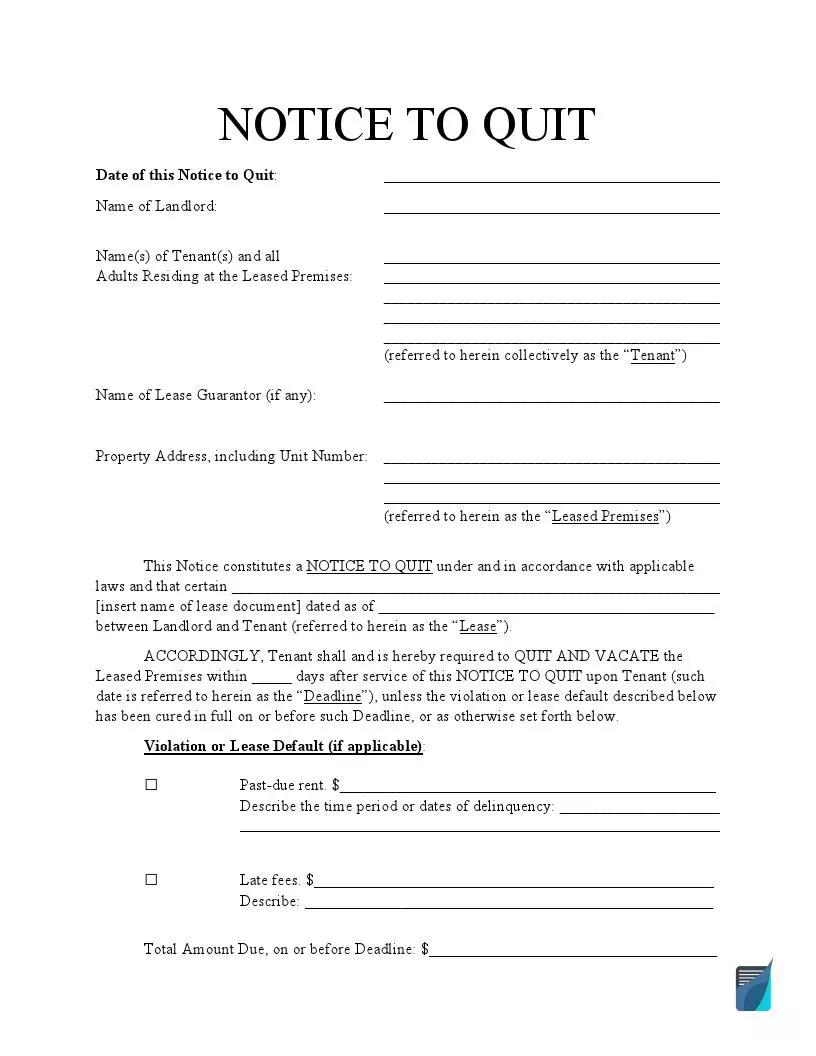
An eviction notice (also called a notice to vacate/quit) is a document that helps a landlord evict a tenant that does not comply with the terms of your contract in one way or another. Whether the tenant has violated a specific term or failed to make a payment in a specified amount of time, you can start the eviction process by sending them this notice, or you can persuade them to comply with the lease agreement.
If you need a fillable eviction notice template, you can download one in PDF format here at FormsPal. Or, use our custom document builder to add any details that you need in your exact case.
Build Your Document
Answer a few simple questions to make your document in minutes
Save and Print
Save progress and finish on any device, download and print anytime
Sign and Use
Your valid, lawyer-approved document is ready
In most cases, a notice to quit sent by a landlord to a tenant is curable. A curable notice gives the tenant a time frame (for example, a week) to make things right and fix the problem they have caused. Usually, this involves paying rent fully, fixing the damages done to the rental property, or paying for cleaning if the property is not in livable condition.
There are lease violations that are considered incurable, meaning the tenant should unconditionally leave the premises. These types commonly include the use of drugs, causing significant property damage, conducting illegal activities such as gambling, intentional destruction of property, subletting without the landlord’s consent, etc. Each state has different laws regarding this issue, so you can read more here – State Laws for Incurable Violations.
Eviction is a legal process of removing the tenant who violated the lease agreement from the premises. A tenant can be evicted for non-payment of rent or any other serious lease violation. Normally, before eviction, a landlord or a property manager can reach out to the tenant to try to handle matters unofficially. However, if the tenant or tenants refuse to comply, the only thing that is left to do is to file a notice to terminate the tenancy or an eviction notice.
If the property manager is lenient towards the tenant and is willing to give them a chance to make things right, they can file a curable eviction notice. If that is the case, the tenants of their property have the chance to meet the demands of the eviction notice and keep the tenancy. This involves either settling on a payment scheme with the landlord or fixing any problems that were caused by them.
If the tenants fail to fix the reason they’re being evicted, the property owner can file for eviction and remove them from the property legally. In most cases, the tenants will comply with the notice to terminate the tenancy and will leave out their own will. If they refuse to leave, hoping to win an ensuing court battle, the rental property would have to either use police presence to facilitate the eviction process or win a dispute in the housing court. When the due process is over, the winning side is liable to get their court costs covered and remedies paid.
While the end result of the eviction process is always the same, tenants either pay rent or quit the property, the reason for filing it may be different. Depending on the reason the landlord wants the tenant to leave, the form and wording of the eviction notice changes.
Here are the types of free eviction forms you can find at FormsPal.
The most common eviction form template is a notice to pay or vacate, otherwise known as a pay or quit notice or past due rent notice. This form is issued when a tenant (or tenants) fails to pay rent twice during the last six months. It’s a curable eviction notice that is usually given with up to seven day’s notice.
The notice should include a copy of the lease agreement and proof of non-payment of rent. The document gives the tenant the option to either pay for the services provided or vacate the property.
This notice should state the sum owed to the property owner as well as a reasonable deadline for payment. You can find a free template of pay or quit notice on FormsPal. All you have to do is fill in the blanks and sign the document.
Not all eviction notices are filed because of the non-payment of rent. Some tenants may be ordered to vacate the premises because they have failed to comply with some lease requirements.
The examples are as follows:
This notice is also curable. The tenant has a limited time frame to “cure” the problem they have created. If they do not meet the requirements of the lease agreement, they are ordered to vacate the premises.
At FormsPal, you can find a notice to comply or vacate forms that handle most situations that can go wrong with a tenancy. If you can’t find a template that is right for you, you can use the eviction form builder to create a custom eviction notice.
Illegal activity is one of the very few reasons that give the owner of the property to evict the tenants with one day notice. If the tenant is accused of possession of illegal drugs, or otherwise conducting illegal activity on the premises, a special eviction notice is filed and the tenant is required to leave the premises. Unlike with past due rent notice, this notice operates on a shorter timeline and has no option to “cure” it with rent payments. In some states, the tenant is required to vacate the property within 24 hours, others require a 3-day notice to be sent.
This type of eviction notice does not require legal action being taken against the tenant prior to the eviction process. If the landlord has sufficient evidence to have suspicions of illegal activity, they may get legal advice from a lawyer and start the eviction process.
Illegal activities that can lead to an eviction like this include:
If there is no fixed-time rental agreement or it has expired, the tenancy is continued on a month-to-month basis, also known as a tenancy at sufferance. This arrangement, often known as tenancy-at-will, can carry on until one of the parties of the agreement sends a termination notice.
Both landlord and a tenant are able to file this notice, notifying the other party that they are leaving the property or that they’re required to leave. In most states, this should be done on a 30-day notice. Some even make it as high as 60 days. The idea behind this is to give the other party sufficient time to find another housing option.
Unlike in the previous eviction notices, the landlord does not need a just cause to file for eviction. Since there is no long-term rental agreement, the landlord is free to ask the tenant to leave the premises without providing a reason, as long as this is done with ample time to find another rental.
| STATES | Non-Payment/Non-Compliance Notice | Time to Vacate after Receiving the Writ of Restitution | State Laws |
| Alabama | 7 days | 7 days | Alabama Code, Section 35-9A, Article 4 |
| Alaska | 7 days / 10 days | Not defined | Alaska Statutes, Section 34.03, Articles 05 and 06 |
| Arizona | 5 days / 10 days | 12 hours to 5 days (depending on the reason for eviction) | Arizona Revised Statutes, Sections 33-1361 to 33-1378 |
| Arkansas | 3 days / 14 days | 24 hours | Arkansas Annotated Code, Sections 18-17-701 to 18-17-707 |
| California | 3 days | 5 days | California Code of Civil Procedure, Sections 1161 to 1161b |
| Colorado | 10 days | No writ can be issued until 48 hours after the time of entry of the judgment | Colorado Revised Statutes, Sections 13-40-101 to 13-40-127 |
| Connecticut | 3 days / 15 days | 24 hours | Connecticut Revised Statutes, Chapter 832, Sections 47a-23 to 47a-42a |
| Delaware | 5 days / 7 days | 24 hours | Delaware Code, Title 25, Sections 5501 to 5517 |
| Florida | 3 days / 7 days | 24 hours | Florida Statutes, Sections 83.40 to 83.683 |
| Georgia | Immediate / Not specified | At least 7 days | Georgia Code, Title 44, Chapter 7 |
| Hawaii | 15 days / 10 days | Not defined | Hawaii Revised Statutes, Sections 521-61 to 521-82 |
| Idaho | 3 days | Immediately to 5 days | Idaho Statutes, Sections 6-301 to 6-324 |
| Illinois | 5 days / 3 days | 7 to 14 days | Illinois Compiled Statutes, Chapter 735, Sections 5/9-201 to 5/9-212 |
| Indiana | 10 days / Not specified | 48 to 72 hours (depending on the reason for eviction) | Indiana Code, Sections 32-31-1-1 to 32-31-1-23 |
| Iowa | 3 days / 7 days | 3 days | Iowa Code, Sections 562A.21 to 562A.33 |
| Kansas | 10 days / 14 days | Within 14 days | Kansas Statute, Chapter 58, Article 25 |
| Kentucky | 7 days / 15 days | 7 days | Kentucky Revised Statutes, Sections 383.500 to 383.715 |
| Louisiana | 5 days | 24 hours | Louisiana Code of Civil Procedure, Articles 4701 to 4705 |
| Maine | 7 days | 48 hours | Maine Revised Statutes, Title 14, Sections 709-6000 to 709-6017 |
| Maryland | 10 days / 30 days | Within 60 days | Maryland Annotated Code, Real Property, Sections 8-401 to 8-501 |
| Massachusetts | 14 days / Not specified | 48 hours | Massachusetts General Laws, Chapter 140, Section 32J |
| Michigan | 7 days | No writ can be issued until 10 days after the time of entry of the judgment | Michigan Compiled Laws, Sections 554.131 to 554.139 |
| Minnesota | 14 days / Not specified | 24 hours | Minnesota Statutes, Section 504B.281 to 504B.371 |
| Mississippi | 3 days / 30 days | Immediately to 5 days | Mississippi Annotated Code, Sections 89-8-1 to 89-8-29 |
| Missouri | Immediate / 10 days | 24 hours to 5 days | Missouri Revised Statutes, Chapter 441 |
| Montana | 3 days / 14 days | Not defined | Montana Annotated Code, Sections 70-24-401 to 70-24-442 |
| Nebraska | 7 days / 14 days | 10 days | Nebraska Revised Statutes, Section 76-1431 |
| Nevada | 5 days / 3 days | 24 to 36 hours | Nevada Revised Statutes, Sections 40.215 to 40.425 |
| New Hampshire | 7 days / 30 days | 5 to 7 days | New Hampshire Revised Statutes, Chapter 540 |
| New Jersey | 30 days | No writ can be issued until 3 days after the time of entry of the judgment | New Jersey Statutes, Sections 2A:18-53 to 2A:18-84 |
| New Mexico | 3 days / 7 days | 3 to 7 days | New Mexico Annotated Statutes, Sections 47-8-1 to 47-8-52 |
| New York | 14 days / 10 days | 10 or 14 days | New York Consolidated Laws, RPA Chapter 81, Article 7 |
| North Carolina | 10 days / Immediate | Up to 5 days | North Carolina General Statutes, Chapter 42, Article 3 |
| North Dakota | 3 days | Not defined | North Dakota Century Code, Chapter 47-32 |
| Ohio | 3 days | 10 days | Ohio Revised Code, Chapter 1923 |
| Oklahoma | 5 days / 15 days | 48 hours | Oklahoma Statutes, Title 41 |
| Oregon | 6 days / 10 or 14 days | No writ can be issued until 4 days after the time of entry of the judgment | Oregon Revised Statutes, Chapter 90 |
| Pennsylvania | 10 days / Not specified | 10 days | Pennsylvania Statutes, 1951 Act 20, Article 5 |
| Rhode Island | 5 days / 20 days | No writ can be issued until 6 days after the time of entry of the judgment | Rhode Island General Laws, Sections 34-18-1 to 34-18-57 |
| South Carolina | 5 days / 14 days | 24 hours | South Carolina Code of Laws, Sections 27-40-610 to 27-40-800 |
| South Dakota | 3 days / Before end of a term | Not defined | South Dakota Codified Laws, Sections 21-16-1 to 21-16-12 |
| Tennessee | 14 days / 30 days | No writ can be issued until 10 days after the time of entry of the judgment | Tennessee Code Annotated, Sections 66-28-501 to 66-28-522 |
| Texas | 3 days / Not specified | 24 hours | Texas Statutes, Property Code, Title 4, Chapter 24 |
| Utah | 3 days | Within 3 days | Utah Code, Sections 78B-6-801 to 78B-6-816 |
| Vermont | 14 days / 30 days | 5 or 14 days | Vermont Statutes, Title 9, Sections 4455 to 4468 |
| Virginia | 5 days / 21 days | 72 hours | Virginia Code, Sections 55.1-1234 to 55.1-1257 |
| Washington | 14 days / 10 days | 3 to 5 days (depending on the reason for eviction) | Washington Revised Code, Chapter 59.12 |
| West Virginia | Immediate | Not defined | West Virginia Code, Sections 55-3A-1 to 55-3A-3 |
| Wisconsin | 5 days / Depending on lease term | Within 10 days | Wisconsin Statutes and Annotations, Sections 704.01 to 704.95 |
| Wyoming | 3 days | 2 days | Wyoming Statutes, Sections 1-21-1002 to 1-21-1017 |
Notice to quit or notice to vacate and notice of intent to vacate are essentially the same document but with different senders. Notice to quit is a landlord notice that notifies a renter that they have to vacate the premises. Notice of intent to vacate is a tenant notice and sent to the landlord or property manager. The purpose of this document is to notify the landlord that the tenant is going to vacate the premises.
If either of these notices is served by parties in a month-to-month rental agreement, it has to be done with a 30-day notice at least. In some states, a 60-day notice of lease termination should be served.
However, if there is a lease agreement and the reason that the notice to vacate is filed is that the lease terms were violated, the time given to the tenant can be shortened. It can range from a 15-day notice in the case of non-payment of rent to a one-day notice in the case of illegal activity.
Often, landlords or property managers are lenient towards their tenants as they form a relationship over time. But what if something goes wrong and the tenants fail to comply with the lease terms? Even though a verbal notice may be effective with some people, it’s not legally binding in any way. It can only serve as a way to negotiate compliance peacefully.
If that doesn’t work, the property manager has no way to evict the tenant as there is no legal proof of notice to work with. The court does not issue eviction orders based on verbal quit notices.
If you want a tenant to comply with the lease terms or move out, the only way you can do that is by creating an eviction notice and sending it via certified mail. The notice and the proof that the tenant has received it will ensure that if you were to fight it out in court, you’d have all the evidence needed to win the case.
1. Know your laws
Knowing your local and state eviction laws is paramount before trying to evict a tenant. Apart from knowing the basics of the Uniform Residential Landlord-Tenant Act, you should also know the state laws that describe what actions can warrant termination of a lease and how many days of notice you should give the tenant.
If you don’t do that and either try to evict a tenant without a valid reason or give them too little time to move out, the document may be challenged in court. Failing to comply with any legal notice requirement set by your state also disqualifies the case and makes eviction processes longer.
2. Try to negotiate with the tenant

Another step that a landlord may want to take before taking the legal route is talking to your tenant. Most people would be reasonable enough to try and amend their situation whether it’s nuisance or late rent before they’re bothered to appear to a court date.
However, don’t take their word for granted. If they cannot fix the problem immediately, there is no guarantee that they will comply in the long term. You may need to file an eviction notice to be on the safe side regardless. At the very least, the tenant will not become antagonistic upon being surprised by the notice since they know it’s coming.
3. Figure out a reason for eviction

The next step is to figure out the exact reason or reasons for eviction. You will need to specify that in the quit notices and be very precise with the wording. For instance, if the reason is waste and nuisance, the landlord may have to specify what exactly the tenant did wrong and provide evidence. If the reason for eviction is non-payment of rent, you’d have to specify the amount and the months that the person failed to pay rent.
However, if it’s a month-to-month rental lease that’s being terminated, the landlord may not have to provide a reason. Just serve a 30-day eviction notice.
4. Set the right eviction date
The timeframe of the eviction depends on the reason for the eviction and the state law that describes it. In most states, a 30-days notice is the right way to end a month-to-month residency. However, some require 60-day notices to be served in this case.
For other reasons for eviction, the timeframes differ greatly. If a tenant is suspected of conducting illegal activity on the premises, they can be evicted in 24 hours in some states. Other states require 7-day notices to be served in case a tenant is guilty of property damage.
Seek legal advice online or from your lawyer to figure out how much time you need to give the tenant to move out and include that into the document.
5. Find a sample eviction notice for your case
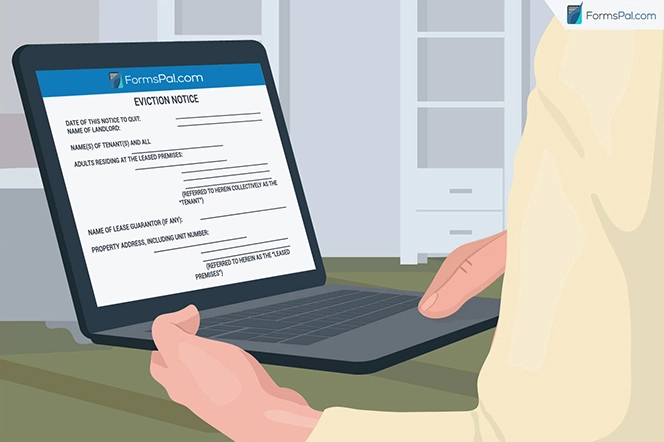
Now that you’re sure what type of eviction notice you need to send, you’ll need to find a template eviction notice that matches your case. You can easily do it here on FormsPal. We offer different types of sample eviction notice forms and they’re all free to use.
If you’re having trouble finding the free eviction notice form that is the right one for you, you can create it. Use our eviction notice builder to create a custom template to use in your specific case.
6. Send eviction notice by certified mail

Once the notice is created and signed, send it to the tenant via certified mail. This is important since you need a record of notice that is only possible to obtain when sending the eviction letter by certified mail.
You may file a case in court with an affidavit of service, but certified mail is still the most comfortable way of handling proof of notice.
7. Wait for the set time period

The eviction notice is considered to be in effect since the day it was delivered. Once you obtain proof of notice, wait for the number of days that are given to the tenant to cure or quit. If they do neither, it’s time to take matters to the court.
8. File the eviction documents with the court

File the eviction notice, the proof of notice, and all the documents related to the case with the courts and wait for the court to set a court date. Both you and the tenant should be notified of the court date by court summons delivered by a sheriff. You may need to seek legal advice here because if you don’t file the case correctly, it may be thrown out by the court.
9. Attend a hearing

The next step is to appear to court date with the tenant and let the judge hear the case. If you as a plaintiff provide sufficient evidence that your version of the events is correct and the judge believes it’s enough to evict the tenant, the court order will be in your favor.
10. Collect the money owed to you

If there was damage to the landlord’s property or failed rent payment involved, the court order requires the defendant to compensate for the losses of the plaintiff. In that case, you can either collect the amount of money owed to you right away or settle on a payment plan.
After the due process, the losing side is usually liable to pay court fees, attorney fees, and other legal expenses of the winning side.
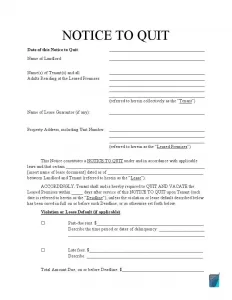
Once you have an eviction form, filling it out is not a big issue. However, you will need to make sure you go through this first and crucial step.
1. Choose the correct eviction notice form
Choosing the right form is one of the most important things that you should do before you start filling it out. If you choose the wrong one, it may not be legally viable and will be thrown out by the court, making you start the process again.
Here at FormsPal, we have a collection of free eviction notice forms that are fit for different purposes. Find the one that works for you or create custom eviction notice templates with a free builder on FormsPal.
2. Include information about all adult tenants
The next step is to fill out the information about all adult tenants that reside in the building including their name and mailing address. The phone number and email address are optional. If the landlord is dissatisfied only with some of the tenants, they can file only their names in the eviction notice, however.

3. Include the property address
After this step, fill in the full address of the property that the tenants reside in and that you want them evicted from. This includes street address, apartment number, and zip code.

4. Include your information
The landlord themselves need to add information about themselves as well, including their name, contact information, and mailing address.

5. Include the reason(s) for eviction (optional)
If you’re filling out a month-to-month eviction notice, you may not provide any reason for eviction. However, in all the other cases, you do need to provide a reason for eviction. If there is more than one reason, you need to specify each reason, providing sufficient evidence.
This will later be useful if you need to take the matter to court.
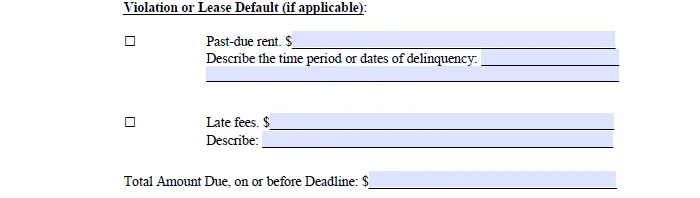

6. Include the due date of eviction
Provide the due date for the tenants to pay or quit. In the case of month-to-month rent termination, you need to give a 30-day notice. Other cases require quit notices from seven to 30 days, depending on your state laws.

7. Sign the eviction form
The final step is putting a signature on the document. Double-check that all the fields are filled out correctly and sign the document.
8. Send via certified mail
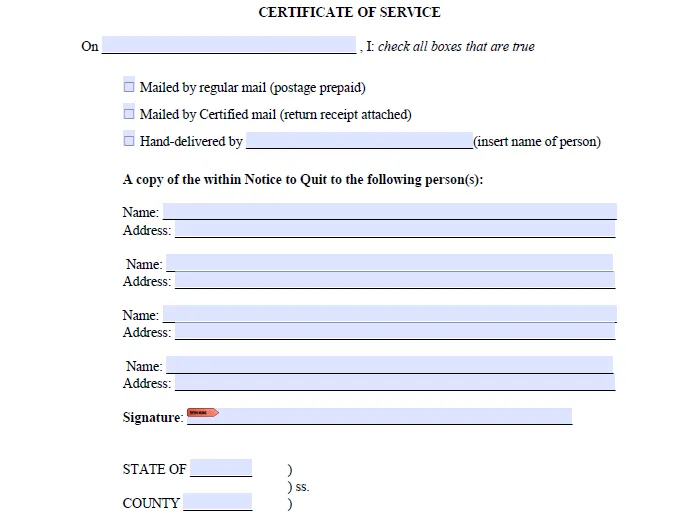
After the document is ready, send it to the tenant via certified mail. This is necessary because you will need proof of notice if you want to take the matter to the court that hears evictions. Alternatively, some states allow for other evidence of notice like a signed affidavit of a notice served by a disinterested party or evidence of the notice taped to the front door. However, certified mail proves to be an easier delivery method.
The landlords’ responsibilities include:
All of these responsibilities are implied even if they’re not included in the lease agreement. The landlords also enjoy the following implied rights:
Note that if a landlord tries to enforce constructive eviction that involves changing locks or forcible removal from the premises, they’re in breach, not the tenant. This is an illegal practice and even if it feels faster that way, it’s not allowed under any circumstances.
The only way to legally evict a tenant is through courts that hear evictions and lawyers. It may take more time but if you’re in the right, you will win the lawsuit and regain all the damages. Otherwise, the tenant may win a lawsuit against a landlord and be liable to receive remedies from them.
Tenant’s responsibilities include the following:
The tenants have the following rights:
If a roommate cannot contribute their share of a month-to-month lease payment, it could go two ways. You can either go to a landlord and ask them to negotiate with the roommate or file a notice if you’re subletting this space. To mitigate these sorts of issues early on, demand your landlord to give both of you separate rent agreements. This way, the nonpayment of rent by another tenant is their problem, not yours.
There are strict eviction processes and rules that govern problems like this. First, you file an eviction notice and send it to the tenant via certified mail. Once you have the proof that they have received it, you file it with the court clerk together with copies of the lease, eviction notice, any complaint the neighbors may have had, etc.
Then you attend a hearing and the judge will give the warning to move out. If they don’t, they will be removed by police under the threat of jail time. In most instances, this process is long, but residents will move out eventually. You will be liable for remedies that you can take out of their advance payment or from their job wages over a period of time.
You personally should not deliver the notice. Send it via certified mail and you will have a certificate of notice. If there is no response from them, you still have the legal grounds to go to court. Depending on the location of your county, you may send a disinterested party for assistance with delivery or just tape the eviction notice on the front doors and take a picture of it.
A tenant who is being evicted may file a motion to stay with the courts. If the judge accepts it—and under most regulations, it may be accepted—the court process will be postponed for up to ten days. Tenants do this to stall the process and win some time to move out or to prepare a better defense or hire a lawyer for representation.
If a tenant asks for a motion to stay to have more time to move out, it’s not a bad thing for the landlord as the provision of the lease implies that the tenant is still liable for penalties. What this does is just making them pay more in damages for lost rent.
If you are a tenant who wants to stop the eviction process, you have several options: