
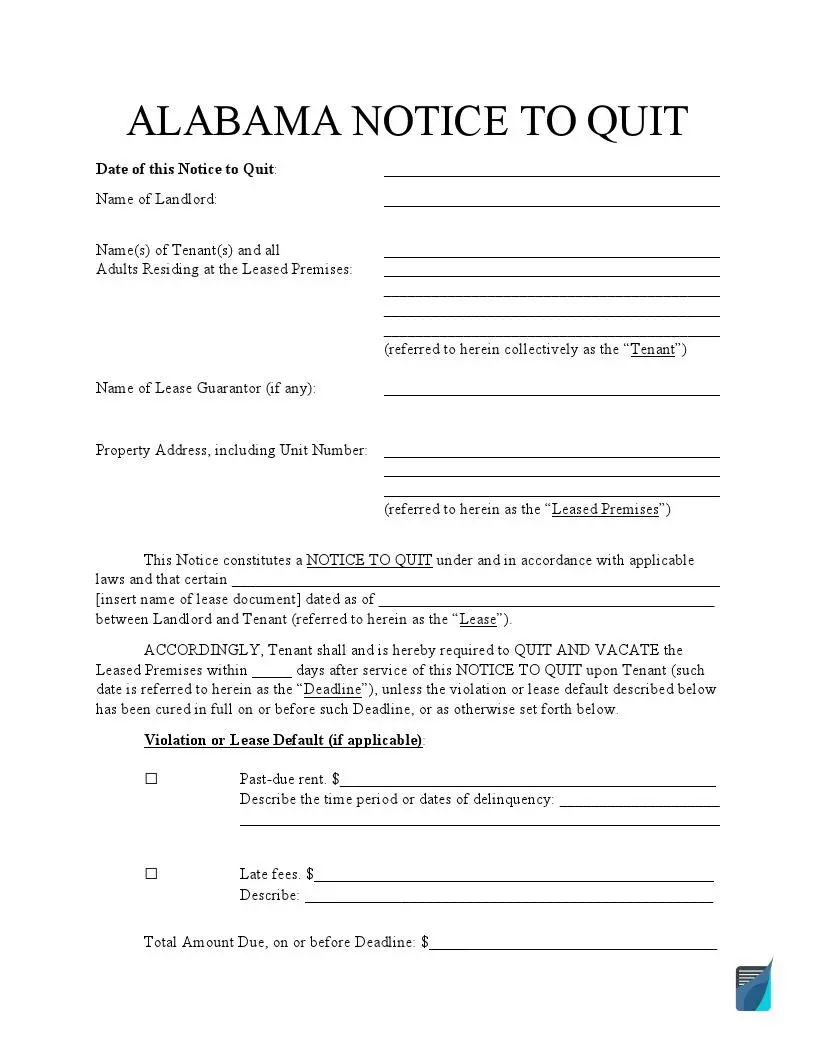
An Alabama eviction notice is a written notice a landlord serves on a tenant to end a tenancy for unpaid rent, a lease violation, or without cause, before filing an eviction case in court.[1]
Last Updated: October 2026. This guide is reviewed and updated regularly to reflect current Alabama law. If you notice an error or outdated information, please contact us.
Build Your Document
Answer a few simple questions to make your document in minutes
Save and Print
Save progress and finish on any device, download and print anytime
Sign and Use
Your valid, lawyer-approved document is ready
Alabama eviction notice templates let a landlord document a lease violation, an unpaid rent balance, or the end of a tenancy and give the tenant a chance to fix the problem or move out. Alabama law gives the tenant seven business days to respond to a notice for unpaid rent or a lease violation, seven days for a default that cannot be cured, and thirty days when a month-to-month tenancy ends.[1][3]
The most common reason to serve an eviction notice form in Alabama is unpaid rent, but a landlord can also use one for a lease violation, a repeat violation, or to end a month-to-month or week-to-week tenancy without cause. The notice period depends on which of those reasons applies.[1]
An Alabama eviction notice is also called a notice to quit, a notice to vacate, or a letter to quit. All three names refer to the same written notice a landlord serves before starting a court case.
Once a landlord decides to end a lease, Alabama law sets out how much time the tenant gets to respond, and the landlord may only recover possession through a court action.[1][2] In practice, a landlord who skips these steps risks losing the case, and the tenant stays in the unit until a judge orders otherwise.
The notice periods below apply to the most common reasons a landlord ends a tenancy in Alabama.
If rent is unpaid when due, the landlord must give the tenant written notice stating the amount owed, and the rental agreement will terminate on a date not less than seven business days after receipt of the notice.[1] The tenant can avoid the eviction by paying the full amount before that date.
The nonpayment notice can be served as soon as rent is unpaid when due.[1] The seven-business-day notice above begins as soon as the rent is late.
For a lease violation other than nonpayment, the landlord may deliver a written notice specifying the acts and omissions constituting the breach. The rental agreement will then terminate on a date not less than seven business days after receipt of the notice.[1]
If the breach is not remedied within those seven business days, the rental agreement terminates on the date stated in the notice unless the tenant remedies the breach first. A tenant may not cure a breach of the lease more than two times in any 12-month period, except with the landlord’s express written consent.[1]
A landlord or tenant who wants to end a month-to-month tenancy for reasons other than a violation must give the other party written notice at least 30 days before the next periodic rental date.[3]
| Rent Grace Period | None |
| Notice of Non-Payment | 7 business days[1] |
| Notice of Non-Compliance (Lease Violation) | 7 business days[1] |
| Month-to-Month Termination (No Cause) | 30 days[3] |
| Week-to-Week Termination (No Cause) | 7 days[3] |
| Governing Law | Ala. Code § 35-9A (Alabama Uniform Residential Landlord and Tenant Act) |
Alabama landlords use different eviction notices depending on why the tenancy is ending: nonpayment of rent, a lease violation, a repeat violation, intentional misrepresentation, nuisance or illegal activity, or the no-cause end of a month-to-month or week-to-week tenancy. A notice for unpaid rent or a lease violation states the reason and gives the tenant at least seven business days before the lease can terminate, while a notice ending a month-to-month tenancy gives thirty days and states no reason.[1][3]
Used when the tenant has not paid rent. The notice states the amount owed and gives seven business days to pay in full or move out.[1]
Used for a violation other than nonpayment, such as an unauthorized pet or property damage. The tenant gets seven business days to fix the problem or move out.[1]
Some violations give the tenant no right to cure unless the landlord agrees. These include a second breach involving substantially the same acts or omissions as a breach the landlord already gave notice for and the tenant already cured, when the second breach occurs within six months of the first. They also include an intentional misrepresentation of a material fact in the rental agreement or application.[1]
Either the landlord or the tenant can end a month-to-month tenancy without giving a reason. The party ending it must give the other written notice at least 30 days before the next periodic rental date.[3]
A week-to-week tenancy can end the same way, but the notice period is shorter: at least seven days before the termination date stated in the notice.[3]
Serving an Alabama eviction notice starts a legal process with several required steps. The landlord serves the notice, waits out the notice period, and only goes to court if the tenant does not pay, cure the violation, or move out in time.[1][2]
Choose one of the three templates relying on the reasons for your decision and generate a document. To achieve success, you are empowered to use our form-building software.
Define your identification, the address of the rental unit, and the reasons for creating the eviction notice. Depending on the type of the template, you’ll need to specify this or that information. Follow the requirements of the particular form.
When the document is ready, the time comes to send it to your tenant. We recommend using reliable certified mail providers, private services, or sheriff assistance.
Proof of service is your evidence that the tenant received the notice. The tenant should provide a signature confirming they were notified. With that proof on file, the landlord cannot be accused of skipping the required notice.
Do not use self-help. A landlord may not recover or take possession of the unit by action or otherwise outside the court process. This includes willful diminution of services such as interrupting heat, running water, hot water, electric, or gas to the tenant, except in case of abandonment, surrender, or as permitted by law.[2]
By the deadline in the eviction notice, the tenant can pay the debt or cure the violation to keep the tenancy. If neither happens, the rental agreement ends on that date, and the landlord's next step is a court action, since Alabama does not allow removal without one.[1][2]
If the tenant does not pay, cure the violation, or move out by the deadline, the rental agreement ends and the landlord's only route to possession is a court action.[1][2]
In practice, the sheriff's office serves the complaint, and the tenant gets a short window set by the court to respond.
In practice, both sides present their case at the hearing and the judge decides.
Alabama does not require a specific state eviction notice form, but two court documents come up often once a case is filed: the complaint the landlord files to start the case, and the answer the tenant files in response. Both are described below.
The landlord completes this form to start the court case, then the Sheriff’s Office serves a copy on the tenant.
The tenant completes this form to respond to the State of Claim. It is typically due at court within seven days of receiving that notice.
The tenant must get written notice at least seven business days before the landlord can end the lease for a violation.[1] The notice states the violation and gives the tenant that seven-day window to fix it or move out before the lease terminates.
No. Alabama law prohibits a landlord from removing a tenant or the tenant’s belongings, or shutting off utilities such as heat, water, or electricity, to force a move-out without going through the courts.[2] A landlord must file an eviction case and get a court order before retaking the unit.

General information, not legal or tax advice.
Unless noted otherwise, the sources below are from the Ala. Code.
