
Updated:
An immediate resignation letter is written notice that you quit right away. The letter names your last day, gives a brief reason and offers help with the handover. The letter fits employees leaving without the usual notice, especially in an emergency.
Key facts
The sections below cover when to send one, what each part says, how to write and deliver it, and sample letters for print and email.
Build Your Document
Answer a few simple questions to make your document in minutes
Save and Print
Save progress and finish on any device, download and print anytime
Sign and Use
Your valid, lawyer-approved document is ready
An immediate resignation letter is used when you leave your job without the usual notice period, on the day you write it or shortly after. It is usually written when a worker leaves in less than two weeks.
Common reasons for a short notice resignation include:
Quitting at once still affects your team. Your manager has to share out your tasks, find a replacement and keep the work going. A clear, prompt letter gives your employer the facts they need to plan, and a calm exit keeps future references within reach.
A standard notice letter fits when you can stay long enough to finish your work and train a replacement. If you have more time, a two weeks notice resignation letter is a better fit. For other kinds of letters, see the main resignation letter template page.
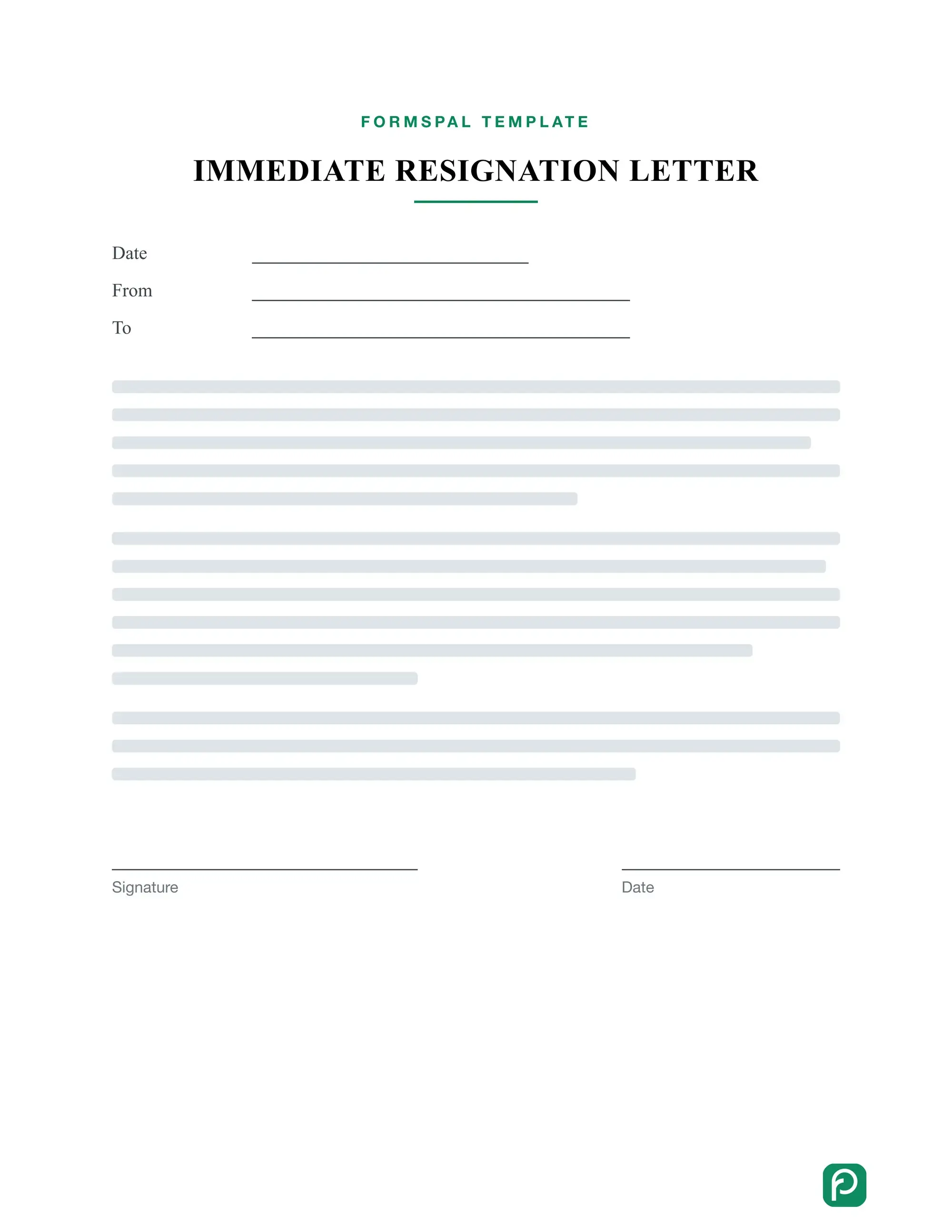
An immediate resignation letter includes your details, your last day, a short reason, thanks and a handover offer, in that order. The same parts work in a printed business letter and in an email.
The last day of work is the one date the letter has to make plain. Write "effective immediately" if you are leaving today, or give the exact date, such as "my last day will be Friday." A vague phrase such as "soon" leaves your employer guessing about pay, access and handover.
The reason is one short, calm sentence, such as "due to a family emergency" or "for health reasons." The letter does not need private details, a diagnosis or a complaint. Some writers add a line acknowledging that they cannot give the usual notice, which shows the employer you understand the impact.
The handover offer tells your employer what help you can still give after you leave. Name something concrete: notes on open projects, passwords returned through IT, or a short call with your replacement. Offer only what you can deliver.
The contact line gives your employer a personal email and phone number for questions after your work account closes. It is also the place to ask how your final paycheck, unused vacation and benefits will be handled, so the answer comes to an address you will still read.
An immediate resignation letter is written in three parts: a heading and greeting, a short body, and a closing. Keep each paragraph to two or three sentences; a manager reading surprising news takes in short text best.
A short notice letter reads best when it is formal, brief and free of blame. Even if you are leaving because of a conflict or poor working conditions, the letter stays polite. Save any complaint for a separate conversation with HR, where you can give details and ask questions.
An immediate resignation letter can be sent as an email or handed over as a printed business letter; the content is the same in both. Choose the format your workplace uses most for formal messages. Email arrives at once and leaves a dated copy in your sent folder.
The subject line tells your manager what the email is before they open it. Use plain words, such as "Resignation, Effective Immediately: Jordan Lee" or "Resignation Notice: Jordan Lee." Send the email to your direct manager and copy HR if your workplace does so.
A printed business letter puts your contact details and the date at the top, then the employer's name and address, then the greeting. Leave space above your typed name for your handwritten signature. Hand it to your manager in person when you can, or send it by mail with tracking.
An immediate resignation letter works best when your manager hears the news from you first, in a call or a short meeting, with the letter sent right after. These steps keep the exit orderly:
Stay professional until your last moment at work. Good relationships with former managers often lead to references and new career opportunities later.
A resignation letter should leave out blame, private details and anything you would not want a future employer to read. The letter can stay with your employer long after you leave, so every line should be one you are comfortable standing behind.
The samples below show an immediate resignation letter in three forms: a printed business letter, an email and a very short version. Replace the blanks and the example names, dates and reasons with your own.
____________ (Your full name and job title)
____________ (Your address, city, zip code)
____________ (Your phone number)
____________ (Your personal email)
____________ (Today's date)
____________ (Manager's name and job title)
____________ (Company name)
____________ (Company address, city, zip code)
Dear _____ (manager's name),
Please accept this letter as notice of my resignation from my position as ______ (job title). Because of a family emergency, I am unable to give the usual two weeks' notice. My last day of work will be February 27, three days from today.
Before I leave, I will write up notes on my open projects and share them with the team. I am also glad to answer questions by phone or email after my last day.
Thank you for the chance to work here. I have valued the support of my colleagues and everything I learned in this role.
Sincerely,
_______ (your handwritten signature)
_______ (your typed full name)
Subject: Resignation, Effective Immediately: ______ (your name)
Dear ______ (manager's name),
I am writing to tell you that I am resigning from my position as ______ (job title), effective immediately. I know this is short notice; personal circumstances mean I cannot continue working, and May 3 will be my final day.
Thank you for three good years with this team. I have learned a great deal here and will remember the support I received.
I am happy to help with the transition. I can prepare handover notes today, and you can reach me at ____ (personal email) or _____ (phone number) with any questions.
Best regards,
________ (your full name)
Dear ______ (manager's name),
Please accept this as notice of my resignation, effective today, for health reasons. Thank you for the opportunities I have had here. I will return my laptop and badge by Friday, and you can reach me at ____ (personal email) with any questions.
Sincerely,
________ (your full name)
Say that you are resigning, give your last day or "effective immediately," add one line on the reason, and thank your employer. Then offer help with the handover. Keep it short and polite; the details can wait for a conversation with HR.
An immediate resignation letter tells your employer you are leaving, but your employment contract, offer letter or handbook may set a notice period or terms for leaving early. Read those papers before you send the letter, and ask HR if anything in them is unclear.
Keep your reasons short and calm. One sentence, such as “due to a family emergency,” is typically enough. Skip private details such as health or family issues, and do not blame anyone. It's better to spend the space on thanks and an offer to help.
If you have more time, a two weeks notice resignation letter is a better fit. It's a calmer way to go, with room to finish projects and train a replacement.
Yes. Add one short sentence about your situation and keep the rest the same. You can also start from the resignation letter for personal reasons and shorten the timeline.
A teacher's letter follows the same structure, addressed to the principal with a copy to the district's HR office. In some states the education code itself, not only the contract, limits a resignation during the school year, so check your state's rules and your contract before you send it. Under Va. Code § 22.1-304, a Virginia teacher may resign after June 15 of a school year only with the approval of the school board or, if the board authorizes it, the division superintendent. Va. Code § 22.1-304 also requires the teacher to request release from the contract in writing at least two weeks before the intended resignation date and to state the cause. If the request is declined for insufficient or unjustifiable cause and the teacher breaches the contract, Va. Code § 22.1-304 allows disciplinary action, which may include revocation of the teacher's license. Send the request to whoever approves releases in your district, and offer lesson plans and grade notes as your handover.
General information, not legal or tax advice.
