
Updated:
A coworker recommendation letter is a colleague's written endorsement of your work. The letter describes the candidate's skills, character and results from first-hand experience. Job seekers, interns, school applicants and volunteers use it, especially when a CV leaves doubts.
Key facts
Build Your Document
Answer a few simple questions to make your document in minutes
Save and Print
Save progress and finish on any device, download and print anytime
Sign and Use
Your valid, lawyer-approved document is ready
A letter of recommendation for a coworker is a short endorsement written by a peer, someone who worked beside the candidate rather than above them. It describes how the person works, what they achieved and how they treat the people around them.
The document goes by several names. "Reference letter", "recommendation letter" and "colleague letter of recommendation" all describe the same thing on this page. A letter of recommendation from a manager speaks to performance reviews and targets; a coworker's letter speaks to daily teamwork, which a manager often sees less of.
Two types are common. A professional reference covers skills, projects and results at work. A character reference covers personal qualities such as honesty, patience and reliability. Most coworker letters combine both.
A coworker recommendation letter adds a second voice to an application: the CV shows what the candidate says about themselves, and the letter shows what a colleague saw. Readers tend to trust it for that reason. Four situations call for one most often:
An internal promotion or a transfer to another team is a fifth use. There, the letter comes from a peer in the same company and goes to the hiring manager of the new role.
A coworker recommendation letter covers six parts: the two names, the date, the working relationship, the candidate's skills, one specific example and the writer's contact details. The list below gives each part in reading order.
Because many coworker recommendation letters are sent by email, you are not obliged to print them or leave your signature. A typed name, job title and employer under the closing serve the same purpose.
The working relationship paragraph tells the reader why this colleague can judge the candidate: how long they have worked together, on which team and in what roles. A peer who shared projects daily speaks with more weight than one who met the candidate at company events.
The paragraph also names the writer's own position and employer. That context lets the reader weigh the praise that follows.
The work example is the part that makes a coworker reference believable. A single story, such as winning back an unhappy client, leading a project under a tight schedule or training new hires, shows a skill instead of claiming it.
A strong example names the situation, what the candidate did and how it ended. A result the reader can picture, such as a finished launch or a client who renewed, beats a string of adjectives.
A coworker recommendation letter leaves out private and unverifiable details: health, family plans, age, salary and gossip about the employer. It also leaves out praise the writer cannot back with something they saw.
A letter of recommendation for a coworker follows a simple plan: a heading and greeting, an opening that names the candidate and the role, a body with skills and one story, and a closing with contact details. The three parts below give each step in order.
The opening of a coworker reference letter tells the reader what the document is and who it recommends, so the purpose is clear from the first lines.
The body of a coworker recommendation letter connects the candidate's skills to the role, then proves them with one story from shared work.
The closing of a coworker reference letter invites the reader to follow up and tells them who stands behind the recommendation.
The tone stays brief and friendly but formal. Short paragraphs with clear examples read better than long, general praise.
A short letter of recommendation for a coworker keeps four parts: who you are, how you know the candidate, one strength with one example, and how to reach you. It fits an online application form, a networking email or a profile recommendation.
The short version drops the separate heading block and joins the opening and the relationship into one paragraph. It still names the role the candidate wants, so the reader knows the praise is aimed at it.
Short sample
Dear _______________ (recipient's name),
I recommend _______________ (colleague's name) for the _______________ (position) role at _______________ (company). We have worked side by side at _______________ (your company) for ____ years, where I am a _______________ (your position).
(He or she) is organized, calm under pressure and generous with teammates. When our team _______________ (a situation), (he or she) _______________ (what your colleague did and the result).
I am glad to answer any questions at _______________ (phone) or _______________ (email).
Sincerely,
_______________ (your name, position and company)
A coworker reference letter gains strength from precise words backed by evidence, not from stacked superlatives. Each word below works best next to the example that proves it.
Words to avoid are the empty ones: "great", "nice", "hardworking" with nothing after them. A reader skims past praise that every letter contains.
A strong coworker recommendation starts with preparation: knowing the role, the candidate's CV and the deadline before the first sentence. These tips keep the letter honest, specific and easy to use.
An honest coworker recommendation letter protects both the candidate and the writer. Do not exaggerate your coworker's skills or experience: your own reputation suffers if the reader finds out. If your colleague asks you to write specific details, decline the parts that are not true.
A recommendation request can be declined politely when you cannot honestly recommend your coworker or did not work closely enough to judge. Offer a shorter letter limited to facts you can stand behind, such as dates, job title and projects, or suggest a colleague who knows their work better.
A coworker recommendation letter reaches the reader by email, an upload or on paper, depending on what the employer or school asks for. These steps cover the email route, the most common one.
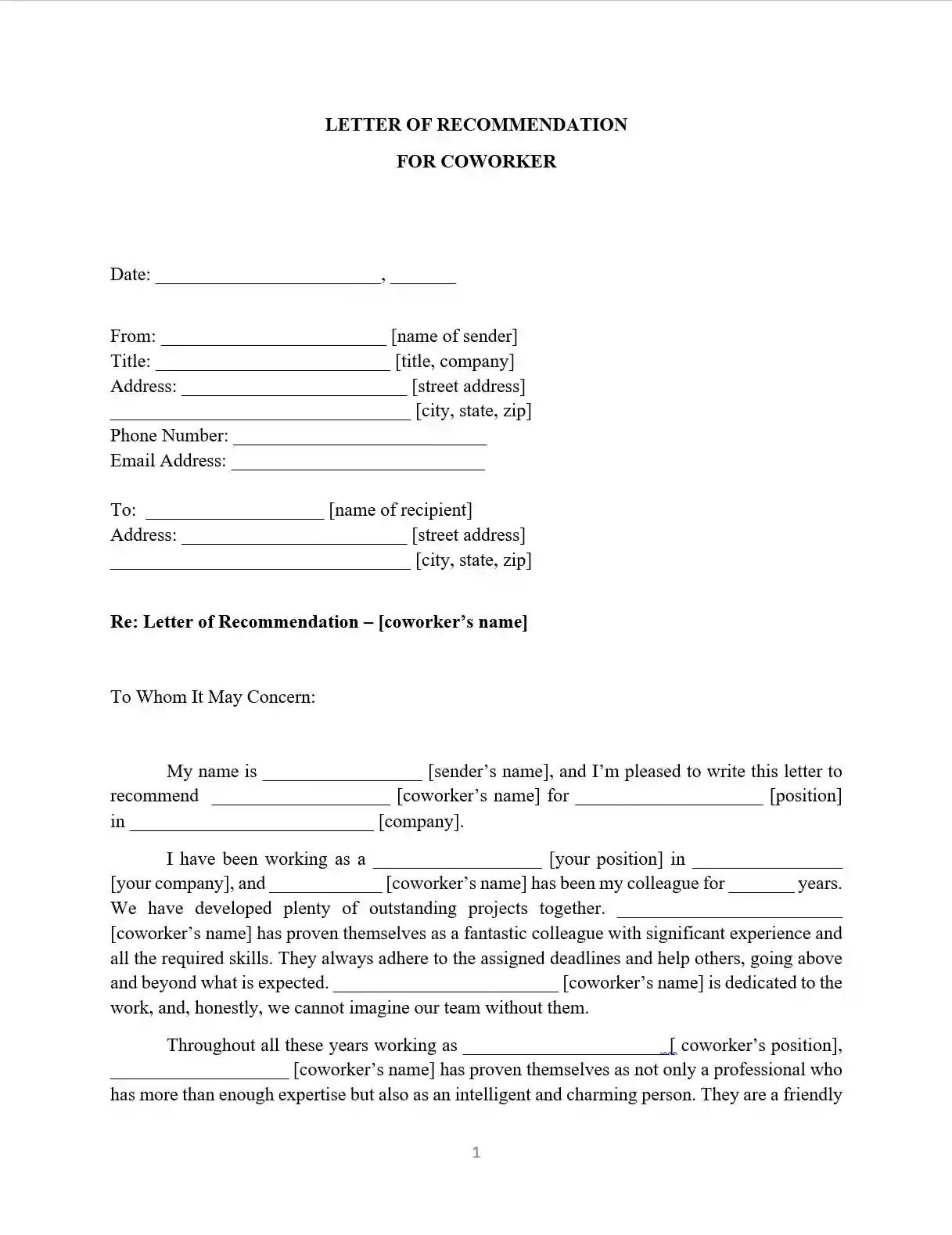
The three coworker recommendation letter samples below use blank lines with short hints to replace with your own details. Pick the sample that fits the situation, or combine parts of several.
Recommendation Letter
___________________, 20___
(enter the date here)
Dear ______________, (insert the recipient's name)
I am writing this letter to recommend _____________ (your colleague's name) for _________________ (the position) at _______________ (the company name).
My name is _______________ (your name here). I have been working as a __________________ (your position) at ________________ (your workplace) for ____ years, and ____________ (your colleague's name) has been my coworker for ____ years. We have delivered many successful projects together.
(He or she) has proven (himself or herself) a fantastic colleague with significant experience and the skills the role calls for. There was no day when (he or she) was late or missed a deadline. (You can add more relevant skills and traits here.)
We once had a client who wanted us to prepare and launch a large project in a short time. Thanks to _____________'s (your coworker's name) work ethic, skills and character, the whole team stayed motivated, and we finished everything on time. (You can add more details about this story to make it vivid for the reader.)
I believe that ________________ (your colleague's name here) is an excellent candidate for this position. If you have any questions about (his or her) work at our company, please contact me. My phone number is ______________ (enter your phone number here), and my email address is _______________ (your email address here).
Best regards,
_____________ (your name here)
_____________ (your position)
_____________ (the company name)
Reference Letter
___________________, 20___
(enter the date here)
To whom it may concern,
I am glad to provide a reference for my colleague, __________________ (enter your colleague's name here), who is applying for the position of ________________ at __________________ (the position and company your coworker is applying to).
I, ________________ (your name here), have known ____________________ (your colleague's name) for ______________ (the period you have known each other). We have worked on many tasks together at _______________ (the company's name).
Throughout these years, ___________________ (your colleague's name) has proven (himself or herself) not only a professional with deep expertise but also a thoughtful, friendly person. (He or she) communicates openly and respects other people's focus. It is always a pleasure to work with (him or her). (Be more specific about the skills.)
One example from our work life shows this. _____ years ago (enter the exact number here), _____________ (your coworker's name) was appointed team leader for ___________ (the project's or department's name here).
(He or she) worked hard to lead (his or her) team to success, communicated attentively with each team member and handled disagreements calmly. (He or she) grew into a talented manager who respects (his or her) team and every client we have worked with.
When the team had just one night to finish a project before a morning meeting with a client, (he or she) motivated everyone and stayed until the work was done.
I have no doubt that _________________ (your colleague's name here) will fit this position well. (His or her) expertise will let (him or her) settle in quickly and deliver results. I will gladly answer any questions you may have about the candidate. My contact details:
Phone: ________________
Email address: __________________
Sincerely,
_____________ (your name here)
_____________ (your position)
_____________ (the company name)
Recommendation Letter
___________________, 20___
(write the current date here)
Dear _______________, (write the addressee's name here)
My name is __________________ (enter your name here), and I am a coworker of _________________ (enter your colleague's name here). In this letter, I am glad to recommend (him or her). (He or she) is applying for __________ at ______________ (enter the position and company name).
I have worked with _________________ (your colleague's name) for _____ years (indicate how many years). Working with (him or her) has been a pleasure from the start. (He or she) is an expert in the field, and such a specialist is not easy to find.
(He or she) has a long list of finished projects and satisfied clients, and (his or her) teammates enjoy working with (him or her). (Remember to be more specific about the skills.)
Let me give you one example from our professional life. (He or she) was part of the human resources department, where (he or she) created many perks and programs for the team.
Once, (he or she) had to organize a large event from scratch in a short time, and the event was excellent. Our colleagues enjoyed the atmosphere, the organization and the gifts. (He or she) developed the plan, set a minute-by-minute schedule, invited the staff needed, chose the gifts, managed the budget and oversaw everything, and finished the project with ease.
I am happy to answer any questions you have about the candidate. Please call or text me.
Phone: ________________
Email address: __________________
Sincerely,
_____________ (your name)
_____________ (position)
_____________ (company name)
These short answers cover the questions people ask most often before they write a coworker recommendation letter.
A teammate, a project partner or a former colleague who worked closely with the candidate can write one. The best writer can give real examples and speak honestly, in a professional tone, about the candidate's work and character.
A page or so is usually plenty. Three to five short paragraphs leave room for the relationship, the skills, one story and the contact details.
Yes, a coworker can write one, and many employers welcome a peer's view of daily teamwork. When the application asks for a supervisor's reference specifically, the coworker's letter works best as an addition to it.
In everyday hiring, the two names describe the same letter. Some readers use "recommendation" for a letter aimed at one role and "reference" for a general one opened with "To whom it may concern".
You can reuse most of it. Change the job title, the employer and the examples so that each version fits the role your coworker is applying for.
A printed copy carries a handwritten signature above the typed name. An emailed letter needs only the typed name, job title and employer, sent from the writer's own work address.
General information, not legal or tax advice.
