
Updated:
A good moral character letter is a personal reference for immigration applicants. A friend, employer, or relative writes it, with real examples of honesty, work, and care for others. It helps applicants show the person behind the paperwork, especially in family and citizenship cases.
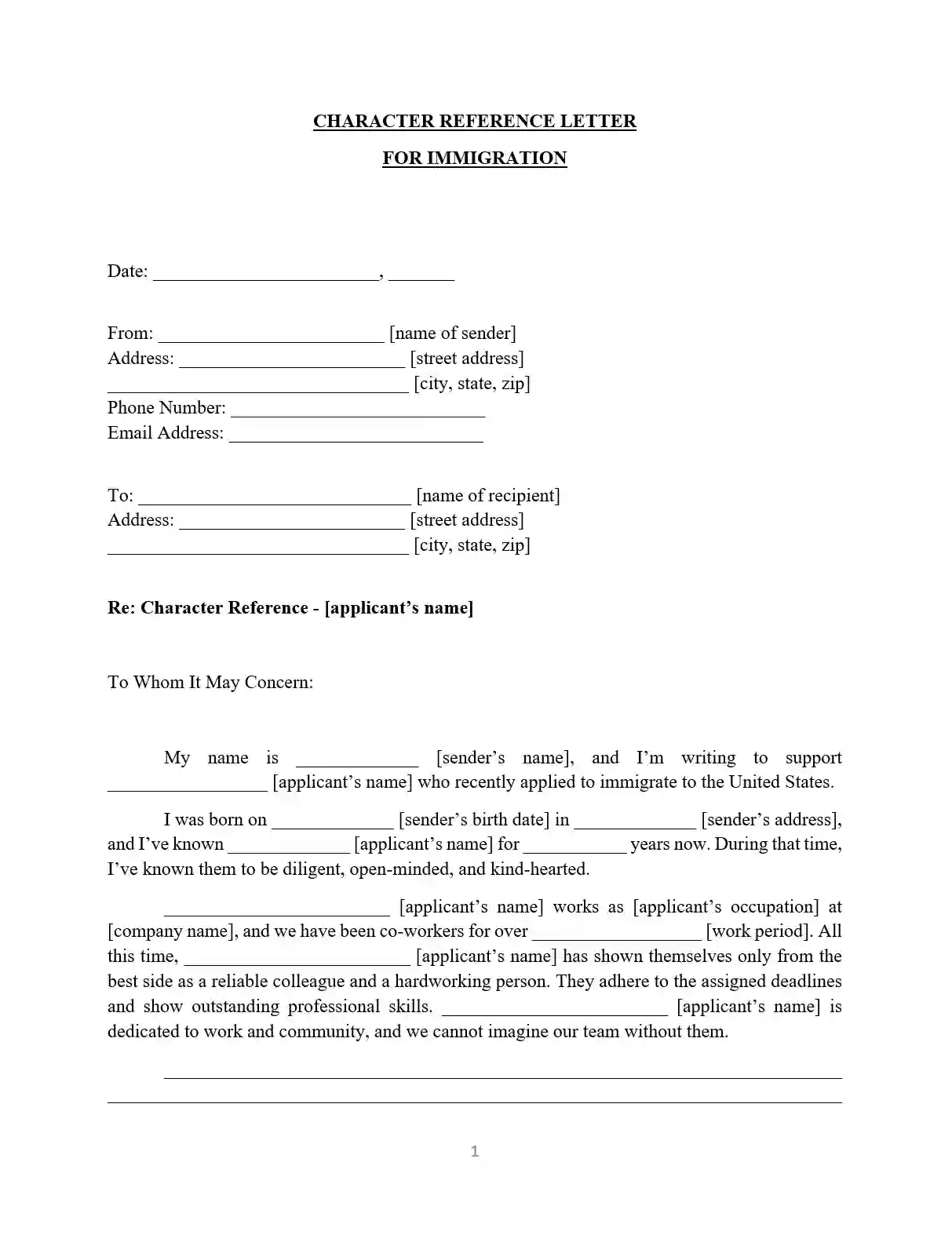
It is also called a character reference letter for immigration. Create yours online with the free template below, or follow the guide and three sample letters on this page. Looking for a general letter of recommendation? Start with the main template page.
Build Your Document
Answer a few simple questions to make your document in minutes
Save and Print
Save progress and finish on any device, download and print anytime
Sign and Use
Your valid, lawyer-approved document is ready
A good moral character letter for immigration is a signed, personal letter in which someone who knows the applicant well describes their honesty, reliability, and conduct with real examples. The writer explains who they are, how they know the applicant, and why they trust them. The letter gives the reader a picture of the applicant that forms and documents cannot.
People use several names for the same letter: character reference letter, character letter, good character letter, letter of support, or good citizen letter. Whatever the name, the content is the same: true, specific examples from someone who knows the applicant.
A character reference letter, a letter of support, and a letter of recommendation overlap, but each puts the weight on a different thing the reader wants to know about the applicant.
An immigration letter can mix these kinds. This page focuses on character, with a friend sample, a family sample, and an employer sample below.
You need a character reference letter for immigration when the applicant, their attorney, or the office reviewing the case asks for personal references that show who the applicant is beyond their forms. Common situations include:
The applicant or their attorney decides which letters go into the packet. Ask them who the letter should be addressed to and whether they need anything beyond a signed letter.
A character reference letter is a personal letter, so it does not answer a request for a sworn affidavit, a police clearance, or a certificate issued by a school or a local office. If a request names any of those documents, ask the applicant's attorney or the office that asked for it what form it takes. For a letter to a judge in a criminal case, see the general character reference letter template.
The best character reference letter for immigration comes from someone who knows the applicant well, has seen their conduct over time, and can give real examples instead of general praise. Each writer can speak to a different strength, so match the writer to the stories they know best.
Whoever writes the letter, the relationship with the applicant should be clear in the first few lines. A few letters from different parts of the applicant's life tell a fuller story than many letters from the same circle.
A good moral character letter for a friend describes the applicant the way the people around them see them: in daily life, in hard moments, and in how they treat others. A friend sees things an employer does not, such as how the applicant helps a neighbor, raises their children, or shows up when someone needs help.
As a friend, focus on:
Keep it personal but factual. Write only what you have seen yourself, and leave out anything you heard from others. A friend's letter reads best in a warm, plain voice, the way you would describe the applicant to a neighbor. The first sample below is written by a friend.
Examples of good moral character in a reference letter are the everyday actions that show honesty, responsibility, respect for others, and care for family and community. The table pairs each trait with the kind of moment a writer may have seen.
| Trait | What it can look like |
|---|---|
| Honesty | Returning extra change, admitting a mistake at work, keeping promises |
| Responsibility | Paying bills on time, showing up for every shift, caring for children or parents |
| Hard work | Holding a steady job, learning new skills, helping coworkers |
| Kindness | Helping neighbors, visiting the sick, sharing meals |
| Community service | Volunteering at a food bank, a place of worship, a school, or a youth team |
| Family commitment | Supporting a spouse, raising children, helping relatives |
Pick the traits you have actually seen and give an example of each. A single true story says more than a long list of adjectives.
A character reference letter for immigration includes the writer's details, the applicant's full name, how they know each other, examples of the applicant's character, and the writer's signature and date. Use the items below as a checklist before you sign.
Extras such as a copy of the writer's ID are worth adding only when the applicant or their attorney asks for them.
To write a character reference letter for immigration, introduce yourself, explain how you know the applicant, give specific examples of their character, close with your support, and sign and date it. The letter has these parts:
Start the letter with the date and a greeting that fits who will read it, and keep any heading short and plain, such as the applicant's name and the purpose of the letter. If the applicant is in removal proceedings before an immigration judge, address the letter to “Honorable Immigration Judge.” In other cases, “To whom it may concern” is enough.
In the introduction, give your full name, your job, your citizenship or immigration status, and how and for how long you have known the applicant, so the reader knows why your view counts. Keep the arguments for the main body.
The main body carries the examples: describe a few moments that show the applicant's honesty, work, and care for others, in the order they happened. An employer can add what the applicant does at work and how they treat coworkers. A friend or relative can describe their life at home and in the community. Write only what you know to be true.
In the conclusion, say plainly that you support the applicant and why, in a short paragraph that sums up the examples you gave above. Offer to answer questions and point the reader to your contact details.
List your full name, address, phone number, and e-mail under the closing or in the opening lines, so the reader can reach you with questions about the letter.
Sign the letter by hand, print your name under the signature, and write the date, then give the signed letter to the applicant or their attorney. They decide how it goes into the application packet.
A strong character letter is honest, specific, and easy to read, while a weak letter leans on general praise, guesses, or claims the writer cannot back up. Use these tips while you write, then read the whole letter aloud once more before you sign it.
Sentence starters help you begin your letter when the first line is the hardest part: adapt the lines below, replace the example names and facts with your own, and keep every claim true and specific.
The sample good moral character letters below cover the most common writers, a friend, a spouse or family member, and an employer, each with blanks you replace with your own details. Change every line to fit what you know; the hints in brackets show what goes in each blank.
A friend's good moral character letter speaks to the applicant's daily life, kindness, and place in the community, and it suits a citizenship application or a family-based case.
Character Reference Letter for a Friend
To whom it may concern,
My name is _____________ (your full name). I am a _____________ (your job) and a _____________ (your citizenship or immigration status), and I live in _____________ (your city). I have known _____________ (your friend's full name) for _____________ (number of years) years. We met _____________ (how and where you met), and our families have been close ever since.
_____________ (your friend's name) is one of the most honest people I know. _____________ (a short story: a time they returned something, kept a promise, or told the truth when it was hard).
For _____________ (number of years) years, _____________ (your friend's name) has volunteered at _____________ (place). Every _____________ (day of the week), they _____________ (what they do there), and the people there know they can count on them.
_____________ (your friend's name) is also a devoted _____________ (parent, son, daughter, or spouse). _____________ (an example of how they care for their family).
I believe _____________ (your friend's name) is a person of good moral character and a valued part of our community, and I fully support their application.
Please contact me if you have any questions. My details are below.
Sincerely,
_____________ (your signature) _____________ (date)
A family member's letter explains the applicant's role at home and what the family would lose without them, which fits a family-based case or a hearing before an immigration judge.
Character Reference Letter for Family
Honorable Immigration Judge,
My name is _____________ (your name). I am _____________ (your job and citizenship status), and I have been married to _____________ (your spouse's full name) for _____________ (number of years) years. I am writing to ask that _____________ (your spouse's name) be allowed to stay in the country with our family.
_____________ (your spouse's name) and I have _____________ (number) children, and we raise them together. _____________ (your spouse's name) takes them to school, helps with homework, and _____________ (what your spouse does for the family every day). Our children need both parents at home.
We also _____________ (a shared business, a home, or care for a relative), and a lot depends on both of us. A separation would hurt our children, our work, and everyone who relies on us.
_____________ (if there is a past mistake the reader will see, name it briefly and describe what your spouse has done since then).
_____________ (your spouse's name) is an honest, kind, and responsible person. Our family asks you to let _____________ (your spouse's name) stay with us.
My personal details are as follows:
Please contact me whenever you need to.
Sincerely,
_____________ (your signature) _____________ (date)
An employer's letter describes the applicant at work, including their reliability, skills, and the way they treat coworkers, which fits a citizenship application or a work-based case.
Character Reference Letter for US Citizenship
To whom it may concern,
My name is _____________ (your name), and I am the _____________ (your job title) at _____________ (company name). _____________ (employee's full name) has worked with us since _____________ (month and year) as a _____________ (their job title), and I have supervised their work for _____________ (number of years) years.
_____________ (employee's name) is reliable and responsible. _____________ (an example: they trained new staff, covered shifts, handled money, or solved a hard problem).
Coworkers and customers trust _____________ (employee's name). _____________ (an example of how they treat others at work).
Outside work, _____________ (employee's name) is a devoted family member who _____________ (an example from their family life).
I believe _____________ (employee's name) is a person of good moral character, and I fully support their application for _____________ (permanent residence or citizenship).
Please find my contact information below.
In case you have any questions, do not hesitate to contact me.
With best regards,
_____________ (your signature) _____________ (date)
A character reference letter should say who you are, how you know the applicant, and what you have seen them do that shows honesty, responsibility, and care for others. End with a plain line of support and your contact details.
In a letter for a family member, include your relationship, how the applicant supports the family, and what daily life looks like with them, with real examples rather than general praise. Add your full name and contact details, then sign and date it. The family sample above shows the layout.
A good moral certificate is a different document from a reference letter: an institution such as a school, an employer, or a local office issues it about a person's conduct. A character reference letter comes from a person who knows the applicant. If a request names a certificate, ask the office that asked for it which document it accepts.
A typical character letter for immigration fits on about a page, with short paragraphs and clear examples that read better than long, general praise. Cut any line that does not tell the reader something new about the applicant.
Yes, each sample letter on this page uses blank lines with short hints, so you can replace every blank with your own details and change any line to fit what you know. You can also build a fresh letter online with the template at the top of this page.
To create the letter on FormsPal, select Create My Document and answer a few simple questions about you, the applicant, and how you know each other. You can save your progress, finish on any device, then download and print the letter. A Word version is also available.
General information, not legal or tax advice.
