
Updated:
An affidavit of service is sworn proof that legal papers were delivered. The server signs it, naming the person served, the date, the place and the delivery method. This page gives a free fillable form, a filled-in sample and step-by-step instructions.
Build Your Document
Answer a few simple questions to make your document in minutes
Save and Print
Save progress and finish on any device, download and print anytime
Sign and Use
Your valid, lawyer-approved document is ready
You need an affidavit of service after papers in a case reach the other side, because it shows who delivered them, to whom, when, where and how. It is one of several affidavit forms used in a case.
The most common use is the summons and complaint that start a case. Replies, motions and notices sent to the other side later can also call for proof of delivery.
Under Fed. R. Civ. P. 4(l), the server's affidavit is the proof in federal cases, unless service is waived or a United States marshal or deputy marshal made the service. That makes the person who handed over the papers the person who signs the form, whether a hired process server or a helper from your side.
Under Fed. R. Civ. P. 1, the Federal Rules of Civil Procedure govern civil actions in the United States district courts, so a case in a state court follows that state's own rules on who may serve, how, by when and whether the proof is sworn, and often its own form; the clerk of that court can point you to them.
Service by mail and by publication follow their own rules, which differ from place to place, and their proof uses different wording. If your papers went out one of those ways, ask the clerk which form fits.
In federal court, any person who is at least 18 years old and not a party may serve a summons and complaint, under Fed. R. Civ. P. 4(c)(2). That can be a professional process server or an adult friend who is not a party to the case, as Fed. R. Civ. P. 4(c)(2) allows.
Even in federal court, Fed. R. Civ. P. 4(e)(1) allows an individual to be served by following state law for serving a summons in the state where the district court is located or where service is made.
The server signs the affidavit afterward, so pick the server before the papers go out. Professional process servers often prepare the affidavit on their own form; you can also use the form on this page.
If you are unsure whether someone qualifies as a server, check with the clerk before the papers are delivered.
The affidavit describes the delivery method that was actually used, and Fed. R. Civ. P. 4(e)(2) names three ways to serve an individual in a federal case: handing the papers over in person, leaving them at the person's home with someone of suitable age and discretion who lives there, or delivering them to an agent authorized by appointment or by law to receive service of process.
| Method | What the server does | Rule |
|---|---|---|
| Personal service | Delivers a copy of the summons and of the complaint to the individual personally. | Fed. R. Civ. P. 4(e)(2)(A) |
| Leaving copies at the home | Leaves a copy of each at the individual's dwelling or usual place of abode, only with someone of suitable age and discretion who resides there. | Fed. R. Civ. P. 4(e)(2)(B) |
| Delivery to the person's agent | Delivers a copy of each to an agent authorized by appointment or by law to receive service of process. | Fed. R. Civ. P. 4(e)(2)(C) |
| Service on a company | Delivers the summons and complaint to an officer, a managing or general agent, or an agent authorized by appointment or by law, and also mails a copy when the agent is authorized by statute and the statute requires it. | Fed. R. Civ. P. 4(h)(1)(B) |
| Service under state law | Follows state law for serving a summons where the district court sits or where service is made. | Fed. R. Civ. P. 4(e)(1) |
Whatever the method, the affidavit should match what happened: the address, the time, and the name or a description of the person who took the papers.
Personal delivery is the simplest to describe. For papers left at a home, add the name or description of the adult who took them and how that person is linked to the recipient, such as a spouse or roommate.
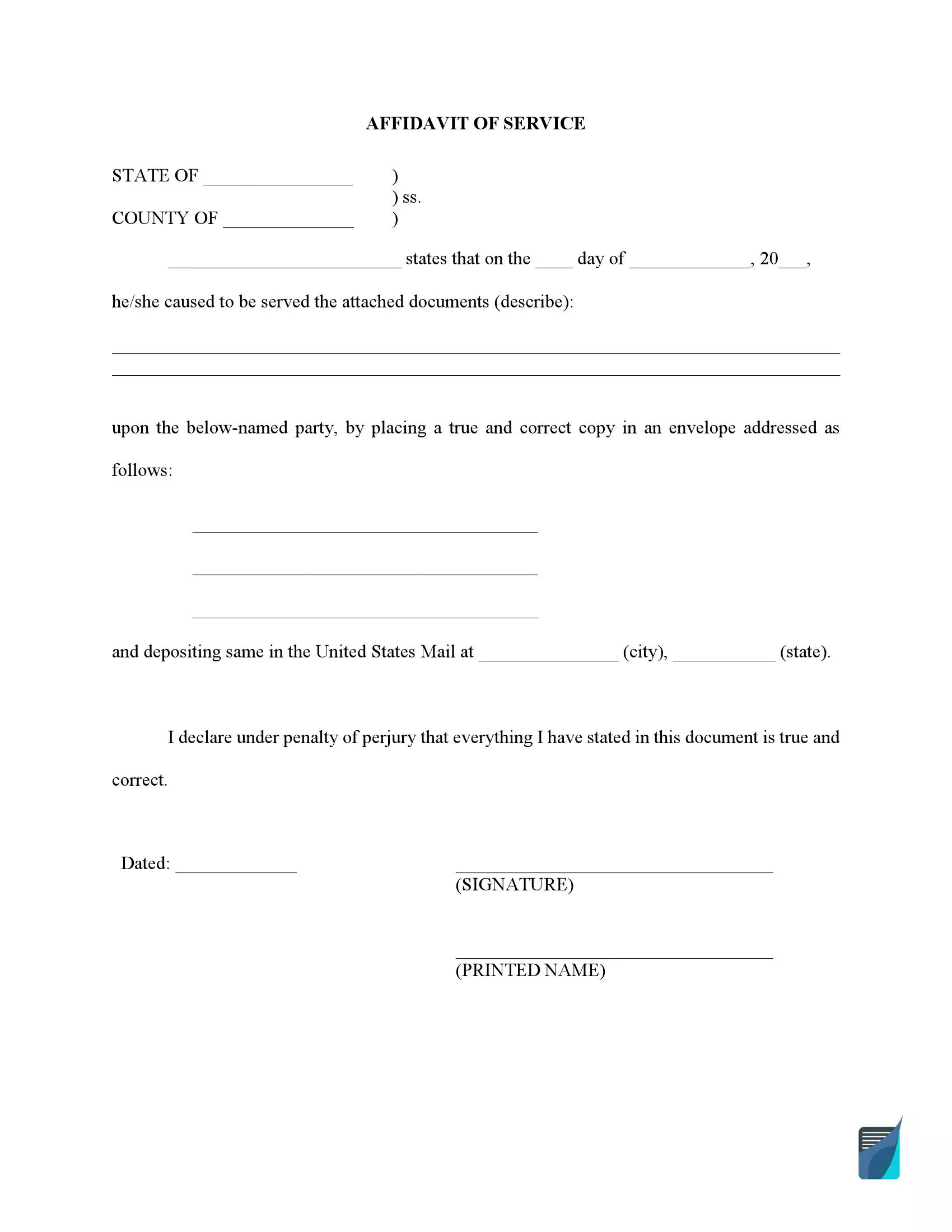
An affidavit of service form includes the case details, the server's name, the papers delivered, the person served, the date, place and method of delivery, and the server's signed declaration that all of it is true.
Most versions ask for these items:
Copies of the papers themselves stay with the person served; the form only lists them. Keep a set of the same papers with your signed copy so you can show exactly what was delivered.
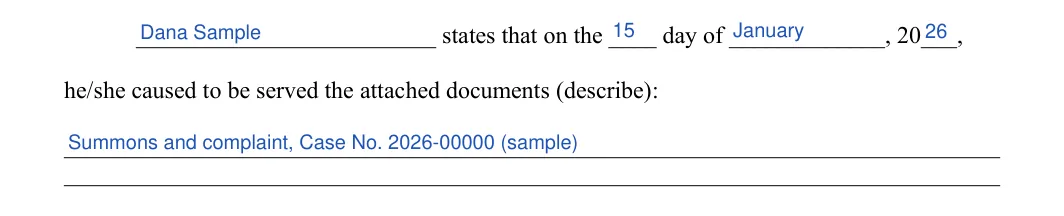
The screenshots under each step show the FormsPal affidavit of service template filled with sample entries in blue, so you can see where each answer goes. The names, addresses, dates and other entries are examples only.
To fill out the form, enter the location of the case, name the server and the papers, describe the delivery to the recipient, then sign and date the declaration of truth.
The declaration is signed under penalty of perjury, the wording 28 U.S.C. § 1746 sets out for federal matters, so check each detail against your notes before signing.
Have these details ready before you start:
In the top left corner of the affidavit of service, copy the location from the caption of the summons: the county and the rest of the place name exactly as printed there, not your own home address.
If your version has spaces for the case number and the names of the parties, copy them exactly from the summons.

The next part of the form names the server, gives the date of delivery and lists each paper delivered, such as the summons, the complaint or a motion. Wording like this is common:
[Name of the authorized server] states that on the [Date of serving the papers] he/she caused to be served the attached documents.
List each paper by the title printed on its first page, so nobody can doubt which papers went out.
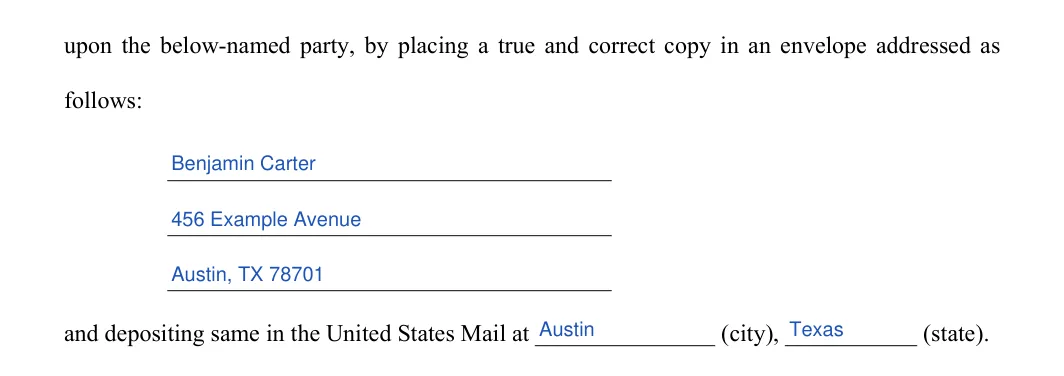
The third part names the person who received the papers and gives the address where they were delivered or sent, so the reader can match the delivery to the right person.
For a summons and complaint handed over in person, describe where and to whom they were handed, as in the example further down this page. The three Fed. R. Civ. P. 4(e)(2) methods for serving an individual do not include mail.
For later papers such as motions and written notices, which Fed. R. Civ. P. 5(b)(2)(C) lets a party in a federal case serve by mailing them to the person's last known address, the sentence often continues like this, followed by the recipient's full mailing address:
…upon the below-named party, by placing a true and correct copy in an envelope addressed as follows… and depositing the same in the United States mail at [name of the city], [name of the state].
The last paragraph of the form is the server's declaration that everything in it is true and correct, signed under penalty of perjury.
For a declaration signed within the United States, 28 U.S.C. § 1746 gives this form: "I declare (or certify, verify, or state) under penalty of perjury that the foregoing is true and correct. Executed on (date)."

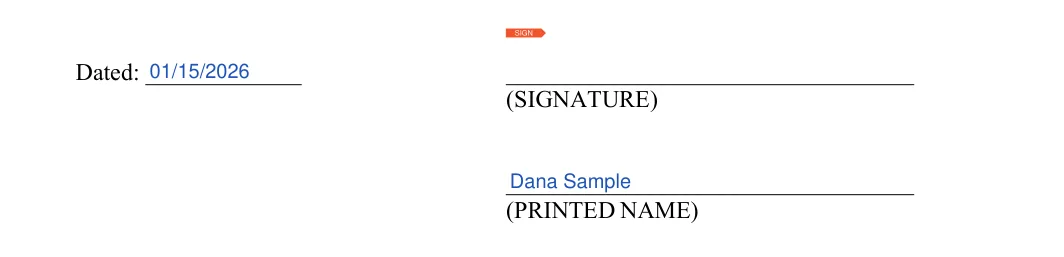
The server finishes the form with the date, a signature and a printed name, whether that is a professional process server or another adult who delivered the papers.
If your version ends with a seal block for an officer who gives oaths, wait and sign in front of that officer rather than in advance.
The example below shows a completed form for personal delivery of a summons and complaint, and every name, date, number and address in it is made up.
Sample (made-up details)
County of Sample, [Your State]. Case No. 26-CV-01234. Jane Miller, Plaintiff, v. Robert Stone, Defendant.
I, Daniel Reyes, am over 18 years of age and not a party to this case. On March 3, 2026, at 6:15 p.m., I served the Summons and the Complaint on Robert Stone by handing copies to him personally at 418 Elm Street, Sampletown.
Description of the person served: adult man, about 45 years old, brown hair, gray jacket.
I declare under penalty of perjury that the foregoing is true and correct. Executed on March 4, 2026.
Signature: Daniel Reyes. Printed name: Daniel Reyes. Address: 92 Oak Avenue, Sampletown.
If the papers were left at a home or with a company's agent, change the delivery paragraph to say so and name the adult or the agent who took them.
Under Fed. R. Civ. P. 4(l), unless service is waived, proof of service must be made to the court, and except for service by a United States marshal or deputy marshal, proof must be by the server's affidavit.
Under Fed. R. Civ. P. 4(m), if a defendant is not served within 90 days after the complaint is filed, the court must dismiss the action without prejudice against that defendant or order that service be made within a specified time.
Fed. R. Civ. P. 4(m) also says that if the plaintiff shows good cause for the failure, the court must extend the time for service for an appropriate period. The time limit in Fed. R. Civ. P. 4(m) does not apply to service in a foreign country under Rule 4(f), 4(h)(2) or 4(j)(1).
The deadline calculator helps you count the days that Fed. R. Civ. P. 4(m) allows.
For any other case, ask the clerk which deadline and which form apply. Once the clerk accepts the affidavit, keep a stamped copy with your case papers; it is your answer if the other side later says the papers never arrived.
An affidavit of service is sworn before an officer who gives oaths, a declaration of service is signed under penalty of perjury without one, and a certificate of service usually shows how a later paper was sent to the other side.
In federal matters, 28 U.S.C. § 1746 lets a dated declaration subscribed as true under penalty of perjury stand in for a sworn affidavit, other than a deposition, an oath of office, or an oath required to be taken before a specified official other than a notary public.
| Document | Who signs it | Typical use |
|---|---|---|
| Affidavit of service | The server, under oath before an officer | Proof that a summons, complaint or other papers were delivered |
| Declaration of service | The server, under penalty of perjury | The same proof, without an oath before an officer |
| Affirmation of service | The server, who affirms instead of swearing | The same proof, in places that use that name |
| Certificate of service | The party or their attorney | A note on a later paper saying how and when it was sent |
"Proof of service" is the general name for all of them, which is why a proof of service template and an affidavit template ask for much the same details.
Not always: in federal matters, 28 U.S.C. § 1746 lets a dated declaration signed as true under penalty of perjury replace a sworn affidavit, so no notary is needed for that version in federal court. 28 U.S.C. § 1746 does not reach a state court form, so a form whose wording says the server was sworn, or that ends with a jurat or seal block, is signed in front of a notary or other officer who gives oaths.
In federal court, Fed. R. Civ. P. 4(l)(3) says failure to prove service does not affect the validity of service. Even so, without the proof you have nothing to show that the papers were delivered.
Yes, in federal court Fed. R. Civ. P. 4(l)(3) says the court may permit proof of service to be amended. Ask the clerk how to hand in the corrected version.
An affidavit of non-service is a server's signed account of attempts that did not reach the person, listing each date, time and address tried. It helps you show what was done before you ask for another way to serve.
Yes. FormsPal's affidavit of service form asks a few questions about the papers and the person served, then builds the document for you. You can save your progress, finish on any device, and download or print the complete form. If you prefer the PDF file, you can fill it in with the online PDF editor.
You can create one with FormsPal above or download the PDF file. For additional help, ask the clerk which form your case uses.
General information, not legal or tax advice.
