
Updated:
An IOU (I Owe You) is a signed note acknowledging a debt. It names the borrower, the lender, the amount owed, any interest and the due date. This free IOU template fits small loans between friends, family or coworkers.
Below you can download the I Owe You form as a PDF, see what goes in each part, follow a filled-in sample step by step, or use a short letter if you would rather write your own.
Build Your Document
Answer a few simple questions to make your document in minutes
Save and Print
Save progress and finish on any device, download and print anytime
Sign and Use
Your valid, lawyer-approved document is ready

An IOU template, short for I Owe You, is a written note that shows who borrowed money and how much. Friends, family members and business partners often use one when they already trust each other.
People call it an IOU form, an I Owe You letter, an IOU note or an IOU agreement.
Use an IOU when you lend or borrow money from someone you know and want the amount, the repayment plan and the due date written down without drafting a full loan contract.
Writing the terms down while both people remember them avoids a later argument over how much was lent and when it was due.
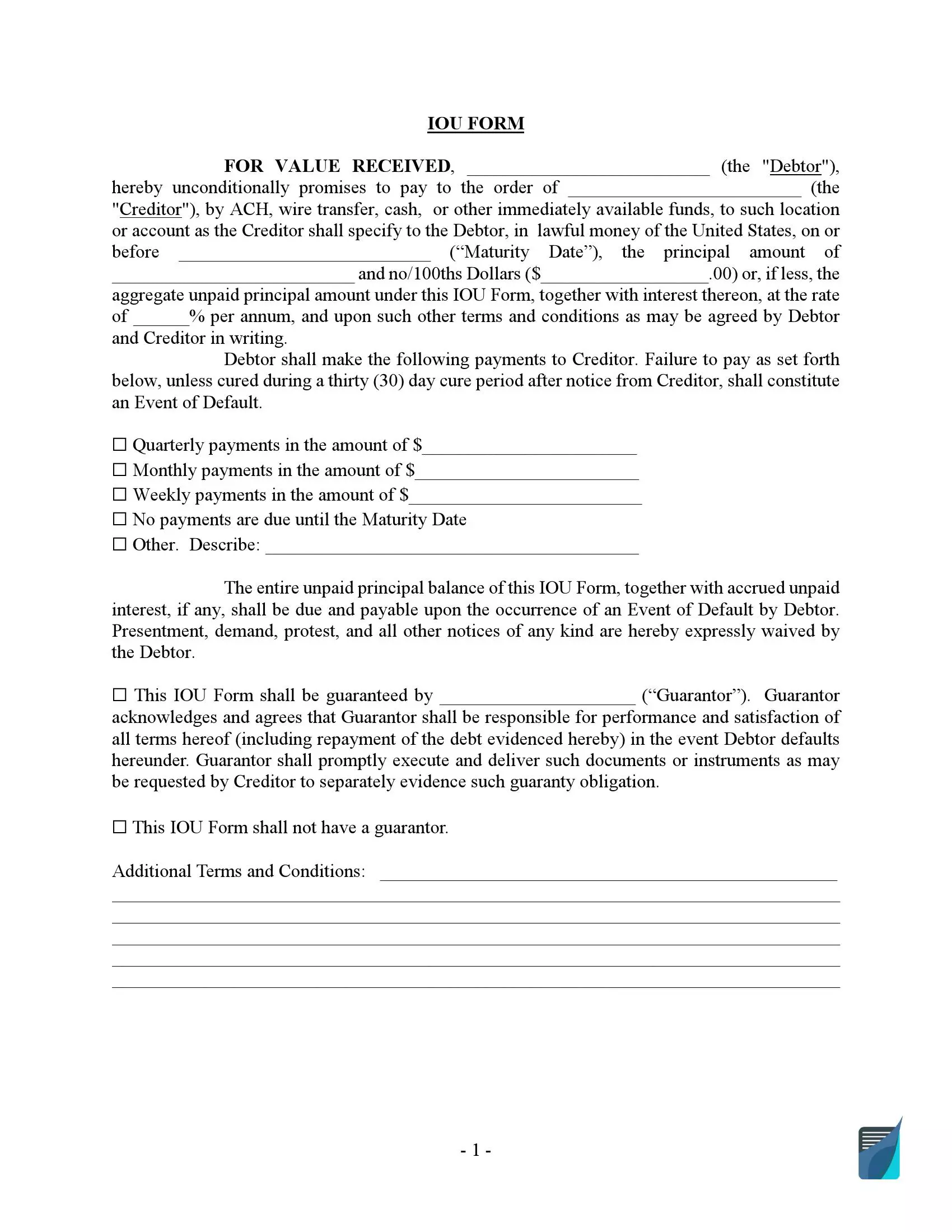
An IOU should include the borrower’s and lender’s full names, the amount owed in words and numbers, any interest rate and late fee, the repayment terms, the maturity date and the signatures.
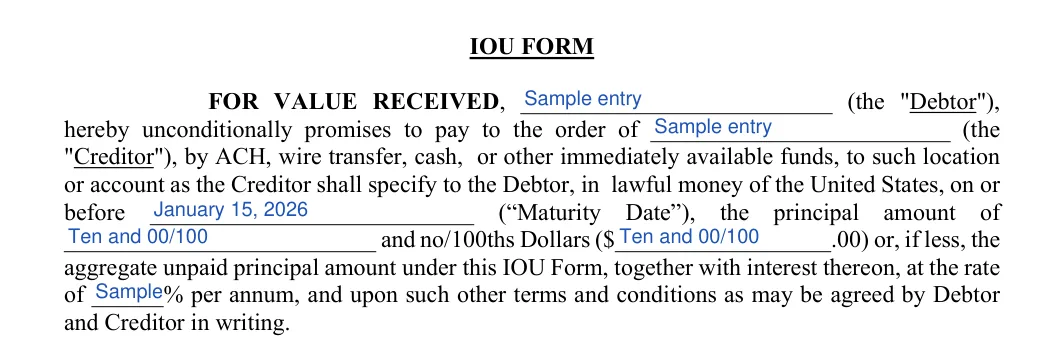
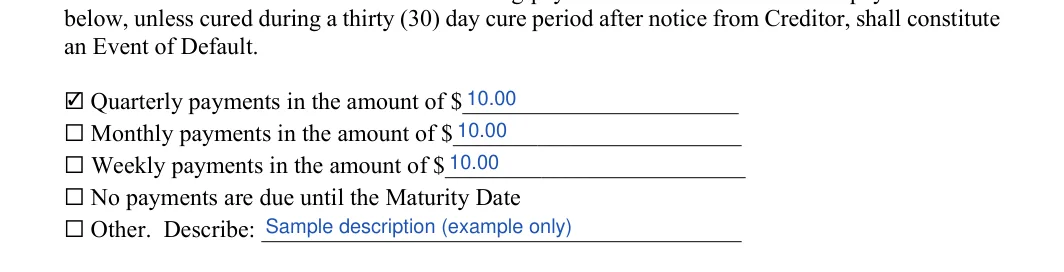

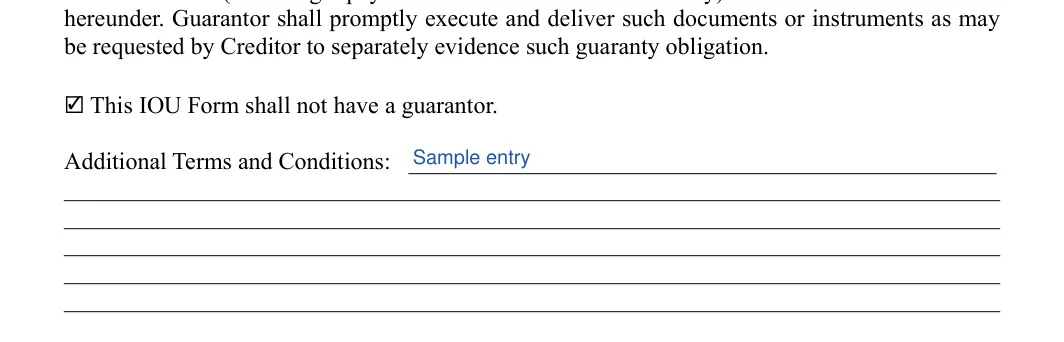
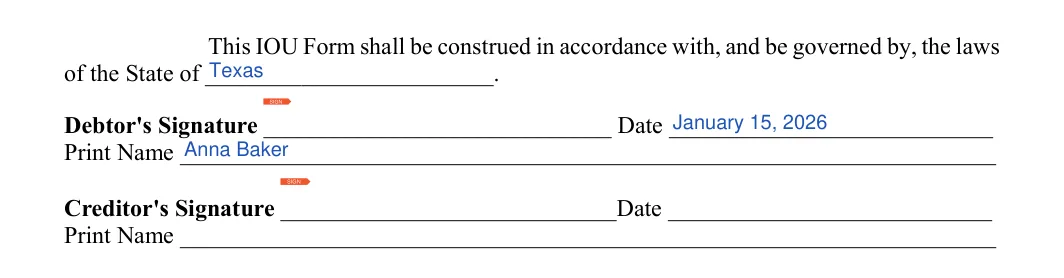

You can download FormsPal’s easy-to-use IOU template for free.
To write an IOU letter yourself, put the date at the top, name the borrower and the lender, give the amount and the repayment plan, then have both people sign and date it.
A letter works for a quick, simple loan. For a loan with interest, many installments or a guarantor, the form above gives every term its own place on the page.
Sample IOU letter (example only)
IOU, March 3, 2026
I, Jordan Lee, owe Sam Rivera five hundred dollars ($500.00), which Sam lent me on March 3, 2026. I will repay it in five monthly payments of $100, due on the first day of each month from April 1, 2026 to August 1, 2026. No interest applies, and I may pay the balance early at no extra charge.
Borrower: Jordan Lee, signature and date
Lender: Sam Rivera, signature and date
The names, dates and amounts are made up to show the format.
Both a loan agreement and an IOU acknowledge a debt, but they usually serve different situations.
The difference between an IOU and a promissory note is the promise to pay, not the amount of detail. In Minnesota, an acknowledgment of a debt is not a promise unless the borrower also undertakes to pay it (Minn. Stat. 336.3-103(a)(12)). A promise is a note under Minn. Stat. 336.3-104(e) only if it is also an instrument, and Minn. Stat. 336.3-104(b) defines an instrument as a negotiable instrument.
Under Minn. Stat. 336.3-104(a), a negotiable instrument is an unconditional promise to pay a fixed amount of money that is payable to bearer or to order, payable on demand or at a definite time, and states no other undertaking beyond the payment, apart from the few terms that section allows. Other states set their own wording in their own codes.
FormsPal’s IOU form has lines for a maturity date, interest per annum, a payment schedule, a guarantor, additional terms and the governing state. Whether a filled-in IOU meets every term of Minn. Stat. 336.3-104(a) depends on its wording, so this page does not call it a negotiable note. See our promissory note template if you want a note by that name.
A loan contract is a much more detailed and formal document and is used when you want to borrow a substantial amount of money. A loan agreement template also contains more details regarding the terms of the transaction as compared to an IOU.
The time limit to sue on an IOU depends on the governing state’s code: in Minnesota, an action upon a contract or other obligation shall be commenced within six years, except where the Uniform Commercial Code otherwise prescribes or another limitation is expressly prescribed for it (Minn. Stat. 541.05, subd. 1(1)).
Our official sources give no interest limit and no signing formality for an IOU, so this page states none. Before you lend at interest, read the governing code or ask an attorney where you live.
After both people sign, give each of them a signed copy of the IOU, then keep track of every payment until the borrower pays the full balance and the lender confirms the debt is settled.
If payments stop, talk first and agree on a new plan in writing. For a larger unpaid sum, ask an attorney what options you have where you live.
These short answers cover what people ask most when they write an IOU for the first time: what the term means, who can use one, how it differs from a promissory note and what to do after signing.
IOU stands for I Owe You, which is a short written acknowledgment that one person owes money to another person.
In casual speech and text messages, “IOU” means “I owe you”: a promise to return a favor, a coffee or a small sum, with no form or signature behind it.
Yes, a signed IOU is a written acknowledgment that the borrower owes the lender a set amount. Its wording matters: in Minnesota, an acknowledgment of a debt is not a promise unless the borrower also undertakes to pay it (Minn. Stat. 336.3-103(a)(12)). Other states have their own codes, so for a large loan read yours or ask an attorney.
Yes, many people use an IOU template for a loan between friends or family members, and it helps to write down the amount, the due date and the repayment plan so both sides remember the same terms.
Not always: the line between them is the promise to pay and its terms. In Minnesota, a bare acknowledgment of a debt is not a promise unless the borrower also undertakes to pay it (Minn. Stat. 336.3-103(a)(12)). A promise is a note under Minn. Stat. 336.3-104(e) only when it is a negotiable instrument: unconditional, for a fixed amount of money, payable to bearer or to order, payable on demand or at a definite time and with no other undertaking beyond the terms Minn. Stat. 336.3-104(a) allows.
Yes, you can open the free template in the PDF editor, type every answer on screen, then download or print it for both people to sign by hand.
Each person keeps a signed copy, and the borrower pays on the schedule written in the form until the full balance and any interest are paid.
General information, not legal or tax advice.
