
Updated:
A car sale contract is a written agreement to sell a car. The version with payments lets the buyer pay the price in installments, with or without interest. It suits a private sale where the buyer pays over time, not upfront.
This page gives you a free car sale contract with payments template to build online, the steps to fill it out and answers to common questions. Create yours online with FormsPal, then download and print it for signing.
Build Your Document
Answer a few simple questions to make your document in minutes
Save and Print
Save progress and finish on any device, download and print anytime
Sign and Use
Your valid, lawyer-approved document is ready
A car sale contract with payments is an agreement between the seller and the buyer of a car that names the car, the price, the down payment and the schedule for paying the rest of the price.
The seller lends the unpaid part of the price, and the buyer repays it in installments. The FormsPal template calls the buyer the Borrower and the seller the Lender.
Searchers also call this document a car payment agreement, an auto sale contract with payments or a bill of sale with a payment plan. It is a kind of loan agreement tied to one vehicle, and it keeps every payment term in writing so both sides know what was agreed.
Use a private car sale contract with payments when you sell a car directly to a buyer who cannot pay the full price upfront and you agree to take the rest in installments.
Typical cases:
This contract covers a seller who lends to the buyer. Other cases call for other paperwork:
In a car sale contract with payments, the buyer can pay a down payment first and then repay the loan amount on a schedule both sides choose: weekly, monthly or as one balance at the end of the term.
The template lists these payment options. Tick each one you agree on and fill in its blanks.
| Payment option | What you fill in | When it fits |
|---|---|---|
| Down payment | The amount and its due date | The buyer pays part of the price at the start |
| Weekly payments | The amount of each payment | The buyer is paid weekly |
| Monthly payments | The amount and the day of the month | The most familiar car payment plan |
| Balance at the end of the Term | The amount left to pay at the end | Small installments with one final payment |
| Discounted payoff | The reduced amount that settles the loan | The buyer may pay the loan off early |
Example plan: the price is $8,000. The buyer pays $2,000 down at handover, which leaves a loan amount of $6,000. With no interest, twelve monthly payments of $500, due on the first day of each month, repay it.
Interest is optional in a private sale with payments. The template has two boxes: one for a yearly interest rate and one for a loan that does not accrue interest.
Many places limit how much interest a private lender can charge, and the limit is not the same everywhere.
Look up the limit that applies to your sale before you fill in the yearly rate in Section 5 and the default increase in Section 11.
The contract sets what happens if the buyer falls behind. In the default clause, you enter how much the interest rate goes up if the Borrower defaults, so both sides know the cost of a missed payment before the sale.
The higher rate after a default is still interest, so keep it within the same limit as the yearly rate.
The seller can secure the loan or leave it unsecured. The template offers a first priority lien on the vehicle, a second priority lien on the vehicle, a lien on other assets of the buyer, or no security at all.
Ticking a lien on the vehicle in the contract does not by itself put the seller on the car’s title as lienholder.
In California, any change in ownership or lienholder must be reported to DMV within 10 days, and the title must be updated (California DMV, Title Transfers and Changes).
Title and lien procedures differ elsewhere, so ask the titling office where the car will be registered how to add the seller as lienholder.
A car sale agreement with payments should name the buyer and the seller, describe the car by make, model, year, color and VIN, and set the loan amount, the interest and the payment schedule.
Each part answers one question about the sale: who is involved, what car is sold and how it is paid for.
Anything else the two sides agree on, such as who keeps the car insured until the last payment, goes in the additional terms at the end of the template.
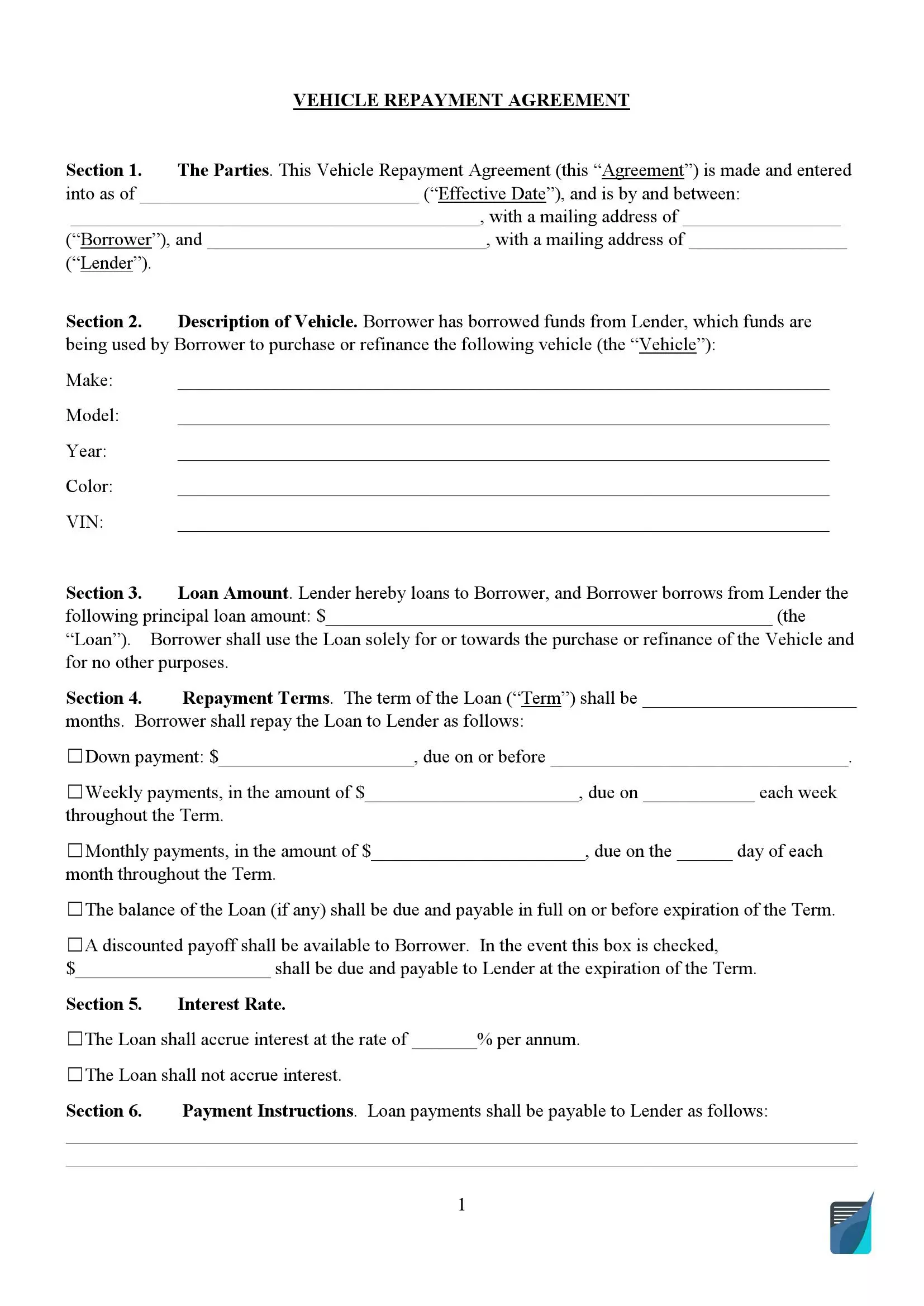
To fill out the car sale contract with payments, enter the date and both parties, describe the car, set the loan amount, term, payments and interest, choose the security, then sign. The steps below follow the FormsPal template from the first line to the signatures.
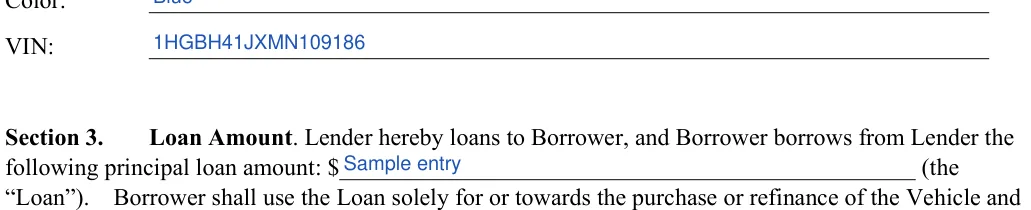
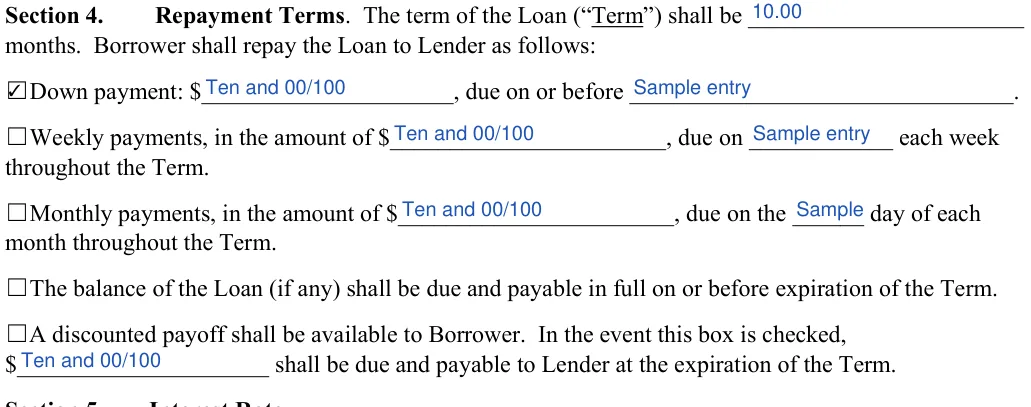
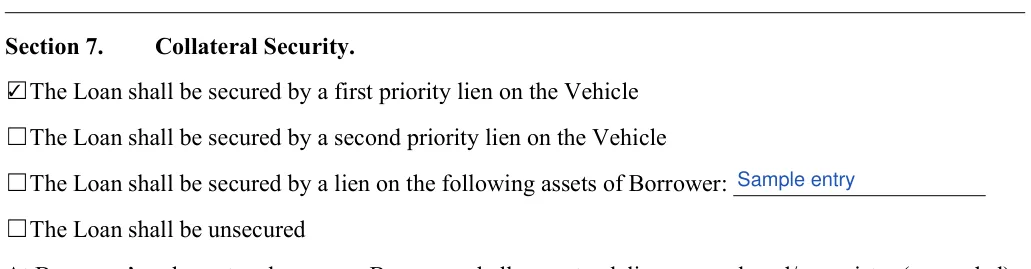
The screenshots under each step show the FormsPal Car Sale Contract with Payments template filled with sample entries in blue, so you can see where each answer goes. The names, addresses, dates and amounts are examples only.
Section 1: Date, Borrower and Lender
Enter the Effective Date, then the Borrower’s name and mailing address and the Lender’s name and mailing address in the blanks of the first paragraph.

Section 2: Vehicle make and model
Write the vehicle’s Make and Model on the first two lines under Section 2.

Section 2: Vehicle year and color
Write the Year and Color of the vehicle on the next two lines.

Sections 2 and 3: VIN and loan amount
Write the VIN on the last line of Section 2. Under Section 3, enter the principal loan amount in dollars.
Section 4: Length of the Term
Enter the length of the loan Term in months in the first blank of Section 4.

Section 4: Repayment options
Tick each option that applies and fill in its blanks. The options are a down payment with its due date, weekly payments, monthly payments with the day of the month, the balance due at the end of the Term, and a discounted payoff amount.
Section 5: Interest Rate
Tick the first box and enter the percent per annum, or tick the second box if the Loan does not accrue interest.

Section 6: How and where payments are made
Write how and where the Borrower pays the Lender on the lines under Section 6. The lines continue at the top of page 2.

Section 6: How and where payments are made, continued
Finish the payment details on the remaining lines at the top of page 2.

Section 7: Collateral Security
Tick one option. The choices are a first priority lien on the Vehicle, a second priority lien on the Vehicle, a lien on other assets of the Borrower (list them on the line), or unsecured.
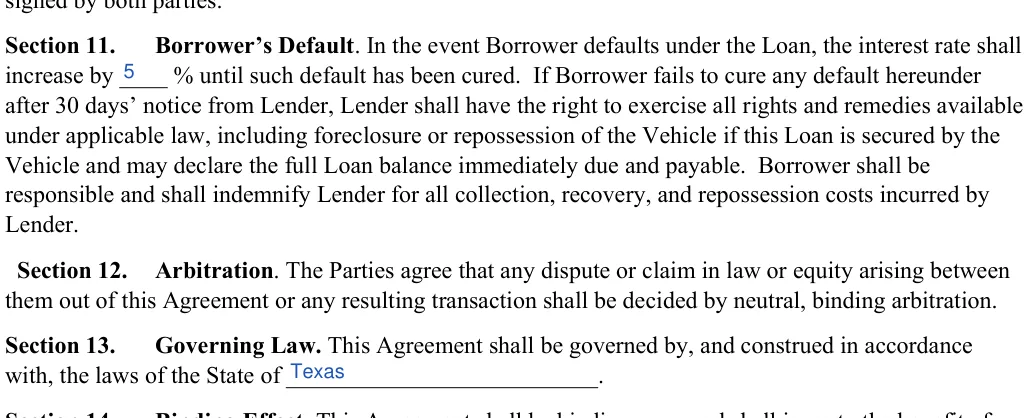
Sections 11 and 13: Default rate and State
In Section 11, enter the percent the interest rate goes up if the Borrower defaults. In Section 13, write the state in the blank.
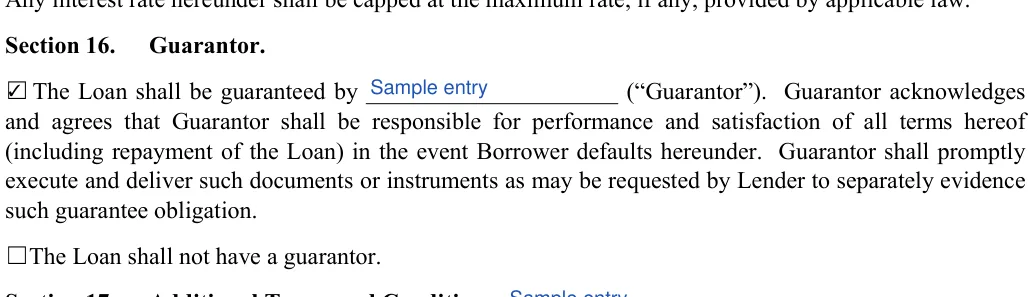
Section 16: Guarantor
Tick the first box and write the Guarantor’s name, or tick the second box if the Loan has no guarantor.
Section 17: Additional Terms and Conditions
Write any extra terms on the lines under Section 17, or leave the lines blank.
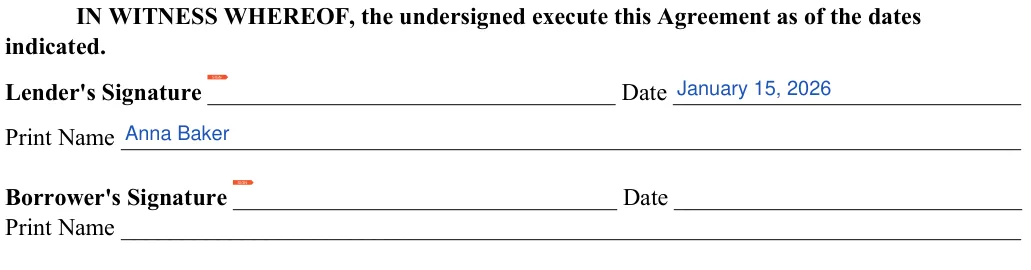
Lender and Borrower signatures
The Lender and the Borrower each sign, date and print their name on their own lines at the bottom of page 3.
Guarantor signature, if any
If you ticked a Guarantor in Section 16, the Guarantor signs, dates and prints a name on the last block. Otherwise leave it blank.

After everyone signs, make a copy for each side and keep it with the car’s other paperwork.
The signed contract does not transfer the car’s title: the title changes hands in a separate step with the titling office where the car is registered.
In a California private sale, the seller signs the title and the buyer submits it to DMV (California DMV, Title Transfers and Changes).
Under 49 CFR 580.5, the transferor shall disclose the mileage to the transferee on the title when ownership of a motor vehicle is transferred, and the transferee signs the disclosure as well.
Some vehicles are exempt under 49 CFR 580.17, including a 2011 or later model year vehicle transferred at least 20 years after January 1 of its model year.
A car sale contract with payments sets how the buyer pays for the car over time, while a bill of sale shows that the seller handed the car to the buyer for a price.
| Question | Car sale contract with payments | Bill of sale |
|---|---|---|
| What it shows | The loan and how it is repaid | The handover of the car for a price |
| Payment terms | Down payment, installments, term | The sale price |
| Interest and default | A yearly rate and a default rate, if agreed | Not covered |
| Security | A lien on the car or other assets, or none | Not covered |
| Who signs in the template | Lender, Borrower and any guarantor | Seller and buyer |
One sale can use both documents: the contract for the payment plan and a bill of sale for the handover of the car.
Yes, a contract with monthly payments lets you agree on the amount and the day of the month the buyer pays. Tick the monthly payments option in the template and enter both.
Yes, if you agree on it: the template has a discounted payoff option where you enter the amount that settles the loan. Leave it unticked if early payoff gets no discount.
Yes. Section 16 has a box for the Guarantor’s name, and the last page has a signature block for the Guarantor. If there is no guarantor, tick the second box in Section 16.
Yes, the template has lines for additional terms and conditions near the end. Write each extra promise there in plain words, such as who pays for repairs before the loan is paid, or leave the lines blank.
Both sides keep it. After everyone signs, make a copy for each side and keep it with the car’s other paperwork.
Yes. Answer a few questions on FormsPal to build the contract, then save it and download it. To fill in or edit the downloaded PDF, use the FormsPal PDF editor.
General information, not legal or tax advice.
