
Updated:
A scholarship recommendation letter is a reference supporting a student's scholarship application. A teacher, mentor or employer writes it to describe the student's work, strengths and achievements. This page covers the letter's parts, the right writer, and sample letters to copy.
Key facts
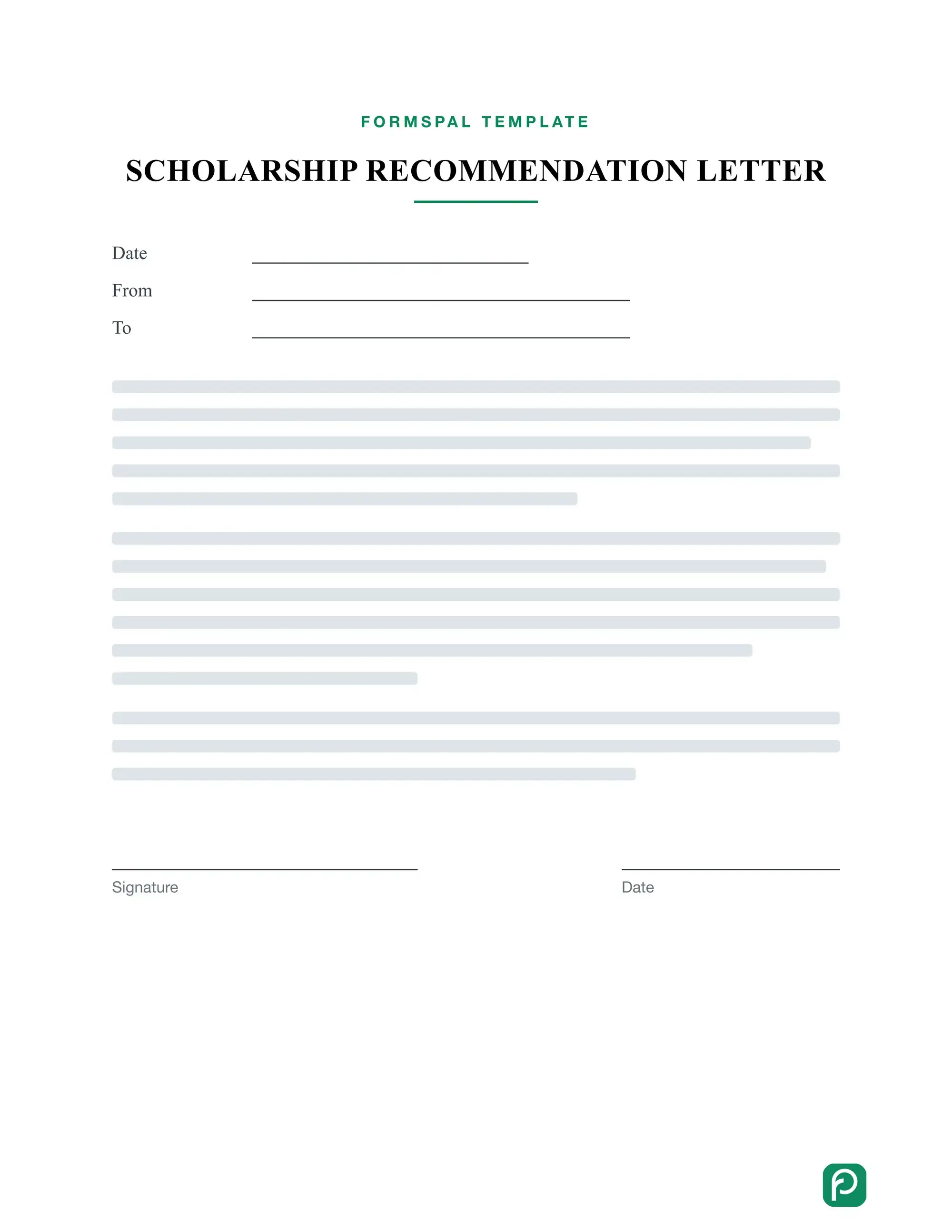
A scholarship recommendation letter is a free-form letter in the writer's own words, while a scholarship recommendation form is a set of questions and rating scales written by the program. The application instructions name the format the program accepts.
The form asks the recommender to rate the student on traits such as academic ability, leadership, motivation and character, then leaves a box for comments. The letter gives the writer room for examples, context and a personal view of the student. When a program supplies its own form, a separate letter is added only if the instructions allow one.
The recommendation form follows the program's layout, so the recommender completes it in the order its questions appear.
A scholarship recommendation letter includes a heading, a body about the student and a signed closing, and each part answers a question the committee has about the applicant. The parts below follow the order a reader expects.
The heading names the writer, the writer's title, the school or business and the date. The addressee line names the scholarship committee or its chair. "To Whom It May Concern" fits when the program gives no name.
The relationship paragraph says how the writer knows the student, in what role and for how long. A committee weighs praise by how closely the writer saw the work, so a teacher names the class and a manager names the job.
The qualities section is the core of the letter. It describes the student's strongest traits, results and achievements in their field.
Many writers split it into two short paragraphs. The first covers the student's qualities. The second gives examples, such as research, artwork, awards and active involvement. About ten to fifteen sentences in total is usually enough.
The fit paragraph links the student's strengths to the award's purpose, such as academic merit, leadership, community service, a field of study or financial need. A letter written for a named award reads stronger than a general letter sent to every program.
The closing repeats the recommendation in a sentence and offers to answer questions. The writer's phone number or email, signature and printed name follow, so the committee can reach the writer for more detail about the applicant.
A scholarship reference letter follows a standard business letter format: heading or letterhead, date, salutation, body paragraphs, closing and signature. Programs use "reference letter" and "recommendation letter" for the same document.
A scholarship recommendation letter is written from the award's criteria outward: the writer reads what the committee values, then builds each part around it.
A brag sheet is a short list the student writes of their activities, awards and goals. It gives the writer accurate details to work from.
A scholarship recommendation letter reaches the committee by the method the program names, such as an online portal link, an email address or a sealed envelope.
A scholarship recommendation letter carries weight when it comes from someone who has seen the student's work up close, such as a teacher, professor, program counselor, coach or employer.
A writer with real examples outweighs a well-known name who barely knows the student. A family member or friend fits only when the program asks for a personal or character reference.
The request works best as a short, polite conversation followed by the details in writing.
A scholarship recommendation letter loses its value through late delivery, inflated claims or a negative remark, and each one is easy to prevent.
The samples below show a finished letter from a mentor and a fill-in letter from an employer, both in the format above. All names, titles and details in them are made up.
Recommendation Letter for Scholarship from a Mentor
Melanie Hills,
Ph.D., Head of the Playwright Master Program
New York Institute of Performing Arts
Green Street, 167
2347890, New York
US
mhillsmhills@pa.com
11/12/2020
To whom it may concern,
Recommendation Letter
I would like to provide a reference for Victoria Fouad, my graduate student. Victoria did her masters at the New York Institute of Performing Arts, in the "Project Performance / Playwriting" Master Program, where I was the Head.
During her studies, Victoria proved herself a talented, creative and extremely responsible person. Her commitment and interest in the field led her to graduate from the Institute with honors.
Victoria also stood out during practical training at the New York Theatre of Contemporary Arts. Her final project, an opera titled "The Bliss," got the highest mark and became a centerpiece of our graduation performances. Victoria herself coordinated the team that created and performed her act.
Victoria also managed an international project of our Institute and Amsterdam Drama High School, "Choice of Freedom" (2019). As a playwright, Victoria works successfully both in individual and group projects.
Victoria sets high standards for herself and pursues ambitious goals. She is open to criticism and feedback and steadily improves her skills. Victoria is a real pleasure to talk to, and her optimism, compassion, sense of humor and stress-management skills make her an incredible team member and a loyal friend.
Please feel free to contact me with any questions at mhillsmhills@pa.com.
Melanie Hills,
Ph.D., Head of the Playwright Master Program
New York Institute of Performing Arts
Recommendation Letter for Scholarship from the Employer
_____________, 20__ [enter date]
__________________ [author's name]
_______________________________ [title]
_______________________________ [name of business]
_______________________________
_______________________________ [address]
__________________ [contact phone]
__________________ [email]
To whom it may concern,
I, _____________________ [the author's name], am privileged to write this letter of recommendation in support of _____________________ [the applicant's name] and their application for the _________________________ [grant program or scholarship].
It has been a pleasure to have ___________________ [the applicant's name] as a valuable member of our team at _____________________ [name of business] for the past _______ years.
My professional experience with ___________________ [the applicant's name] has been marked by loyalty, respect and understanding. Our work together has always rested on mutual regard, confidence, a positive attitude and commitment.
Moreover, _____________________ [the applicant's name] has achieved outstanding results in their work and has won the awards listed below:
________________________________________________________________________
________________________________________________________________________
I am honored to recommend _____________________ [the applicant's name] for this scholarship.
If you would like more details about ____________________ [the applicant's name] and their performance, please reach me by phone or email.
Kind regards,
Signature _________________________
Date _____________
A scholarship recommendation letter is one of several reference letters, each written for a different reader and purpose. The general recommendation letter page covers letters outside school, and the pages below cover specific cases:
A scholarship recommendation letter is usually a single page. Keep each paragraph on one idea and stay within any length limit the scholarship gives you. A short, focused letter leaves room for a few concrete examples.
A scholarship reference letter and a scholarship recommendation letter are the same document under different names. Both describe the student from the writer's own experience and support the application.
A letter from a family member fits only when the program asks for a personal or character reference. For academic and merit awards, a teacher, coach or employer gives the committee an outside view of the student's work.
Some writers ask students for a draft. If yours does, list your real achievements with clear examples and keep the tone honest. The writer can then edit the draft and sign it in their own words.
A base letter can serve several applications when the writer updates it each time. The scholarship's name, the addressee and the fit paragraph change for every award.
The letter mentions financial need only when the award weighs it and the student agrees to share it. Otherwise the letter stays on the student's work, character and achievements.
General information, not legal or tax advice.
