
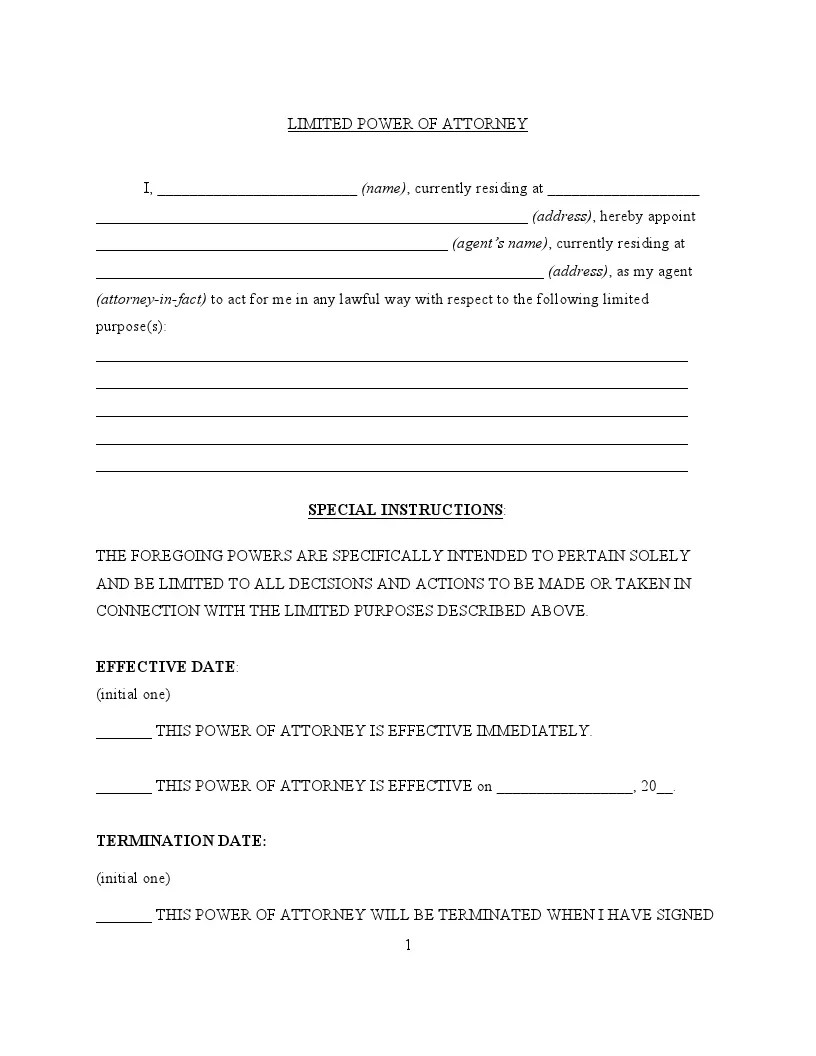
A limited power of attorney (LPOA) is a legal document that lets another person act for you only for the matters, period or purpose you name. You are the principal, and your agent is also called your attorney-in-fact. It is narrower than a general power of attorney form. Use the free form below to list the powers you grant and when they end.
Last Updated: October 2026. This guide is reviewed and updated regularly to reflect current law. If you notice an error or outdated information, please contact us.
Build Your Document
Answer a few simple questions to make your document in minutes
Save and Print
Save progress and finish on any device, download and print anytime
Sign and Use
Your valid, lawyer-approved document is ready
A limited power of attorney is a more constrained kind of power of attorney. You limit the powers you give your agent, the time they last, or the circumstances in which they apply. Anything you do not list stays with you.
Many limited powers of attorney cover one task or one period of time. Say you are traveling abroad and need someone to manage your finances while you are gone. A limited power of attorney lets that person act for you until you return.
When you return, you can revoke the power in writing and tell your agent. Or you can set an end date, and the power ends on its own on the date you choose.
In many states, a power of attorney can also start at a future date or when a future event happens. This is called a springing power of attorney. If you use one, say in the document who decides that the event has happened.
In many states, a power of attorney that is not durable ends if you become incapacitated. Whether yours keeps working depends on its wording and your state's law, so say in the document whether it should continue.
A limited power of attorney can give all or only some of the powers that other powers of attorney can grant. Examples include:
What your agent can actually do depends on the document's wording and on your state's law.
Medical decisions need a separate health care document, such as a health care power of attorney and a living will. The limited power of attorney on this page does not cover them.
Use a limited power of attorney when a general power of attorney would give your agent more authority than you want. It also fits a task or a period of time with a clear end. Because you write the powers into the form, there is little room for anyone to read in powers you never meant to grant.
Here are a few common situations where it can help to appoint an agent with limited powers:
If your agent will sell real estate for you, the power is usually recorded with the county where the property is. It must also meet that state's rules for the deed.
If you might become incapacitated, for example during a hospital stay or an illness, a power of attorney that is not durable ends at that point in many states. A power meant to keep working then must be durable. In that case, use the durable POA form instead.
If you want someone to care for your child while you are away, use a child power of attorney instead.
It is also your job to keep the document up to date. Do it when your personal details change or when you want to change the powers you grant.
If you want your spouse to act for you, name your spouse as your agent in the document. In many states, a spouse-agent's authority ends when a divorce or legal separation is filed, unless the document says otherwise.
In many states, signing a new power of attorney does not cancel an older one unless the new one says so. If you mean to replace a power, revoke the old one in writing and say so in the new one.
You can have several limited powers of attorney active at the same time. Each can grant different authority, as long as the powers do not contradict one another. That means several different people can act for you.
| Document Name | Limited Power of Attorney Form |
| Other Names | Special Power of Attorney, Temporary Power of Attorney |
| Subtypes | Vehicle POA; Real Estate POA; Tax POA |
| When to Use? | To manage finances, business transactions, investments, or other affairs for a limited period. |
| Avg. Time to Fill Out | 9 minutes |
| # of Fillable Fields | 34 |
| Available Formats | Adobe PDF; Microsoft Word |
Getting a limited power of attorney takes five steps. If you already have a lawyer, they can draft one suited to your purpose. Otherwise, you can use the limited power of attorney form we provide and customize it yourself with our document builder. Here is what you need to do.
Step 1: Select Your Agent

Think about who you can trust with the powers and responsibilities you are giving.
Choose someone you trust who will be available when the task comes up and who understands it. Name a successor agent in case your first choice cannot serve. Check your state's page in the State-specific Forms list for any rule on who may serve as an agent.
Step 2: Choose the Powers You're Granting

Next, choose the powers you want to grant. These are often one-time or short-term powers, and you can customize them as exactly as you like.
Keep those powers in mind when you pick your agent, so the person is a good match for your purpose.
Step 3: Fill Out the Limited Power of Attorney Form

Once you have chosen the powers and your attorney-in-fact, fill out the form completely. If your form uses initials, initial every power you grant and none you do not.
Read the form again to be sure it grants no power you do not want to grant.
Step 4: Sign It the Way Your State Requires

The last step is to sign the form the way your state requires. The rules differ from state to state:
Check your state's page in the State-specific Forms list for its rules. Even where a notary is optional, banks and county recorders generally want a notarized power of attorney.
Sign every signature line your form includes. Check the form for any line your agent must sign too.
Step 5: Keep the Form Available

Keep copies of your limited power of attorney with you and with your agent. That way, your agent can always prove the right to sign a contract on your behalf.
A power used for real estate is usually recorded with the county. Ask the county recorder what it requires.
The form asks who you and your agent are, which powers you grant, when they start and end, whether you name a successor agent, and for your signature. Fill out each part before you sign. The signing formalities depend on your state, so check them first.
Step 1: Fill Out Personal Information
Fill out your personal information as the principal, including your name and address, as well as your agent's information. The form asks for names and addresses, and you can add other contact details too. Use full legal names.

Step 2: Choose Agent Powers and Authority
Choose the powers you want to grant your agent. Also decide when and how your agent may act on your behalf. You can grant as many powers as you like. Examples include:

Step 3: Fill Out Special Instructions
This section lets you add special instructions or limits on your agent's authority. You can also choose when the document becomes active and when it ends.
If you leave the end date blank, your agent keeps the powers you list until the power ends another way. In many states, it still ends when you die or when its purpose is accomplished. A power that is not durable also ends if you become incapacitated. If you set an end date, the document becomes ineffective automatically at the end of that period.

Step 4: Choose a Replacement Attorney-in-fact (optional)
A replacement attorney-in-fact, or backup agent, keeps your power of attorney working if your first agent cannot serve. In many states, the power ends when the agent dies, becomes incapacitated or resigns, unless the document names another agent. A named backup closes that gap. It also helps if your first agent cannot be reached in time.

Step 5: Sign Before a Notary or Witnesses and Share Copies
Once your details are ready, sign the form the way your state requires, before a notary, witnesses, or both. The rules depend on your state, not on the powers you grant. Check your state's page in the State-specific Forms list.
After signing, share copies:

There are several ways to end a limited power of attorney. If your form has an end-date field, fill it in when you know when the power should expire. Otherwise, you can fill out a POA revocation form whenever you are ready to withdraw it.
Depending on the state, a limited power of attorney ends when:
When you revoke it, tell your agent and every person or business that relied on it. Do this in writing and collect any copies. In many states, a person who acts in good faith without knowing the power ended is protected. If you recorded the power, record the revocation the same way.
These answers cover the questions people ask most about ending, replacing and starting a limited power of attorney. Rules differ by state, so check your state page or ask a lawyer about your case.
Depending on the state, it ends when:
In many states, a spouse-agent's authority also ends when a divorce or legal separation is filed.
In many states, no. A new power of attorney does not cancel an earlier one unless the new document says so. If you mean to replace a power, revoke the old one in writing and say so in the new document.
In many states, it takes effect when you sign it, unless it names a later date or event. A power that starts on a future event is called a springing power of attorney. If you use one, say in the document who decides that the event has happened.
In many states, a person who acts in good faith without knowing the power ended is protected. So tell your agent and everyone holding a copy, in writing. If you recorded the power, record the revocation too.
General information, not legal or tax advice.
