
A Colorado limited power of attorney is a written document in which one person, the principal, names another person, the agent, to act for them on specific matters only. The agent is also called an attorney-in-fact. It is "limited" because it lists the tasks or the time period the agent covers, such as selling one piece of property or managing one financial account. You can fill out the Colorado limited power of attorney form online with FormsPal for free or download the PDF.
Last Updated: October 2026. This guide is reviewed and updated regularly to reflect current Colorado law. If you notice an error or outdated information, please contact us.
Build Your Document
Answer a few simple questions to make your document in minutes
Save and Print
Save progress and finish on any device, download and print anytime
Sign and Use
Your valid, lawyer-approved document is ready
Other kinds of power of attorney are listed with all Colorado power of attorney forms.
The FormsPal Colorado limited power of attorney form is a PDF with 32 fillable fields. It covers the limited purposes, the effective date, the termination date, a successor agent, the principal's signature and a notary acknowledgment. Filling it out takes about 8 minutes.
| Document Name | Colorado Limited Power of Attorney Form |
| Other Name | Colorado Special Power of Attorney |
| Relevant Laws | Colorado Revised Statutes, Sections 15-14-705 to 15-14-713 |
| Avg. Time to Fill Out | 8 minutes |
| # of Fillable Fields | 32 |
| Available Formats | Adobe PDF |
A Colorado power of attorney must be signed by the principal, or by another individual the principal directs to sign the principal's name in the principal's conscious presence. The principal's signature is presumed to be genuine if the principal acknowledges it before a notary public or another individual authorized by law to take acknowledgments.[1.1]
A signature on a power of attorney is presumed to be genuine if the principal acknowledges the signature before a notary public or other individual authorized by law to take acknowledgments.
An acknowledgment is the principal's statement, made in front of the notary, that the signature is the principal's own. The FormsPal form has an acknowledgment page for the notary to complete.
Ask the notary how they want you to sign before you sign the form. The notary completes the acknowledgment page with you.
Colo. Rev. Stat. § 15-14-724 lists specific acts, such as creating or amending an inter vivos trust and making a gift, that an agent may perform only if the power of attorney expressly grants that authority.[1.7]
A limited power of attorney is also called a special power of attorney. Both names describe a document that covers only the matters it names. A power of attorney that is not durable ends if the principal becomes incapacitated.[1.5]
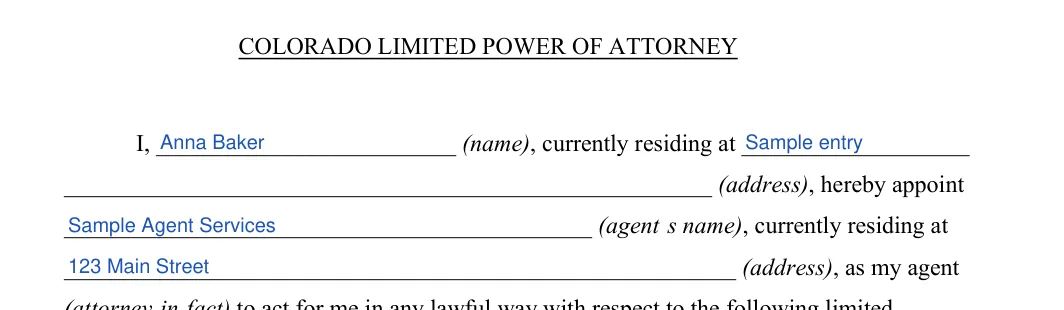
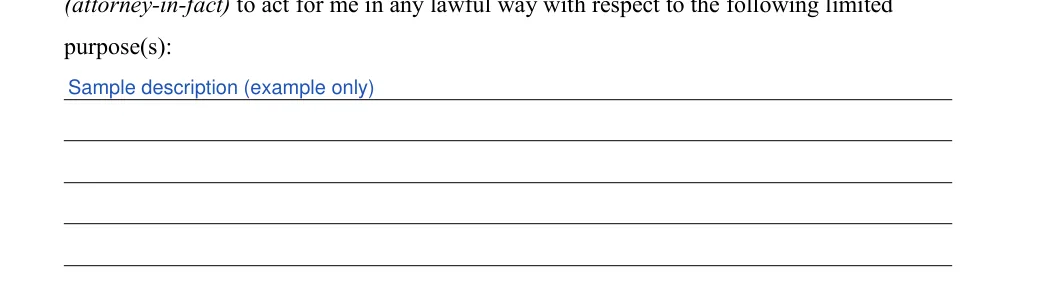
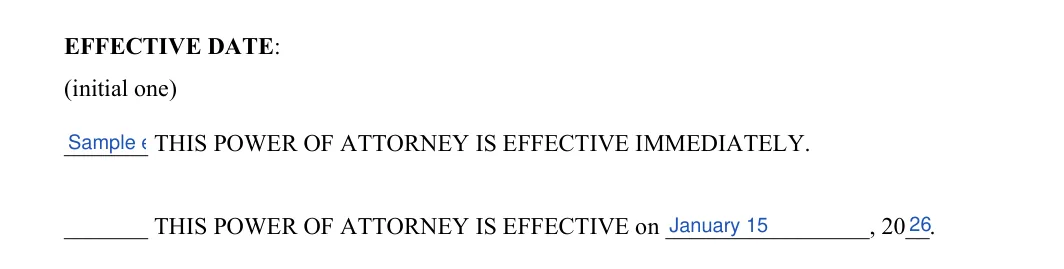
The form has eight parts across three pages. Work through them in order and use the sample screenshot under each step to see where each answer goes. Fill in every blank that applies to you and leave the rest empty.
The screenshots under each step show the FormsPal Colorado limited power of attorney template filled with sample entries in blue, so you can see where each answer goes. The names, addresses, dates and amounts are examples only.

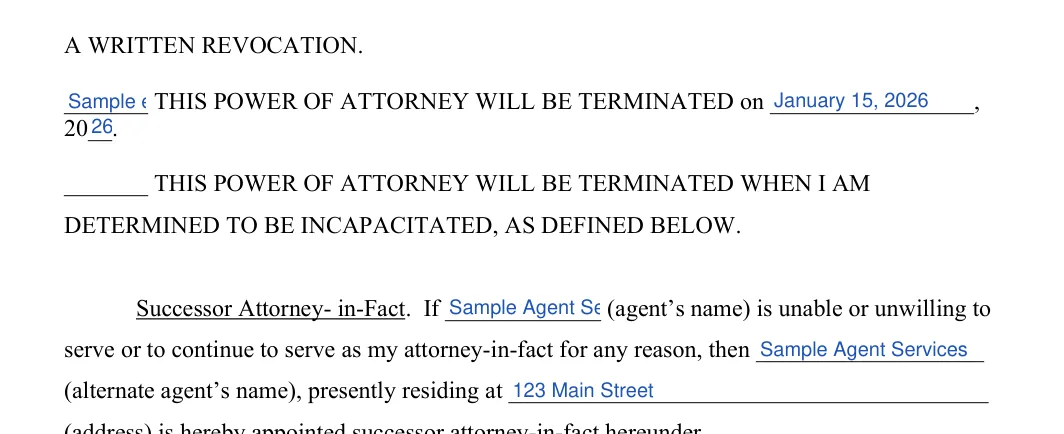
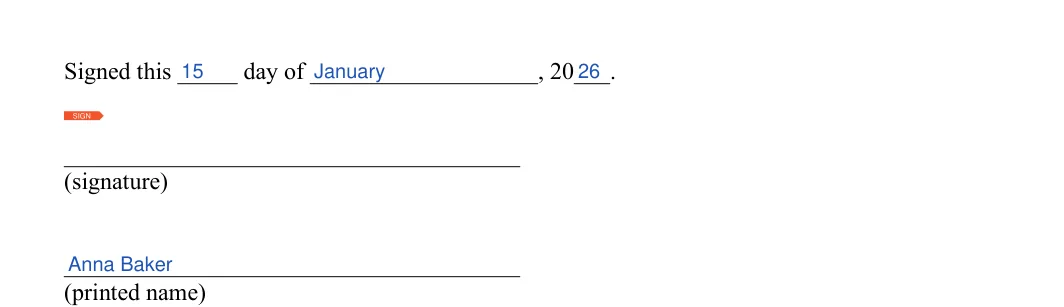
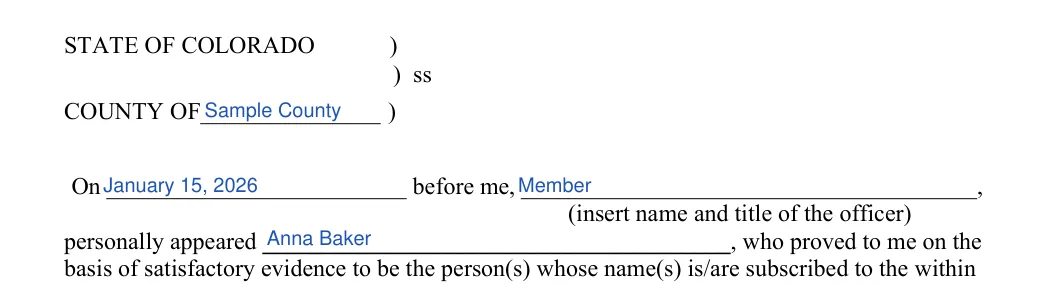

Once the form is filled in, signing it and sharing copies finish the job. Take the printed form to a notary public and ask how they want you to sign. Keep the original in a safe place. Give copies to your agent and to any bank or office that will deal with the agent.
If you want an agent to manage your finances and make decisions beyond one task, see the Colorado general power of attorney.
A Colorado power of attorney can end in several set ways, and the agent's authority can end separately from the document itself. Colorado law lists both kinds of ending, starting with the ways the whole power of attorney ends. A power of attorney terminates when:
The agent's authority terminates when:
If the principal revokes the agent's authority, or the agent dies, becomes incapacitated or resigns, the power of attorney itself ends too, unless it provides for another agent to act.[1.5]
These short answers come from the Colorado statutes that govern a power of attorney. They cover copies, acceptance by the agent, replacing an older document, incapacity, acts done in good faith, and which state's law applies.
Unless another statute provides otherwise, a photocopy or electronically transmitted copy of an original power of attorney has the same effect as the original.[1.2]
Unless the power of attorney provides otherwise, a person accepts appointment as an agent by exercising authority or performing duties as an agent. Any other assertion or conduct indicating acceptance also counts.[1.6]
Not automatically. Signing a power of attorney does not revoke one the principal signed earlier. The exception is a new power of attorney that says the previous one is revoked, or that all other powers of attorney are revoked.[1.5]
If the power of attorney is not durable, it ends when the principal becomes incapacitated. Incapacity does not revoke or terminate it as to an agent or other person who, without actual knowledge of the incapacity, acts in good faith under it.[1.5]
Yes, in most cases. Colorado law says two things about an agent or other person who acts in good faith under the power of attorney without actual knowledge that it ended:[1.5]
In practice, it helps to tell everyone who holds a copy when you revoke.
The meaning and effect of a power of attorney is determined by the law of the jurisdiction indicated in the power of attorney. If the document indicates none, the law of the jurisdiction where it was executed applies.[1.3]
General information, not legal or tax advice.
