
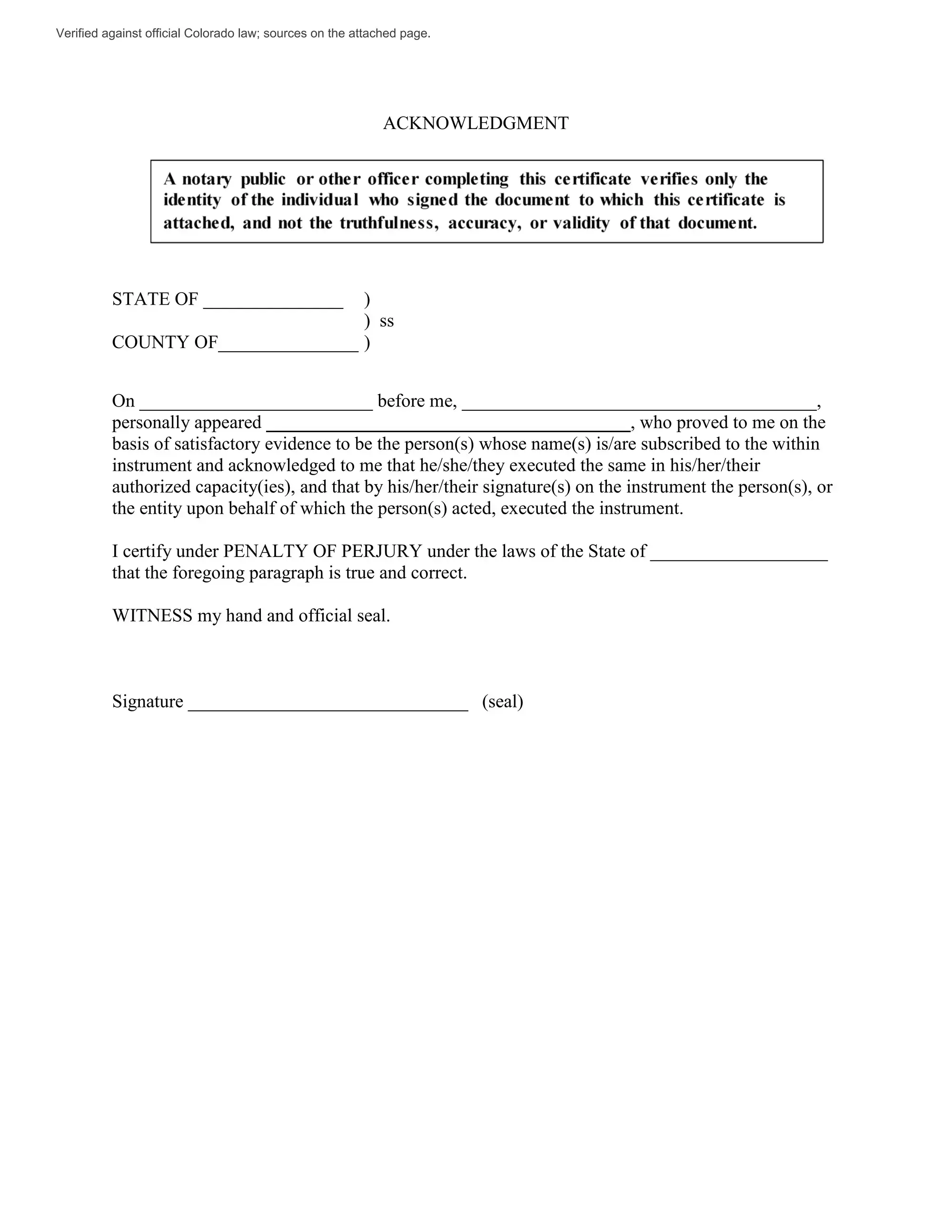
A Colorado notary acknowledgement is a written certificate that evidences a notarial act, such as a person acknowledging a document before a notary public. Colorado law says the act must be evidenced by a certificate and sets what it must contain.[1.2] It also gives a short form for an individual acknowledgment.[1.3] This free FormsPal form lets you fill in that certificate wording online or download it as a PDF.
Last Updated: October 2026. This guide is reviewed and updated regularly to reflect current Colorado law. If you notice an error or outdated information, please contact us.
Build Your Document
Answer a few simple questions to make your document in minutes
Save and Print
Save progress and finish on any device, download and print anytime
Sign and Use
Your valid, lawyer-approved document is ready
This Colorado notary acknowledgment form comes from our notary template family. Its acknowledgment page follows the statute's short form and includes:
A Colorado notary acknowledgement works through a certificate. Colorado law says a notarial act must be evidenced by a certificate, and it sets what that certificate must contain. The list below covers the requirements for the signing, the date, the place and the title of office.[1.2]
The certificate must:
Do not ask a notary to sign a certificate ahead of time. A notarial officer may not affix the officer's signature to a certificate, or logically associate it with one, until the notarial act has been performed.[1.2]
Where the certificate goes depends on the record. If the notarial act is performed regarding a tangible record, such as a paper document, the certificate must be part of, or securely attached to, the record. For an electronic record, the certificate must be affixed to, or logically associated with, the electronic record.[1.2]
Colorado gives short form certificates in Section 24-21-516 of the Colo. Rev. Stat. For an acknowledgment in an individual capacity, the certificate names the state and county. It says the record was acknowledged before the officer on a date by the named individual. The notary block follows.[1.3]
This record was acknowledged before me on______________________(date) by ______________________(name(s) of individual(s))
The statute gives separate wording for a person who signs a statement on oath or affirmation. The table shows the two certificates side by side.[1.3]
| Certificate | Used when | What the wording says |
|---|---|---|
| Acknowledgment in an individual capacity | An individual acting in his or her own right acknowledges a document. | This record was acknowledged before me on a date by the name(s) of the individual(s). |
| Verification on oath or affirmation | A person signs a statement on oath or affirmation. | Signed and sworn to (or affirmed) before me on a date by the name(s) of the individual(s) making the statement. |
Both certificates end with the same notary block. It has the signature of the notarial officer, the stamp with the title of office, and the line "My commission expires."[1.3]
A certificate does not have to use the short form to be sufficient. Under Section 24-21-515, it is sufficient if it meets the requirements of subsections (1) and (2) of that section and takes one of these forms:
Section 24-21-515 refers to sections 24-21-505, 24-21-506 and 24-21-507 for those actions.[1.2]
If a notary public performs a notarial act regarding a tangible record, an official stamp must be affixed to the certificate.[1.2] Colorado also sets what the stamp itself must look like and contain.[1.4]
The official stamp of a notary public must be rectangular and contain only the outline of the seal and the following information printed within that outline:
The stamp must also be capable of being copied together with the record to which it is affixed or attached or with which it is logically associated.[1.4]
Getting a document notarized in Colorado usually takes one short visit to a notary public. The steps below walk you through that visit. The next section shows how the acknowledgment form itself is filled in.
Under Colorado law, a notary public may perform a remote notarization only for an electronic record, apart from one exception the statute sets out.[2.1]
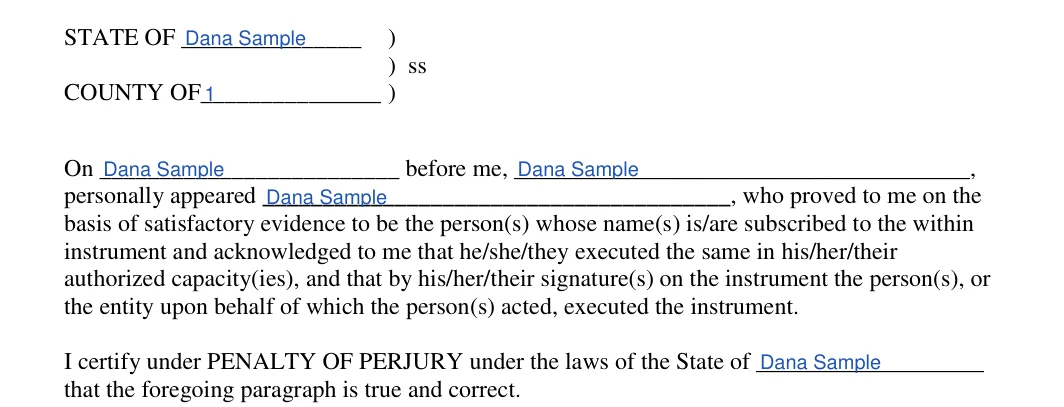
The FormsPal Colorado notary acknowledgment form has two fillable pages. Page 1 is a general acknowledgment, and page 2 is the Colorado notary acknowledgment with the fields for the state, county, date and individual. The steps below follow the form from top to bottom. You can fill in the PDF form on screen with our online PDF editor.
The screenshots under each step show the FormsPal Colorado notary acknowledgement template filled with sample entries in blue, so you can see where each answer goes. The names, addresses, dates and amounts are examples only.


These answers cover the Colorado notary acknowledgement wording, the certificate rules in Colo. Rev. Stat. §§ 24-21-514.7 to 24-21-517, and where to find a notary. They apply to the FormsPal form on this page and do not cover other notary forms.
Yes. Section 24-21-516 of the Colo. Rev. Stat. sets out a certificate for an acknowledgment in an individual capacity. It reads "This record was acknowledged before me on" a date "by" the name of the individual. The notary block follows with the signature, the stamp, the title of office and the commission expiration date.[1.3]
An acknowledgment certificate says the record was acknowledged before the officer. A verification on oath or affirmation says the statement was signed and sworn to (or affirmed) before the officer. Section 24-21-516 gives separate wording for each.[1.3]
Under Section 24-21-514.7 of the Colo. Rev. Stat., the certificate must indicate that the notarial act was performed using an interpreter. It must include the name and credential or certification number, if any, of the interpreter. It must also comply with the requirements of Section 24-21-515.[1.1]
A notary public offers services in several places:
It is common to call ahead and ask what they charge and what to bring.
General information, not legal or tax advice.
The statutes cited on this page are listed below. Each marker in the text, such as [1.2], points to the section of Title 24, Article 21 of the Colorado Revised Statutes that supports the sentence before it.
