
Free Lady Bird Deed Form

A lady bird deed is a deed that lets you keep control of your home for life and names who receives it after you die, usually without probate. It is also called an enhanced life estate deed. Only a few states use it. Fill out the free lady bird deed form below online or download it as a PDF, then see the state-specific forms for the details that apply to you.

Last Updated: October 2026. This guide is reviewed and updated regularly to reflect current law. If you notice an error or outdated information, please contact us.
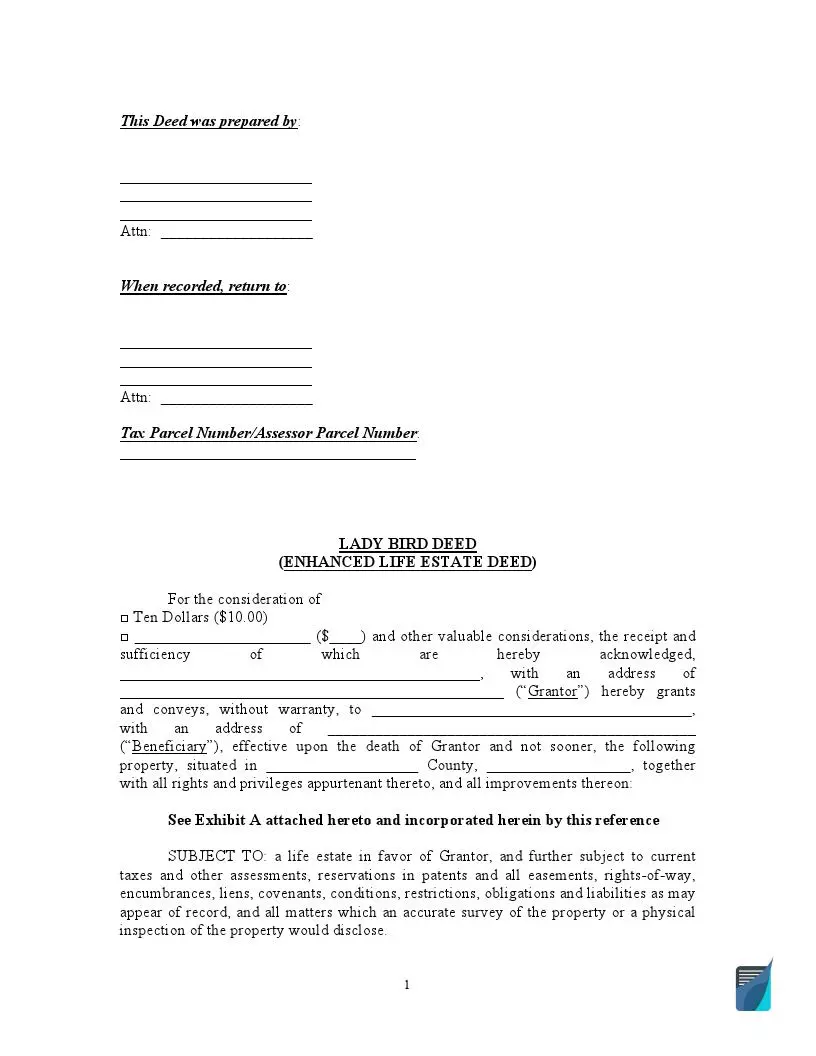
Lady bird deed form preview

Create a free high quality Lady Bird Deed online now!

Build Your Document

Answer a few simple questions to make your document in minutes

Save and Print

Save progress and finish on any device, download and print anytime

Sign and Use

Your valid, lawyer-approved document is ready

... or download your Lady Bird Deed (Enhanced Life Estate Deed) as a  PDF file

What Is a Lady Bird Deed?

A lady bird deed is one of the deed forms that pass a home to a named beneficiary at death. It is a variation of a life estate deed, which is why it is also called an enhanced life estate deed. You keep the right to live in the home for life, and the beneficiary receives it when you die.

The deed is drafted to split the home into two interests:

  • You keep a life estate, which gives you the right to live in and use the real estate for life.
  • You also keep the power to sell, lease or mortgage the home without the beneficiary's consent, because the deed reserves it.
  • The beneficiary receives the remainder, which means the home itself once you die.
  • Until then, the beneficiary usually has few rights over the property.

Compared with a standard life estate deed, where a sale usually needs the beneficiary to sign too, this gives the owner more control. Unlike a gift deed, which hands the property over right away, it leaves the transfer until your death.

In the states our pages cover, no statute creates or governs this deed. It rests on court decisions and on the powers written into the deed itself, so check with your county recorder or an attorney before you rely on it.

The lady bird nickname is commonly tied to Lady Bird Johnson, though the story behind it is disputed. Courts in some states have recognized these deeds. Only a few states use them, and FormsPal has a page for each state in the State-specific Forms list above.

When to Use a Lady Bird Deed

Homeowners use a lady bird deed when they want to keep full control of the home for life and pass it to a named beneficiary outside probate. It fits best where your state uses this deed. Other ways of passing a home at death usually stay available alongside it, so you can compare them before you choose.

People often consider this deed when:

  • they own real estate as a home and plan to keep living in it
  • they want to keep the right to sell, lease or mortgage the home
  • they want a named person, such as a child or a spouse, to receive the home without probate
  • they want to keep their property rights during their life and still plan who inherits
  • they want something simpler than a living trust, which usually takes more work to set up

Because only a few states use this deed, check the state-specific forms above, your county recorder or an attorney before you start.

Lady Bird Deed vs. Other Documents

A lady bird deed is one of several ways to pass a home at death. Each works differently, so the three comparisons below show where this deed differs and where it does not. Which one fits you depends on your state, your home and your plans.

Lady bird deed vs. last will

A last will usually goes through probate, while a lady bird deed usually passes the home outside it.

  • Probate: property passed by the deed usually avoids probate for that property, while a will generally goes through it.
  • After your death: the beneficiary usually records a death certificate or an affidavit with the county instead of waiting for a court.
  • Reach: the deed covers one property, while a will can cover all of your assets.
  • Availability: wills are accepted in every state, while only a few states use this deed.

Lady bird deed vs. trust

A living trust is another way to steer a home away from probate. You usually act as trustee while you are alive, and a successor trustee you name takes over when you die.

  • Setup: it usually takes more work, because you create a trust agreement and move assets into it.
  • Reach: it can hold many kinds of assets, while the deed covers one property.
  • Control: with either one, you can usually keep using and managing the property during your life.

Lady bird deed vs. TOD

A transfer-on-death deed works much like a lady bird deed, since it also passes a home to a named beneficiary at death. The two are different instruments, though. A transfer-on-death deed is made under a state's transfer-on-death law, and a lady bird deed is not.

  • Beneficiary: a transfer-on-death deed usually gives the beneficiary nothing until you die.
  • Availability: a transfer-on-death deed exists only where a state's statute provides for one.
  • Control: with either deed, you usually keep the right to live in the home and to sell or mortgage it.
A lady bird deed is also called an enhanced life estate deed. It is not a transfer-on-death deed, even though the two work alike.

A state that has a transfer-on-death law may also leave other ways of passing property at death in place, so check which options your state offers.

Benefits of a Lady Bird Deed

A lady bird deed lets you keep control of your home during your life and still plan who receives it. For many homeowners, the main appeal is that the home can pass outside probate and that you keep the power to change course. The benefits below are general, and they depend on your state and on your deed.

  • The home can usually pass to the beneficiary outside probate, which avoids a court proceeding for that property.
  • You keep the right to live in the home, and the deed is drafted to reserve your power to sell, lease or give it away without the beneficiary's consent.
  • Because the deed reserves your powers, you can usually cancel or replace it without the beneficiary's consent. In the states our pages cover, this rests on case law, so check before you rely on it.
  • You can prepare the deed from a template and then record it with the county.
  • Many people consider this deed as part of estate planning, including tax and Medicaid planning. How a state's tax and Medicaid rules treat it varies, so get advice before relying on it.

Drawbacks of a Lady Bird Deed

A lady bird deed is not the right fit for every home or every family. It is used in only a few states, and the rules that apply to it mostly come from court decisions, so results can vary. Weigh the drawbacks below before you sign.

  • Some title companies and lenders ask more questions about property held under this deed, which can slow a sale or a refinance.
  • Probate may still be needed if the beneficiary named in the deed dies before you. Naming an alternate beneficiary can reduce that risk.
  • Because the deed gives the beneficiary a remainder interest, that interest may be exposed to the beneficiary's creditors in some states.
  • The deed covers one property only, so your other assets need other planning.

Before you sign, ask yourself:

  • Does my state use this deed, and does my county accept it for recording?
  • Who should be the beneficiary, and who should be the alternate?
  • Will a lender or title company need to review the deed before I sell or refinance?
  • Do I need advice on tax, Medicaid or creditor questions for my situation?
Template Preview
Create a free high quality Lady Bird Deed online now!

Details to Include in a Lady Bird Deed

Before you fill out the lady bird deed form, ask your county recorder what it needs to record a deed, or ask an attorney. Requirements differ from county to county. If you are not sure what to include, use the checklist below as a starting point.

  • the full names and addresses of the grantor and each grantee
  • the legal description of the property
  • consideration, if any
  • a co-ownership form if several beneficiaries are named
  • the date of execution
  • a statement reserving the grantor's power to sell, lease or mortgage the property during their lifetime
  • the grantor's signature
  • information about witnesses and their signatures, if your state requires them
  • a notary statement acknowledging the signatures
  • the name and address of the person who prepared the deed, which some counties require

There might be different or additional requirements in your location.

After the deed is signed and acknowledged, people usually record it in the land records of the county where the property is located. The recorder's office can tell you which format it accepts.

Frequently Asked Questions

These are the questions people ask most often before they sign a lady bird deed. The answers are general and apply to the states our pages cover, so check your county's rules and ask an attorney if your situation is unusual.

Can a lady bird deed be contested?

Like any deed, it can be challenged. Common grounds include:

  • the grantor's capacity when signing
  • undue influence on the grantor
  • a defect in how the deed was signed or recorded

Signing and recording the deed carefully makes problems less likely.

Does it have to be notarized?

In the states our pages cover, a county will usually record a deed only when the signature is either:

  • acknowledged before a notary or a similar officer, or
  • proved by witnesses.

Some states also want two witnesses at signing. Recording the deed in the county land records is standard practice, and in some states an unrecorded deed does not hold against later buyers or creditors.

Can I revoke such a deed?

The deed is drafted to reserve your power to sell or convey the property, and that power is how the deed is usually changed or cancelled. You can record a new deed or a revocation, and the later recorded deed usually controls. The rules come from case law in the states our pages cover, so check before you rely on it.

General information, not legal or tax advice.

Mara Erlach
Mara Erlach
Writer & Attorney
Mara has been practicing estate planning and trust law in California since 2003, taking pride in helping clients of all backgrounds and asset profiles form a complete and customized estate plan. Her specialties are: estate planning, wills and trusts, trust and probate administration.
Published: Jun 16, 2022