
Updated:
A gift deed is a deed that passes property without payment. This page offers a free printable gift deed form, an online builder and a PDF download. Donors use it to give a house or land to family, friends or a charity.
Build Your Document
Answer a few simple questions to make your document in minutes
Save and Print
Save progress and finish on any device, download and print anytime
Sign and Use
Your valid, lawyer-approved document is ready
A gift deed, also called a deed of gift, is a written document in which the owner (the donor) gives property to another person or an organization (the donee) and asks nothing in return. The donor signs it and delivers it to the donee during their lifetime. Signing alone is not the whole transfer: in Texas, for one, a conveyance of land must be subscribed and delivered by the conveyor (Tex. Prop. Code § 5.021).
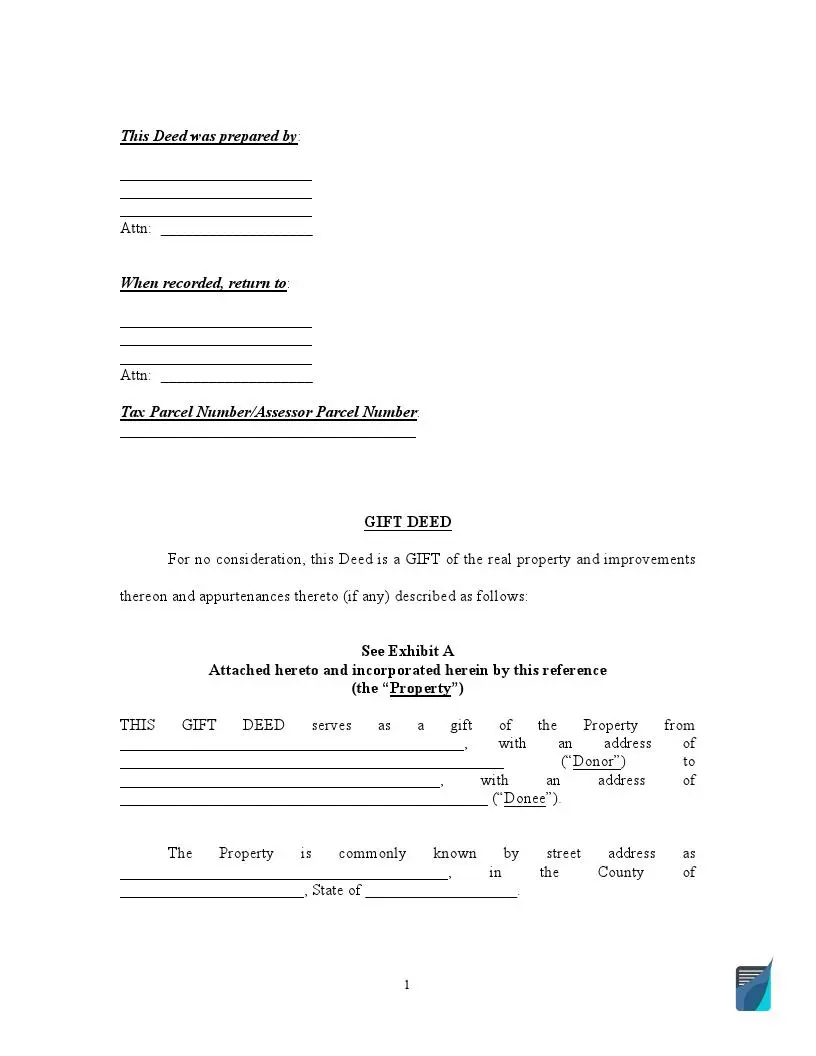
The FormsPal form on this page is built for real property: a house, a lot or a piece of land. It has boxes for the preparer, the return address, the tax parcel number, the donor and donee, and an Exhibit A page for the property description.
The word "gift" is the core of the document. A sale deed shows a price; a gift deed shows that the property changes hands free of charge, out of the donor's own will.
This deed fits when you want to hand a home, land or another piece of real property to someone now, without being paid for it. Families use it for gifts such as these: a parent gives a house to a child, a grandparent gives land to a grandchild, a spouse adds a partner to the title.
A house, a lot or farmland are typical gifts of this kind, and the FormsPal template is set up for that kind of real property. The template asks for the street address, the county and the parcel number, so it suits immovable property far better than a gift of cash or personal items.
A gift deed takes effect while the donor is alive, whereas a last will says how possessions are shared out after the owner's death and can be changed until then. Choose the deed when the donee should own the property now; choose the will when the transfer should wait.
If the new owner pays a price for the property, use a deed made for a sale instead. Our deed forms page lists the other deed types, such as deeds used for sales between a buyer and a seller.
A gift deed names the donor, the donee and the property, says the transfer is a gift, and carries the donor's signature with an acknowledgment block. If the gift is the family home or homestead, more may be needed: in Alaska, in a deed of the family home or homestead by a married man or a married woman, the husband and wife shall join in the deed (Alaska Stat. § 34.15.010). In Oklahoma, a deed affecting the homestead exempt by law is valid only if subscribed by both husband and wife, if both are living and not divorced or legally separated, except as otherwise provided for by law (Okla. Stat. tit. 16, § 4). In Wyoming, a deed of a homestead contains in substance the words "Hereby releasing and waiving all rights under and by virtue of the homestead exemption laws of this state" and is signed and acknowledged by the owner and the owner's spouse (Wyo. Stat. Ann. § 34-2-121). The template has no spouse line or homestead release wording, so add them where they apply. The list below follows the fields of the FormsPal template:
A few statutes in our sources name specific fields of a deed. Some match a box in the FormsPal template; for the others, add the line to the deed yourself:
The steps below follow the FormsPal Gift Deed template on this page, in the same order as the form. You can fill it in online, or download the PDF and complete it with the PDF editor. Enter the details of your own gift and check every name and address twice.
The screenshots under each step show the FormsPal Gift Deed template filled with sample entries in blue, so you can see where each answer goes. The names, addresses, dates and amounts are examples only.
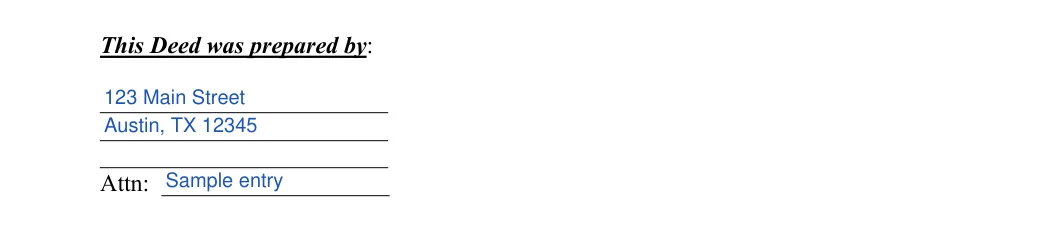
This Deed was prepared by
Enter the mailing address of the person who prepared the deed, plus an Attn name, in the box at the top of page 1.
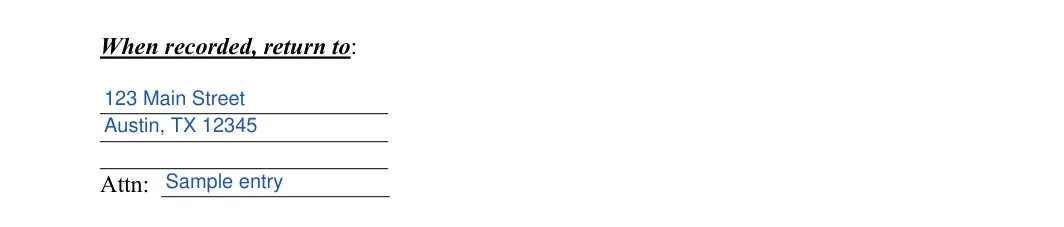
When recorded, return to
Enter the address where the recorded deed is sent back, plus an Attn name.
Tax Parcel Number/Assessor Parcel Number
Write the parcel number of the property on the line below the return address. Copy it exactly as it appears in your property records.

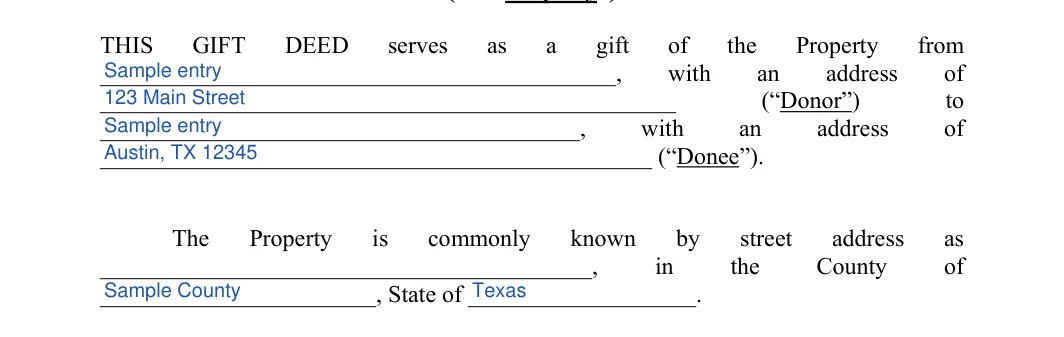
Gift Deed: donor, donee and property
Type the full names and addresses of the donor (the person giving the gift) and the donee (the person receiving it). Then enter the street address, county and state of the property.
Irrevocable or revocable
Read the paragraph on page 2, then tick the box that matches your plan. The FAQ below explains the difference between the two.

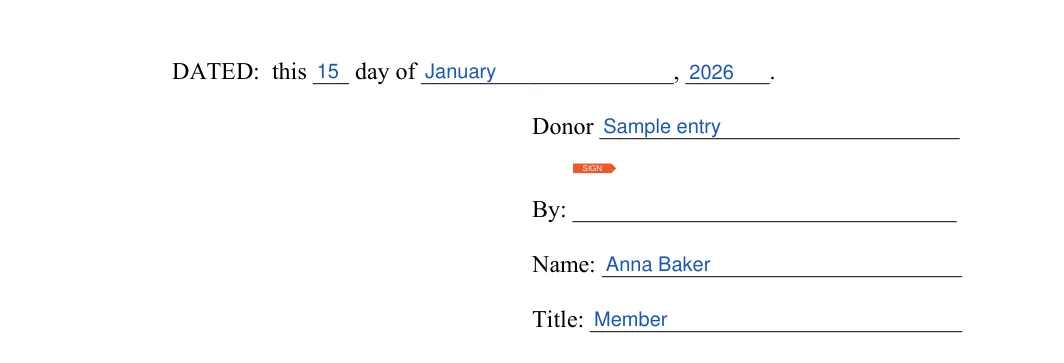
Date and Donor signature
Enter the day, month and year. Then fill in the By, Name and Title lines under the Donor line and sign by hand after printing.
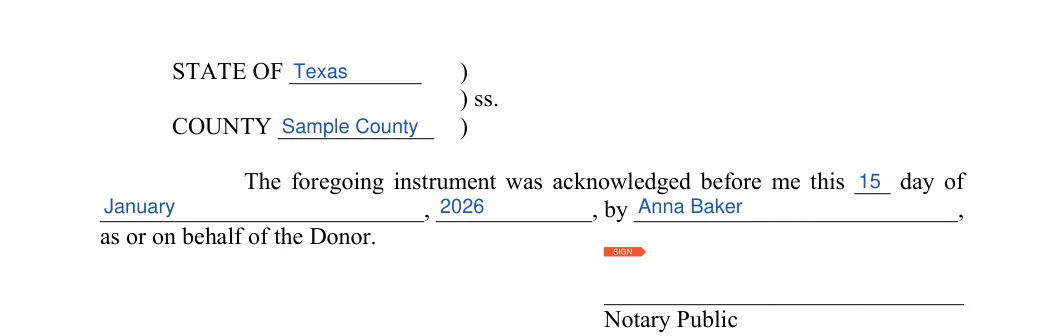
Acknowledgment before the notary
Fill in the state, county, date and name in the acknowledgment on page 3. The notary public signs on the line below.
My commission expires
The notary enters the date the notary commission expires under the Notary Public signature.

Exhibit A
Repeat the tax parcel number on the Exhibit A page, the last page of the deed.

Once every blank is filled in, print the template, but do not sign it at home. The last pages hold the signature and acknowledgment blocks, and you sign them in front of the officer who takes the acknowledgment. The steps below cover what to do with the finished deed.
Review the finished deed
Read it once more and compare every name, address and parcel number with your documents.
Sign and notarize
Sign on the Donor line in front of the officer who takes the acknowledgment, who then completes that block. In Florida (Fla. Stat. § 689.01), Georgia (O.C.G.A. § 44-5-30), Connecticut (Conn. Gen. Stat. § 47-5), Arkansas (Ark. Code Ann. § 18-12-104) and Alabama (Ala. Code § 35-4-20), the witnesses the table below names for that state also watch you sign and sign the deed as witnesses. In South Carolina, the deed is executed in the presence of and subscribed by two or more credible witnesses (S.C. Code Ann. § 27-7-10), and the donor acknowledges the signing in the presence of two witnesses, taken before some officer within this State competent to administer an oath (S.C. Code Ann. § 30-5-30(B)).
In Louisiana, a donation inter vivos shall be made by authentic act under the penalty of absolute nullity, unless otherwise expressly permitted by law (La. Civ. Code art. 1541), so the acknowledgment block of this template is not enough there: have a Louisiana notary prepare the act.
Hand it over
Give the signed deed to the donee. In Texas, a conveyance of an estate of inheritance, a freehold, or an estate for more than one year, in land and tenements, must be in writing and must be subscribed and delivered by the conveyor or by the conveyor's agent authorized in writing (Tex. Prop. Code § 5.021).
Take it to the recording office
Bring the signed deed to the office listed for your property in the table further down (a county office in most states, a town office in Connecticut, Rhode Island and Vermont), and keep your own copy in a safe place.
Witness and notary rules for this deed come from the deed statutes of the state where the land lies: Florida, for example, has the deed signed in the presence of two subscribing witnesses (Fla. Stat. § 689.01).
The table below gives the witness counts and signing form rules in our legal sources, with the condition attached.
| State | Witness rule for a deed | Source |
|---|---|---|
| Alabama | One witness attests the signing; two witnesses who are able to write, where the signer cannot write; two witnesses who can and do write their names, where the signer can write but has another write the name. Our sources do not say whether an acknowledgment can take the witness's place | Ala. Code § 35-4-20 |
| Arkansas | Two disinterested witnesses; failing that, the grantor acknowledges the deed in the presence of two such witnesses, who then sign it | Ark. Code Ann. § 18-12-104 |
| Connecticut | Two witnesses, plus acknowledgment by the grantor or the grantor's agent | Conn. Gen. Stat. § 47-5 |
| Florida | Two subscribing witnesses; they may be present and sign electronically by audio-video communication technology as defined in s. 117.201 | Fla. Stat. § 689.01 |
| Georgia | Attestation by an officer as provided in Code Section 44-2-15 and by one other witness | O.C.G.A. § 44-5-30 |
| Louisiana | Two witnesses and a notary: a donation inter vivos shall be made by authentic act under the penalty of absolute nullity, unless otherwise expressly permitted by law (La. Civ. Code art. 1541); an authentic act is a writing executed before a notary public or other officer authorized to perform that function, in the presence of two witnesses, and signed by each party, each witness and each notary public (La. Civ. Code art. 1833) | La. Civ. Code art. 1541; La. Civ. Code art. 1833 |
| New York | At least one witness, only if the deed is not acknowledged before its delivery; without either, it does not take effect against a later purchaser or incumbrancer until acknowledged | N.Y. Real Prop. Law § 243 |
| South Carolina | Two or more credible witnesses, in whose presence the deed is executed and who subscribe it | S.C. Code Ann. § 27-7-10 |
| South Carolina | Two witnesses: the grantor's signing of a deed is acknowledged in their presence, taken before some officer within this State competent to administer an oath | S.C. Code Ann. § 30-5-30(B) |
| Tennessee | Acknowledgment by the vendor, or proof by two witnesses upon oath, for the deed to be good as to strangers | Tenn. Code Ann. § 66-5-106 |
| Texas | Two or more credible subscribing witnesses, only when the deed is proved by witnesses instead of acknowledged before an officer | Tex. Prop. Code § 12.001 |
| Virginia | For recording, except when otherwise provided: acknowledgment, or proof by two witnesses in the court | Va. Code Ann. 55.1-600 |
| West Virginia | Acknowledgment, or proof by two witnesses, before the clerk of the county commission. A quitclaim deed without consideration, or a deed of property worth $100 or less with no real property transfer excise tax paid, is recorded only if the grantee also signs it and acknowledges it (or it is proved by two witnesses as to the grantee), which a gift deed may trigger | W. Va. Code § 39-1-2 |
For the states not in the table, our sources hold no witness count for a deed, so this page gives none. Vermont, for one, has the deed acknowledged by the grantor before a notary public (27 V.S.A. § 341).
A Texas gift deed can be recorded only if the donor signs and acknowledges it in the presence of two or more credible subscribing witnesses, or acknowledges it before an officer authorized to take acknowledgments (Tex. Prop. Code § 12.001).
A person who presents the deed in person for recording shows a photo identification to the county clerk (Tex. Prop. Code 12.001(b)). The full text of that chapter is on the Legislature's site, and our Texas gift deed form follows the same steps as the template on this page.
A deed of gift for land is recorded with the office each statute names, usually a county office but a town office in Connecticut, Rhode Island and Vermont: in Kentucky, the county clerk's office of the county where the property, or the greater part of it, is located (Ky. Rev. Stat. 382.110(1)).
| State | Office named for recording | Source |
|---|---|---|
| Arizona | County recorder of the county where the property is located; without recording, it gives no notice to later purchasers or encumbrance holders for valuable consideration without notice | Ariz. Rev. Stat. § 33-411(A) |
| Colorado | County clerk and recorder of the county where the property is situated | Colo. Rev. Stat. 38-35-109(1) |
| Connecticut | The records of the town in which the land lies; unrecorded, a conveyance does not hold the land against any person but the grantor and the grantor's heirs | Conn. Gen. Stat. § 47-10 |
| Georgia | Clerk of the superior court of the county where the land is located | O.C.G.A. § 44-2-1 |
| Illinois | The county where the real estate is situated | 765 ILCS 5/28 |
| Indiana | The recorder's office in the county where the land is located | Ind. Code § 32-21-4-1 |
| Kansas | Register of deeds of the county where the real estate is situated | Kan. Stat. Ann. § 58-2221 |
| Kentucky | County clerk of the county where the property, or the greater part of it, is located | Ky. Rev. Stat. 382.110(1) |
| Louisiana | The appropriate mortgage or conveyance records; unrecorded, it is without effect as to a third person | La. Civ. Code art. 3338 |
| Massachusetts | Registry of deeds for the county or district where the land lies | M.G.L. c. 183, § 4 |
| Minnesota | County recorder of the county where the real estate is situated | Minn. Stat. § 507.34 |
| Mississippi | Clerk of the chancery court of the county where the land is situated | Miss. Code Ann. § 89-5-1 |
| New Mexico | County clerk of the county where the real estate is situated | N.M. Stat. Ann. 14-9-1 |
| New York | Clerk of the county where the property is situated | N.Y. Real Prop. Law § 291 |
| Ohio | County recorder of the county where the premises are situated | Ohio Rev. Code Ann. § 5301.25 |
| Pennsylvania | Office for the recording of deeds in the county where the land is situated | 21 P.S. § 351 (Act of May 12, 1925, P.L. 613, No. 327) |
| Rhode Island | Records of land evidence in the town or city where the land is situated | R.I. Gen. Laws § 34-11-1 |
| South Dakota | Register of deeds of the county where the property is situated | S.D. Codified Laws 43-28-1 |
| Tennessee | Register of the county where the land lies | Tenn. Code Ann. § 66-5-106 |
| Texas | Office not named in our sources; a person presenting the deed in person for recording presents a photo identification to the county clerk | Tex. Prop. Code 12.001(b) |
| Vermont | Clerk's office of the town in which the lands lie | 27 V.S.A. § 341 |
Recording protects the donee against later buyers: in Minnesota, a conveyance not recorded is void as against a subsequent purchaser in good faith and for a valuable consideration whose conveyance is first duly recorded (Minn. Stat. § 507.34).
Some state statutes in our sources speak to gifts or to the price a deed shows, and a deed of gift there follows them: Louisiana, for one, sets a form rule for every donation made during life (La. Civ. Code art. 1541).
Before you sign, have a local real estate attorney check how these rules apply to your gift.
The main risk is that the donor gives up ownership: once the deed takes effect, the donee alone decides whether to keep, sell or rent out the property.
Suppose an aunt wants to give her house to her niece but keep living there. After a gift deed, the niece is the only owner of the house. She might let her aunt stay, or she might sell it or rent it to someone else.
Taxes are the second risk. A large gift can raise gift tax questions for the donor, and the donee pays tax on any income the property brings in. If the niece sells the house soon after the gift, her tax result can differ from what it would be had she inherited it under her aunt's last will.
Our legal sources hold no tax facts, so this page gives no tax limits or rates.
Ask yourself these questions before you sign:
You can create one on this page: answer the builder's questions, or download the blank gift deed as a PDF, fill it in and print it. Both versions follow the same nine steps described above.
Yes, a deed of gift and a gift deed are two names for one document. Both describe a transfer of property from a donor to a donee without payment.
A deed headed for the county records is acknowledged in most of the states in our sources: in California, before an instrument can be recorded its execution shall be acknowledged by the person executing it (Cal. Gov. Code 27287). Florida adds two subscribing witnesses (Fla. Stat. § 689.01), and the table above lists the rest.
A revocable gift deed is one in which the donor reserves a right to cancel the gift; the template has a box for that choice and one for an irrevocable gift. Whether such a reservation holds once the deed is delivered is not settled in our legal sources, so ask a real estate attorney before you tick the revocable box.
If the gift should wait for a later event or stay open to cancellation, a last will or another document fits better than a deed of gift: as the risk section above explains, once the deed takes effect the donee alone decides what happens to the property.
A gift deed can document a gift of money, but the FormsPal template is built for real property: it asks for a parcel number and an Exhibit A property description. For a gift of cash, a short signed letter that names the giver, the receiver, the amount and the date and says no repayment is expected gives both sides a written note of the gift.
Yes, our Texas gift deed form is a separate template for land in Texas, filled out with the same steps as the general form on this page. The Texas signing and recording rules are in the section above, with their Texas Property Code citations.
Have these details ready before you start:
General information, not legal or tax advice.
