
Updated:
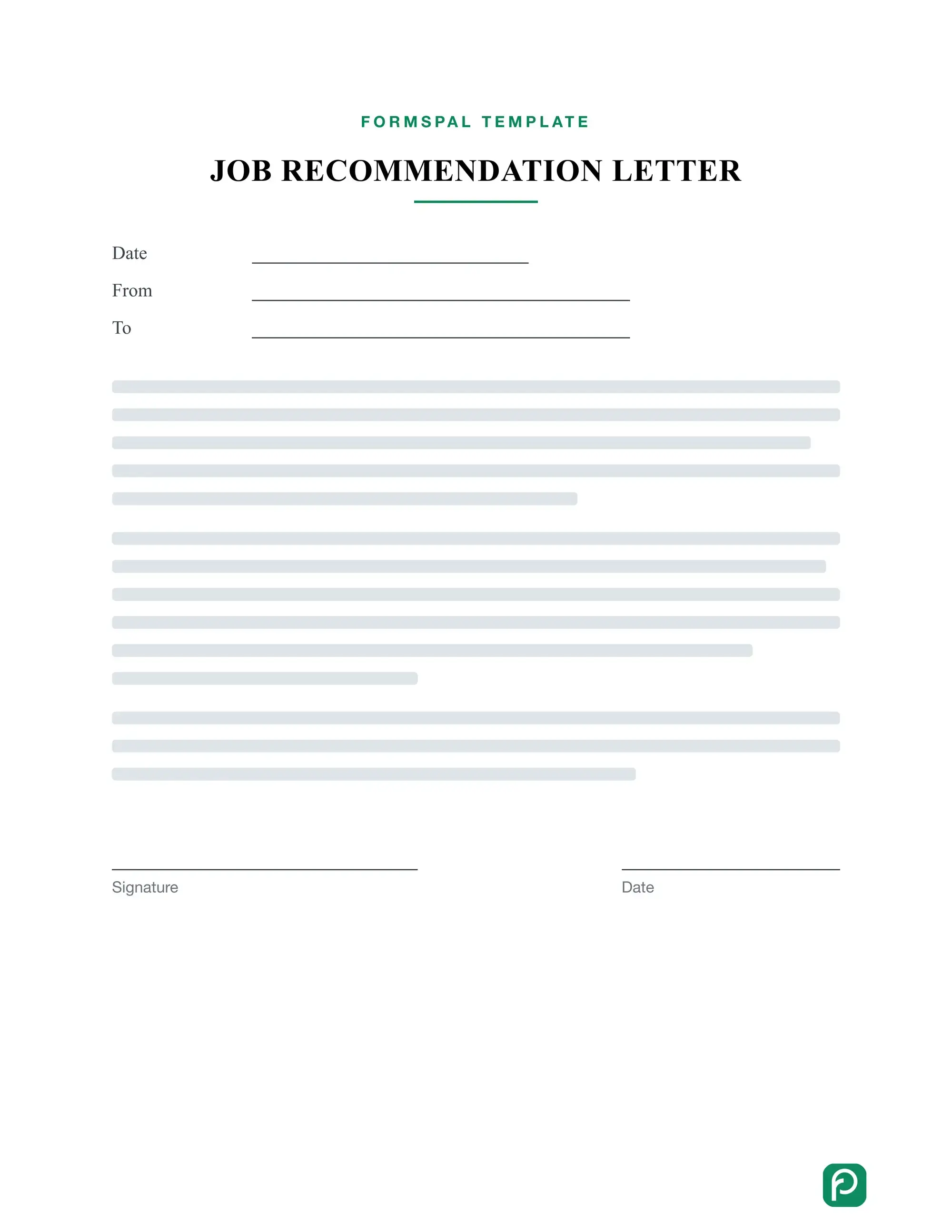
A job recommendation letter is a supervisor's written endorsement of an employee's work. This guide shows what the letter includes, who writes it and how to format it, with three samples. Job seekers need one when an employer asks for references, especially for a competitive role.
Key facts
A job recommendation letter is a signed endorsement from someone who supervised the candidate, written to persuade a hiring manager to make an offer. The letter speaks for one person and one kind of work. It describes real duties and results, not a general opinion.
A recommendation letter and a reference letter overlap, and many employers use the two names for the same thing. A recommendation letter usually targets one job or one employer. A reference letter, often addressed "To whom it may concern", serves several applications. An employment verification letter is a different document: it confirms dates and job title and does not judge the work.
A cover letter comes from the candidate, while a recommendation letter comes from a supervisor. The cover letter introduces the applicant in their own words. The recommendation letter backs those words with a second voice who saw the work.
A character reference covers personal qualities rather than job performance, and a letter for a school program focuses on study. The main letter of recommendation page covers those other kinds.
A job recommendation letter helps most when an employer asks for references or the role is competitive, for example at a large or well-known company. Employers mostly look at experience and hard and soft skills when they hire. The letter adds proof from someone who has seen the work, which a resume alone cannot give.
The letter fits these situations:
A strong job recommendation letter includes the writer's role, the candidate's duties, achievements and strengths, and real examples that show each one. No single template fits every job, because skills and duties differ. The checklist below covers what hiring managers look for.
A specific example makes the letter believable, because it shows a skill instead of only naming it. Each strength in the letter works best with one short, real example from the job.
The closing recommendation tells the reader plainly that the writer supports hiring the candidate. A line such as "I recommend (name) without reservation" leaves no doubt. A letter that only describes duties, with no recommendation, reads as lukewarm.
The writer's contact details let the hiring manager follow up with a call or a message. The letter lists a phone number and an email address, and a mailing address if the employer may write back. A writer who welcomes a follow-up call adds weight to the letter.
The best writer of a job recommendation letter is the candidate's direct supervisor, who knows the day-to-day work better than anyone else in the company. In a small organization, the owner can write the letter instead. A coworker may be a great specialist, but only a supervisor or employer can speak for how the candidate performed on the job.
A recommendation letter for a recent graduate can come from a teacher, a principal, a professor or an internship supervisor. That letter focuses on work habits, projects and reliability rather than past jobs.
A request for a recommendation letter works best when it is polite, early and comes with the details the writer needs.
A job recommendation letter follows a business letter format in three parts: an introduction, a main body and a closing paragraph. The letter stays clear and specific, and it fits on one page so the reader can take it in quickly. The parts below appear in this order.
The top of the letter carries the company letterhead, the date and, when known, the recipient's name, title, organization and address. Letterhead shows that the letter comes from the company. When the recipient is unknown, the letter opens with "To whom it may concern" or "Dear Hiring Manager".
The introduction tells the reader who recommends whom and why the writer can judge the work. The writer opens the letter with these details:
In two or three paragraphs, the supervisor describes the employee's responsibilities and how well they performed. Each paragraph covers one strength with one example.
The closing paragraph repeats the candidate's main skills and strengths and recommends hiring them. It adds the writer's phone number and email address in case the employer has questions.
The signature ends the letter: a handwritten signature on a printed letter, or a typed signature on a letter sent by email. Under it come the writer's full name, job title, company, email and phone number.
Writing a job recommendation letter takes a few short steps, from gathering details to a final proofread, whether the supervisor writes it or the candidate drafts it for the supervisor to edit.
A good reference letter leaves out anything untrue, private or unrelated to the job, because one weak line can undo the rest. The points below apply whether you ask for a letter or write one for someone else.
A writer who cannot recommend the candidate honestly does better to decline than to send a weak letter.
The three sample letters below are starting points to adapt: replace each blank or bracketed part with real details, then cut anything that does not fit. Each sample covers a different type of job.
This sample suits a candidate who has worked in sales or another administrative position.
Mr. or Ms. (Last and First Names)
(Job Title)
(Name of Organization)
(Street and House Number)
(City, State, Zip)
Dear Mr. or Ms._________,
I am glad to write this letter of recommendation for (name of the employee)______, who would like to join (name of the future workplace)__________. (The employee) joined our company in (year)__________ and quickly became a valuable member of the team.
I have taught (the employee) the basics of sales management since then and have watched them grow more professional each year. (The employee)_________ has shown excellent communication skills and the ability to work hard and consistently. They are outgoing, confident and well-spoken, which has helped them succeed as a sales representative.
(The employee)________ learned our software in depth and showed its full value to our potential clients. Their attention to detail helped one of our largest buyers make the right choice. (The employee)________'s most successful contract brought more than (amount in dollars)________ to the company.
I have watched (the employee)________ lead clients from the first contact until the agreement is signed, and I can assure you that they answer questions clearly, truthfully and correctly.
I would like to restate my strong support for (the employee)_______: they are an excellent specialist and a wonderful team member. We are sad to let them go after (number of years)_______ of working together. (The employee)________ is smart, motivated and hard-working, and I am sure they will continue to succeed in sales. If you have any questions, please reach me at (your email)________ or (your phone number)___________.
Sincerely,
(Last and First Names)
(Job Title)
(Company Name)
(Email)
(Contact Number)
This sample works as a teacher recommendation letter, or for any other educator.
Mr. or Ms. (Last and First Names)
(Job Title)
(Name of Organization)
(Street and House Number)
(City, State, Zip)
Dear Mr. or Ms.________,
I am honored to provide this reference letter for ____________________(the employee), who has taught (subject)________ at (school name)_______ for (number of)______ years. (The employee) quickly became one of our most outstanding teachers, with excellent job performance and real care for their students.
(The employee)_______ will soon leave our teaching community because of (reason)_______________. The students and the staff will miss them.
I have observed (the employee)'s________ work from the very beginning as a (job title)______. (The employee)______ is enthusiastic about the job and knows how to motivate students. Over the past couple of years, students under (the employee)'s guidance have improved their academic results.
(The employee)______ has also always been open to talking with parents. Their ability to deliver clear and polite messages is impressive.
In short, we are losing a brilliant specialist. I am sure (the employee)______ will keep up high-quality teaching at (school name)_______, and I highly recommend them for this position. Please contact me with any questions at (email)_______ or (phone number)_______.
Sincerely,
(Last and First Names)
(Job Title)
(School Name)
(Email)
(Contact Number)
This sample describes a part-time employee's work performance and suits a letter with no named recipient.
To whom it may concern,
It is my pleasure to provide this letter of recommendation for (the employee)________, who has worked at (company name)_______ for the past (period)_______. (The employee)______ has kept up steady work performance under pressure and impressed our team by being kind, outgoing and willing to help anyone who asks.
I was (the employee)'s_________ direct supervisor as a manager at (company name)_______. After a short internship, I regularly observed (the employee)______ working with clients. (The employee)_______ has always been attentive and polite with our customers, able to satisfy even a difficult customer and stay calm in a conflict.
To sum up, (the employee)______ is a key asset in customer service. My highest recommendation is that you offer this position to (the employee)________. If you wish to discuss any questions, please reach me at (email)________ or (phone number)________.
Sincerely,
(Last and First Names)
(Job Title)
(Company Name)
(Email)
(Contact Number)
Once the job recommendation letter arrives, check it, keep copies and thank the writer, so the letter is ready for every application.
Aim for one page, which is about 300 to 400 words. Use a short introduction, two or three paragraphs about the work and a brief closing with the writer's contact details. A clear, specific letter is easier for a hiring manager to read than a long one.
Letterhead is a good idea because it shows the letter comes from the company. If the writer has none, a plain page with their full name, job title and contact details works too.
Busy supervisors sometimes ask for a draft. If that happens, start from one of the samples above, fill in your real duties and results, and let the supervisor edit it so it sounds like their own words. Only include things that are true.
An AI tool such as ChatGPT can produce a first draft, but the writer supplies the real facts and checks every line. A generic draft reads as generic to a hiring manager. The final letter carries the writer's own examples, words and signature.
Strong words in a recommendation letter are specific qualities backed by an example, such as reliable, organized, resourceful, trusted, dependable, proactive, collaborative, thorough, adaptable, motivated and skilled. A word works only next to proof: "resourceful" means more after a line about a problem the candidate solved.
A positive recommendation names a strength, proves it with a result and ends with a clear endorsement. For example:
"In her two years on my team, Dana cut our order errors in half by building a new checklist. I recommend her without reservation for any operations role."
A general letter works for many applications. If the new job is in a different field, ask the writer to adjust a few lines to match it.
General information, not legal or tax advice.
