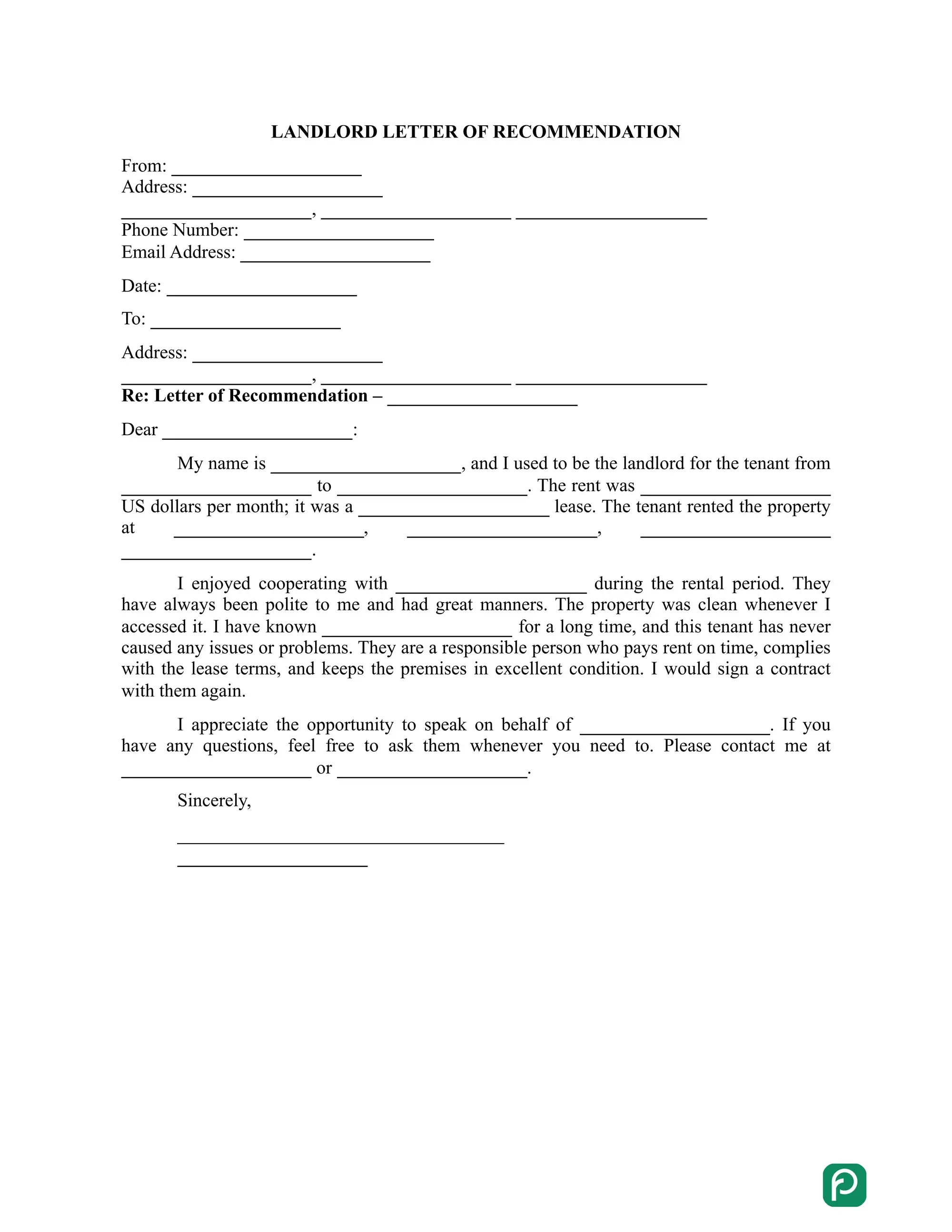
A landlord recommendation letter is a short letter from a former landlord that describes a tenant from the owner’s honest point of view. It covers the lease period, rent, payment record, and the tenant’s habits. The free fillable letter of recommendation template helps tenants speed up the search for new premises. It is also called a tenant recommendation letter, a landlord reference letter, or a reference letter for housing.
Last Updated: October 2026. This guide is reviewed and updated regularly to reflect current law. If you notice an error or outdated information, please contact us.
A tenant recommendation letter shows a new landlord that you are a reliable renter who pays rent on time and takes care of the rental property. It gives the owner a way to check your rental history with someone who has already rented to you, and it can speed up finding a new place.
Try putting yourself in a landlord’s shoes. No landlord on Earth would like to have a renter delaying payment every month and ruining the rented space. Every premises owner cares a lot about who will stay in the place, for how long, and what will happen in the rented space.
As a lessee, you make a strong effort to show your best side when you meet a potential lessor for the first time. Still, a new landlord has no easy way to verify your background and can rely only on what you say. A landlord recommendation letter backs up your words and helps you rent a place faster.
The letter also works for a commercial lease, not only for a home rental. Here is why it helps in both cases:
- Residential rent. The letter assures the lessor that the lessee pays on time, acts politely, and does not plan to ruin the place or bring unpleasant people there.
- Commercial rent. The letter also assures the owner that there will be nothing illegal on the premises because the renter has a lawful business and signs a contract.
In both cases, add specific details so the recipient understands whom they are dealing with.
Tip: Keep a signed copy of the letter, and bring a second copy when you meet the new landlord or attach one to your rental application.
What to Include in a Landlord Recommendation Letter
Most landlord recommendation letters, also called landlord reference letters, follow the same structure, because many owners have written the same kind of letter before. Add the items below so the new landlord gets the key facts at a glance and sees that the letter is complete.
- The owner’s name and address. On the left-hand side, the landlord writing the letter must add their details.
- The date. Date the letter on the day it is signed.
- The tenant’s name. You cannot create a complete tenant reference letter without the tenant’s name.
- The lease period. State the lease term, including when it started and ended.
- Late rent payments. State how many times the tenant paid late. Write “0” if there were no such cases.
- Rent amount. It may seem odd, but give the amount the tenant used to pay for the rented space.
- Characteristics. Describe the tenant’s traits.
- The signature or full name. When you finish describing the tenant, sign the form or type your full name.
- Contact details. Give the new landlord several ways to reach you with questions, such as a phone number, an email address, or a social media profile.
Every owner who writes a reference letter should include these details in the form; each tenant, in turn, must check the letter received from their lessor to ensure that all the demanded items are in place.
How to Write a Landlord Recommendation Letter Step by Step
Follow the eight steps below to write a clear landlord reference letter from top to bottom. Most people finish in 10 to 20 minutes, and the letter fits on one page or even half a page. Keep it brief to save the recipient’s time.
- Heading. Start with a heading so the recipient quickly understands the purpose of the document. Write “Landlord Recommendation Letter” in bold, in a font slightly bigger than the main text. You can use other phrases, such as “reference” instead of “recommendation.”
- The author’s name and address. On the left, below the heading, write your name and address so the recipient knows who wrote the letter.
- The date. Below the address, write the current calendar date. This shows that the letter is new.
- Introduction (first part). This part usually starts with “To whom it may concern,” because you often do not know who will read the letter. If you know the recipient’s name, write it instead. Then introduce yourself and the tenant. Give both names, say whether the rental was residential or commercial, state the monthly rent, and give the lease period. Mention any months when the payment did not arrive on time.
- The tenant’s description (main part). Briefly describe the tenant and their positive sides, and be as sincere as possible. You can note that the tenant has fantastic manners and is always polite and responsible, that the tenant cares a lot about the rented space and keeps it clean, or that the tenant is reliable and always pays on time or even in advance. Stick to truthful details so the recipient gets correct information and faces no surprises later.
- Conclusion. Show your willingness to answer questions and talk with the new landlord about the tenant. Before your contact details, add a phrase such as “I am ready to answer all your questions about the considered tenant.” The samples below show how this looks.
- Signature. Sign the letter or simply write your full name under the conclusion.
- Contact info. Below the signature, enter your contact information. It is good practice to leave several options for the recipient, such as your phone number, email address, or social network profile. Check all calls and messages you get so the new landlord can reach you.
The letter is not a huge or complicated document, so it will not take much of your time. Use the checklist above to confirm nothing is missing, then compare your draft with the samples below.
What to Do and What to Avoid
Review these tips before you look at the samples. They help you write a letter that is useful to the new landlord and fair to the tenant, and they show when it is better to decline a request.
Habits to Avoid
- Agree on writing such a letter if you have had a bad relationship with your tenant. In this case, decline the lessee’s request to provide them with the letter.
- Tell lies in your letter. For instance, you cannot give negative feedback if your tenant was good to you, and vice versa. Do not let the new landlord down by including incorrect information in the letter.
- Delay in writing the letter. Your ex-lessee wants to get a new place soonest possible, so you must give them feedback quickly.
- Refuse to communicate with a potential landlord. Your previous tenant expects you to answer all questions that the letter’s recipient may have. Do not let your lessee down.
Write only what you can stand behind. The new landlord may call you to check the details, so keep your letter and your answers consistent.
Habits Worth Following
- Make your letter brief and easy to read but still informative. We live in a world with an “overload” of information. Aim to make your letter short but tell the new landlord everything they need to know about your lessee.
- Answer all related questions. Again, do not ignore the recipient if they want to ask something regarding the tenant. The sooner you reply, the higher are the chances that your lessee will move quickly.
- Refuse to write a letter if you do not want to. If your relationship with the lessee was flawed and you have no wish to write a reference letter for them, feel free to refuse instead of falsifying the experience. The United States laws do not regulate such letters’ content. It is allowed to provide negative feedback about your lessee; however, this may lead to massive conflicts and arguments, and you probably do not have time for them.
Landlord Recommendation Letter Examples and Samples
Use these two samples as a starting point for your own landlord reference letter. Both follow the same structure, so you can pick the tone you like and adapt it. They cover these core points:
- The landlord’s and the tenant’s names
- The lease period and the monthly rent
- Any months when the payment was late
- A short description of the tenant
- Contact details for the new landlord
Replace each blank with your details, and change the wording so it matches your experience with the tenant.
Sample 1
Landlord Recommendation Letter
From ________________
_____________________
_____________________
(Write your name and address here)
___________________, 20___
(Write the current date here)
To whom this may concern,
This is a tenant recommendation letter for ________________ (write the tenant’s name). My name is ________________ (write your name) and I used to be the landlord for the named tenant from ___________ (lease start) to _____________ (lease end). During this period, there were ___ cases when the payment was not delivered on time. The rent was ______ US dollars per month; it was a ________________ (commercial or residential) lease.
I enjoyed cooperating with _______________ (insert the tenant’s name) during the whole rental period. (He or she) was always polite to me and had great manners. The property was clean any time I accessed it, and when the lease terminated, I got the place back in perfect condition.
I will gladly answer all questions about _________________ (the tenant’s name here). Use my contact info below to reach out to me.
_______________ (your signature or full name)
E-mail: _______________
Phone number: _____________
Sample 2
Tenant Recommendation Letter
From ________________
_____________________
_____________________
(Insert your name and address)
___________________, 20___
(Write the date of signing here)
Dear ______________ (the recipient’s name here, if known)
I, _____________________ (insert your name), am writing to you with a purpose to recommend _______________ (enter the lessee’s name) as a tenant. (He or she) was renting my place for a ______________ (commercial or residential) purpose from _________ to __________. The price was ______ US dollars per month, and there were _____ months when the payment did not arrive on time.
I have known _____________ (the tenant’s name) for a long time, as you may notice from the lease term, and this tenant has never caused any issues or problems. (He or she) is a responsible lessee who pays rent in advance and keeps the premises in a great state. I would definitely sign a contract with (him or her) again.
If you have any questions, do not hesitate to call or text me. I leave my contacts below.
_______________ (your signature or full name here)
E-mail: _______________
Phone number: _____________
Social media or messenger account(s) ________________
Frequently Asked Questions
How do I ask my previous landlord for a recommendation letter?
Asking your ex-landlord is easy in theory. In real life, many tenants run into unexpected problems when they try to get a letter. These tips make the request easier for both sides:
- Think of all your landlords from the past years. Make a list and choose the ones you liked most and who were good to you. A good relationship between you two is key to your success.
- Write a letter to the lessor. A written message is more convenient than a call because you can describe what you need in a couple of phrases without disturbing the person much. Many people nowadays prefer text messages to calls. After you send it, give them a couple of working days (not weekends) to reply. If nothing happens, you can call them.
- Set a date. You probably want the letter as soon as possible, but remember that people have daily tasks of their own. Tell them from the start which day you need the letter, and give them at least three days to write it.
- Be polite. This is rather obvious: you are the one who needs something from your landlord. Be careful and pleasant when you talk to them, and do not push.
- Choose another landlord in case of denial or silence. If you get no response for an extended period or the person refuses to help, go back to your list of ex-lessors and contact someone else.
Are a tenant recommendation letter and a landlord reference letter the same thing?
Yes, a tenant recommendation letter, a reference letter for a tenant, and a reference letter for housing all name the same document. Some writers use the word “reference” in the heading instead of “recommendation,” and the letter works the same way.
How long is a landlord recommendation letter?
It is short, because most letters fit on one page or even half a page, and writing one takes about 10 to 20 minutes. A brief letter saves the new landlord time and still covers the lease period, the rent, the payment record, and the tenant’s habits.
Can a landlord write a recommendation letter for a commercial tenant?
Yes, the letter works for both residential and commercial rentals. State the lease type, the monthly rent, and the lease period, and describe how the business tenant handled payments and looked after the space.
General information, not legal or tax advice.
With over 25 years of experience as a business and transactional attorney, Jennifer has mastered the craft of closing highly successful deals for her clients. Through her wide-ranging expertise in commercial contracts, real estate transactions, M&A and corporate law, Jennifer secures results that are second-to-none.
Published: Jul 7, 2022