
A personal recommendation letter, also called a personal reference letter or a letter of recommendation for a friend, is a short letter from someone who knows the candidate well. The writer describes the candidate's character, strengths and achievements to support a job, rental, scholarship, immigration or community application.
Last Updated: October 2026. This guide is reviewed and updated regularly to reflect current law. If you notice an error or outdated information, please contact us.
Build Your Document
Answer a few simple questions to make your document in minutes
Save and Print
Save progress and finish on any device, download and print anytime
Sign and Use
Your valid, lawyer-approved document is ready
Various spheres require reference letters to disclose why the candidate is worthy of the benefits and prospects offered. In many cases, these papers are submitted to meet the demands of college and other educational programs, employers, rental and immigration purposes, and more. Most spheres in life require a candidate to provide a relevant portfolio complemented by a reference paper.
The following purposes and situations may require a professional reference notice from someone reputable and heavyweight.
Letters for a friend fall into two categories: personal reference letters and character reference letters.
A colleague, a partner or a friend can write either type of letter.
Reference Letters are free-form documents. A clear layout helps the reader, so cover each part below. Consider the must-have list below and always keep it in mind while preparing your support or completing a sample character reference letter for a friend.
A strong personal letter starts with the right writer and a clear request. Follow the four steps below to choose someone who knows you well, ask politely, and give them what they need to write a specific, honest letter.
Whether you are writing a letter for someone or choosing a template for yourself, it helps to know what to leave out and what to keep. These points apply to both the writer and the candidate.
Choose one of the two sample letters below, or use the Create My Document button above to build your own letter online. Fill in the blanks, check the details, and print the finished letter.
Before you print, have these details ready:
Character Reference Letter
Date: ____________________
To Whom It May Concern,
I, ________________________ [enter the full name], am honored to provide a reference for ________________________ [person’s full name]. This person appears to be one of the dependable people I have known personally as ____________________ [indicate the type of relations, for example, a friend, a colleague, other].
My interactions with ____________________ [individual’s name] have always been full of responsible care, high regard, and confidence.
That aside, ____________________ [individual’s name] has always treated other people with dignity, respect, and commitment.
Please do not delay contacting me should you require more details.
Kind Regards,
Name and Signature ______________________________
Date ______________
Contact Phone ____________________
Email Address ____________________
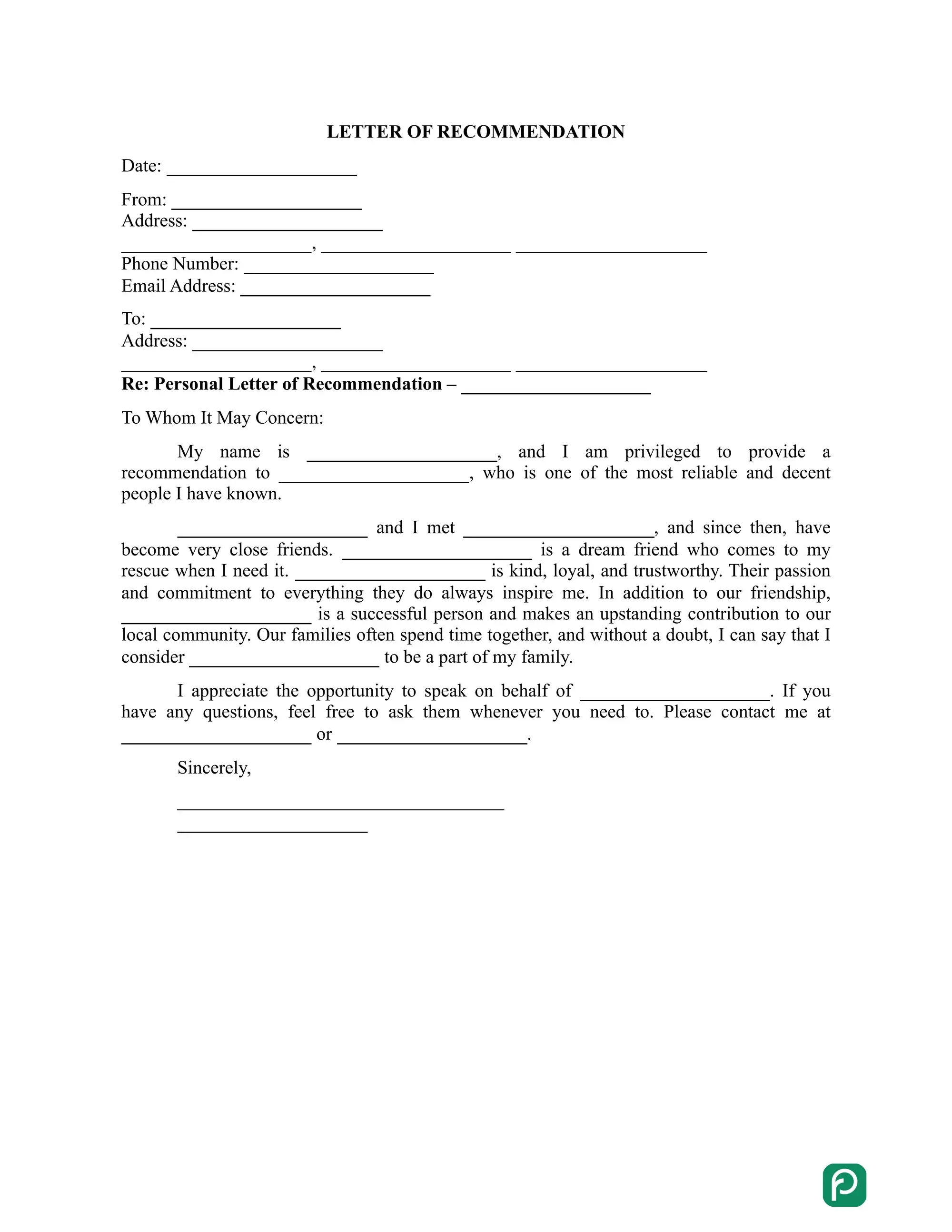
Personal Letter of Recommendation
Today, on ____________________
To __________________________ (enter the addressee’s name) and everyone Whom This May Concern,
I, ________________________, [enter the name] am privileged to provide a recommendation notice to ________________________ [candidate’s name] who from all appearances, is one of the reliable and decent persons I have known personally.
__________________ [candidate’s name] appears to be my considerable ____________________ [indicate the type of relations, for example, a friend, a colleague, other].
_________________________________________________________________________
_________________________________________________________________________
_________________________________________________________________________
[Use the offered space to list the person’s important achievements and honors].
My personal interactions with ____________________ [individual’s name] have always prospered with delight, high regard, and confidence.
That aside, ____________________ [individual’s name] has always treated other people with dignity, respect, and responsible care.
Please be encouraged to reach me if you need further details and additional information.
Best Regards,
Name and Signature ______________________________
Date ______________
Contact Phone ____________________
Email Address ____________________
It is a short letter from someone who knows the candidate well. The writer describes the candidate's character, strengths and achievements to support a job, rental, club or school application.
Anyone who knows the candidate well enough to describe real examples can write one. Colleagues, neighbors, mentors, friends and family members are common choices.
One page is usually plenty. Three or four short paragraphs work well. Say how you know the candidate, share one or two specific examples, and close with an offer to answer questions.
A personal reference letter backs up an application by summarizing the candidate's qualities and experience. A character reference letter focuses on the candidate's moral qualities and trustworthiness.
Use a general greeting such as To Whom It May Concern, as in Sample 1. If you can find out who will read the letter, address it to that person instead.
General information, not legal or tax advice.
