Affidavit of Residency

An affidavit of residency (or proof of residency letter) is a written factual statement of a person about residing at a certain address that might be required by a court, financial institution, or business. It is a legal document that is used to prove your residence or residence of a person who lives or has lived with you. A person making an affidavit form is called the affiant. Download our free template below or create your own online in a few minutes.

Last Updated: October 2026. This guide is reviewed and updated regularly to reflect current law. If you notice an error or outdated information, please contact us.
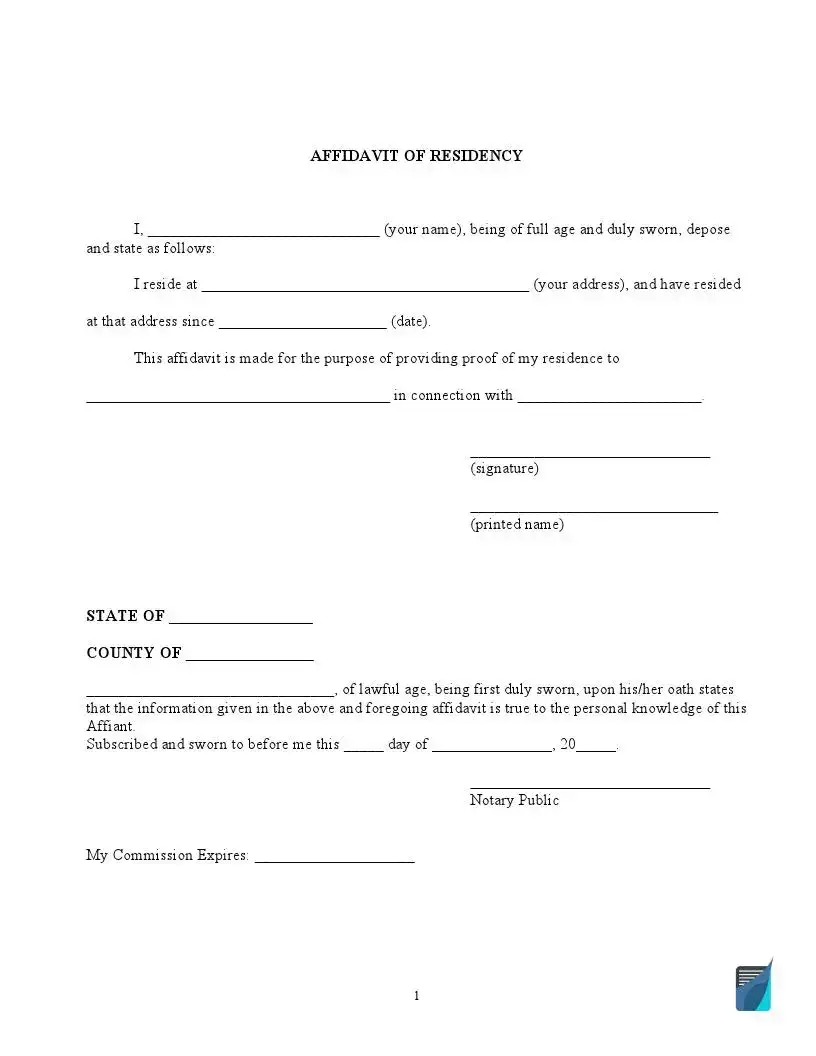
Affidavit of residency form preview

Create a free high-quality Affidavit of Residency online now!

Build Your Document

Answer a few simple questions to make your document in minutes

Save and Print

Save progress and finish on any device, download and print anytime

Sign and Use

Your valid, lawyer-approved document is ready

... or download your Affidavit of Residency as a PDF file

Why You May Need an Affidavit of Residency

People are asked for proof of address in many everyday settings, from a school office to a motor vehicle desk. A sworn statement of residency gives the reader a clear record of where you live and since when.

The situations where an affidavit of residence is most commonly used are:

  1. When an individual wants to get a driving license at a local DMV and needs to prove they are a resident of the state
  2. When a parent needs to confirm their child lives in their home
  3. When a student wants to apply for in-state tuition and needs to confirm to a school they have been living or currently dwell at a certain address
  4. When a person needs proof of being employed in a certain area
  5. When a tenant needs proof from their landlord that they have been living in a rental unit for a certain amount of time
  6. When a person is required by a court to claim residency in a sworn statement that should be notarized
  7. When there is a need to verify the residency of a deceased family member before releasing this person’s accounts or funds

Ways to Prove Your or Somebody’s Residence

When there is a need to prove a resident’s address, the burden of getting supplemental evidence lays on the resident. They should gather as many documents and personal testimonies as possible, but it also depends on the nature of a residence they need to prove. For instance, a local DMV will require only proof of current residence when in the case of applying for tuition, an applicant will have to confirm that they have been living in the state for a certain amount of time.

You will typically have to take the following steps to prove your residence.

Write an Affidavit of Residence

A proof of residency letter is official evidence of an affiant that they or a person on behalf of whom they are writing an affidavit is residing at a certain address or within the state.

In situations where a residency affidavit is not needed, it is still better to supply it as it intensifies any testimony or documents that may be required to prove residency.

An affidavit of residence also contains the affiant’s contact details. The reader can use them if any source of residence evidence raises questions.

Provide Evidence

An affiant has to add any forms that might be needed to supply the claim of residency. Among such documents might be:

  • Health insurance card
  • Real estate deed
  • Rental agreement
  • Driver’s license
  • Paycheck stub
  • Utility bill
  • Tax return
  • Bank statement
  • Vehicle title

There is no need to provide plenty of evidence as several of the above-mentioned documents are typically enough to prove residency.

If there is no supplemental evidence, an affidavit has to be notarized.

File the Affidavit of Residence and Supporting Documents

The last step is to file an affidavit of residence along with the supporting documents with the requesting body. Once they are accepted, the body will return them to the affiant.

What to Write in an Affidavit of Residency

An affidavit of residence is a short document, and you can create one in two ways. Download the template on this page and fill it in, or use the FormsPal online builder, which asks a few questions and fills in the form for you.

The FormsPal template has these parts:

  • Your name at the top, after “I,”
  • Your address and the date you have lived there since
  • Who the proof is for and what it is in connection with
  • Your signature and printed name
  • The State of and County of block at the bottom, with the date lines

Before creating an affidavit of residence using any of the available methods, first, answer several questions:

  • For what period of time have you been living in the state/county?
  • Who is living with you now?
  • At what address will the affidavit of residence be signed?

By responding to these questions, you can streamline the process of creating the document. After you have filled out a proof of residency letter properly, you need to find a notary public and finalize the document this way.

Tip: Keep a paper that shows your address, such as a utility bill, next to you while you fill in the form, so the address you write matches it exactly.
Template Preview
Create a free high-quality Affidavit of Residency online now!

What to Gather Before You Start

A little preparation makes the form quick to fill in, because the affidavit asks for a few personal details and the name of the person who will read it. Set out the information below before you open the PDF or start the online builder.

  • Your full name. Use the name that appears on your ID so the form matches your other records.
  • Your address and move-in date. The form asks for the address where you live and the date you have lived there since.
  • The recipient and the purpose. Note who will receive the proof of residence and what it is in connection with, such as a school, a bank or an employer.
  • Proof of your address. A utility bill, a lease or a bank statement helps you copy the address exactly as it is written there.

If you need a different sworn statement, FormsPal also has an affidavit of identity and an affidavit of domicile, which records where a person who has died lived. A certificate of residency is a related form that some people use as another proof of residency.

How to Fill Out an Affidavit of Residency

The Affidavit of Residency template on this page is a one-page form. The steps below follow it from top to bottom, one part at a time, and each step shows the template filled with sample entries. You can fill in the downloaded PDF on screen with the PDF editor or print it and write by hand.

The screenshots under each step show the FormsPal Affidavit of Residency template filled with sample entries in blue, so you can see where each answer goes. The names, addresses, dates and amounts are examples only.


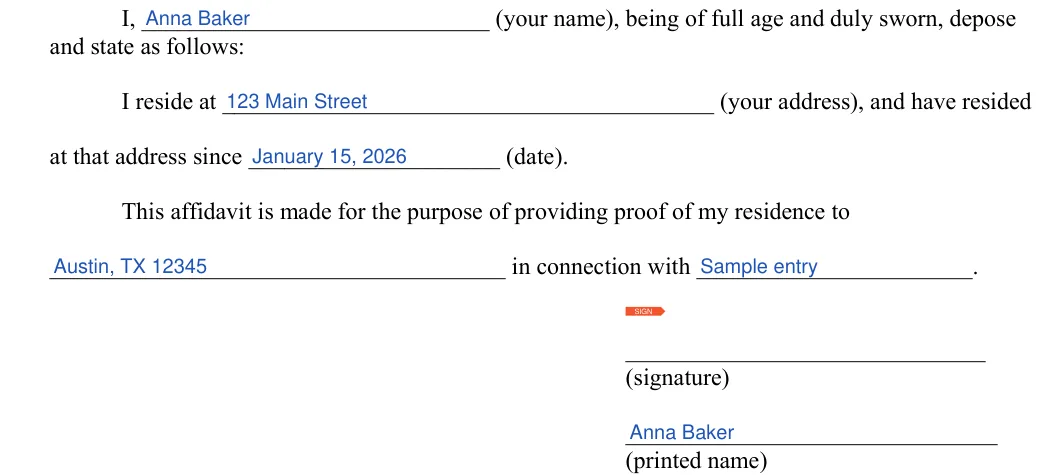
  1. Affidavit of Residency: your name. Under the title Affidavit of Residency, write your full name on the first line after “I,” at the top of page 1.

    Step 1 to filling out an affidavit of residency form signing party

    Affidavit of Residency: AFFIDAVIT OF RESIDENCY, filled with sample entries
    Step 1: sample entries, not a real document.
  2. Address, purpose, signature and printed name. Write your address and the date you have lived there since. Next, enter who the proof of residence is for and what it is in connection with. Then sign on the signature line and print your name beneath it.

    Step 4 to filling out an affidavit of residency example signature

    Affidavit of Residency: and state as follows, filled with sample entries
    Step 2: sample entries, not a real document.
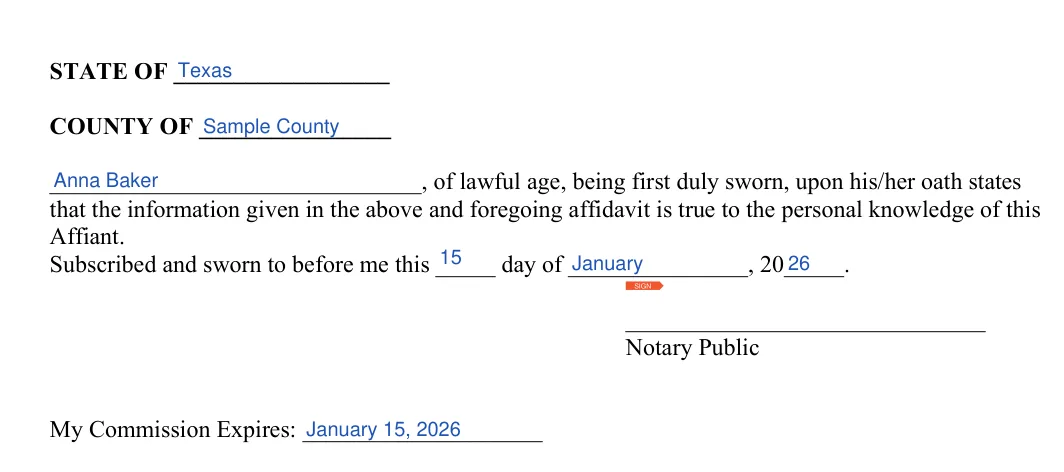
  3. State of, County of and the notary section. In the block at the bottom of page 1, enter the state and county and your name on the line that begins the second paragraph. Then fill in the day, month and year. The Notary Public line and the commission expiry date are left for the notary to complete.

    Step 6 to filling out an affidavit of residency template notary acknowledgement

    Affidavit of Residency: State of, County of and more, filled with sample entries
    Step 3: sample entries, not a real document.

How to Sign and Use the Affidavit of Residency

Filling in the blanks is only part of the job. The steps below take you from a finished form to a paper you can hand over. Go through them in order and keep a copy for your own records.

  1. Attach supporting documents. In the next paragraph, you should tell that you attached each and every legal document needed using the similar wording: “I have attached the following documents for your consideration”. Then, every legal document required by the financial institution, court, or business entity should be added.
  2. Witness acknowledgment. The next page of the affidavit of residence should be the witness acknowledgment. It should tell that witness or witnesses acknowledge that it was you who created the document. To validate the acknowledgment, they should put their signatures, dates of signing the acknowledgment, and print names.
  3. Notary acknowledgment. After putting signatures of witnesses in the document, the proof of residency affidavit might need authorization by a notary public. Notary acknowledgment goes as the last page of the affidavit of residence, and it should state that you personally appeared before the notary public and executed the legal document.
  4. Keep a signed copy. Save a scan or make a photocopy of the finished paper for your own records.

Frequently Asked Questions

Should I get my affidavit of residency notarized?

An affidavit of residence might be notarized, especially in situations where there is no supplemental evidence. For instance, it is recommended to involve a notary public if you are in the process of getting a driver’s license or paycheck stubs. Having an affidavit notarized is not a legal requirement, but signing an affidavit of residence with a notary acknowledgment attached helps verify the identity of the author.

What can I attach to an affidavit of residency?

The guide above lists several papers that people attach, for example:

  • A utility bill
  • A bank statement
  • A tax return
  • A driver’s license

Ask the body that requested the affidavit which of them it prefers.

Can I fill out an affidavit of residency online?

Yes. You can create one with the FormsPal online builder, or download the PDF template and fill it in on screen with a PDF editor.

What should I do with the affidavit after I sign it?

Keep a signed copy for your own records and give the original to the body that asked for it.

General information, not legal or tax advice.

Mara Erlach
Mara Erlach
Writer & Attorney
Mara has been practicing estate planning and trust law in California since 2003, taking pride in helping clients of all backgrounds and asset profiles form a complete and customized estate plan. Her specialties are: estate planning, wills and trusts, trust and probate administration.
Published: Jun 5, 2022