
Updated:
A teacher resignation letter is a formal notice naming your last school day. The letter goes to your principal and gives the school a written account of your departure. This guide covers what to include, the format, sample letters and next steps.
Key facts
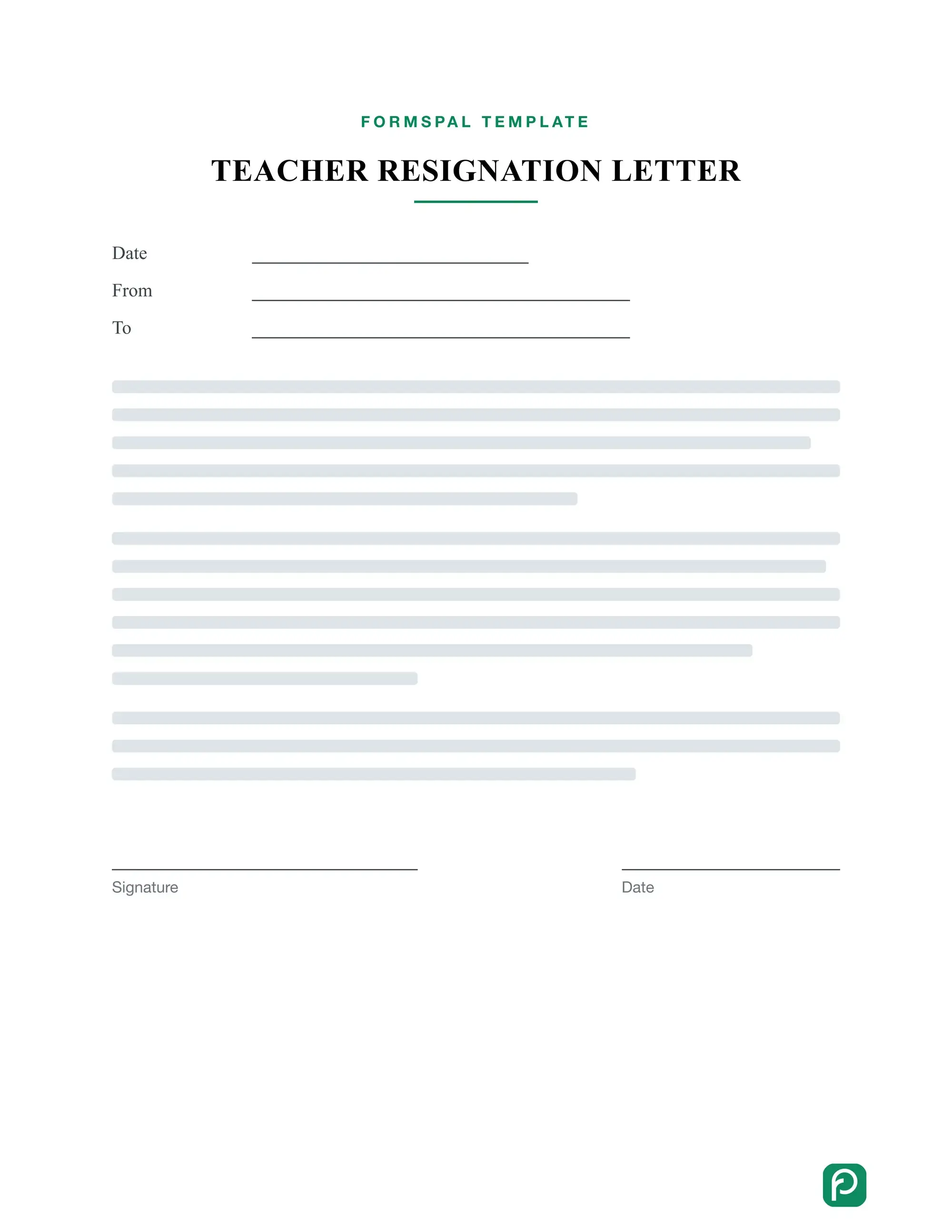
A teacher resignation letter tells your school you are leaving and names your last day, so the principal can plan for your classes and the district has your decision in writing. The letter also closes your time at the school on a polite note.
The letter does several jobs at once:
A teacher resignation letter differs from a retirement notice to a pension system or a leave request. The letter ends your job at one school; a leave request keeps the job and pauses it. For resignation letters in other jobs, see the main resignation letter guide.
A teacher resignation letter works best when it reaches the principal well before your last day, at a point in the school year that leaves time to find and brief a replacement. Your contract and the district handbook are the first places to check for a notice date. Some resignation dates for teachers under contract come from outside the district, so also ask the education department where you teach whether one applies to you.
Write the letter before you talk to the principal. Drafting it ahead of time spares you from writing it under pressure while colleagues ask questions. Read the draft again the next day: a fresh look often catches wording you would like to change.
The end of the school year is the cleanest exit point for a teacher resignation, because classes finish and the school can hire over the summer. Many teachers pick the summer, when most students are on vacation. A letter sent in spring gives the district the longest window to fill your post.
A mid-year resignation letter needs a fuller handover plan, because a new teacher takes over classes already in progress. The letter should name your last day, offer to help brief the incoming teacher and list what you will leave behind: lesson plans, grades, rosters and notes on each class.
Before you choose a mid-year date, read your contract and ask HR how your district treats a resignation during the term. Districts handle mid-year departures in different ways, and the answer can shape the date you choose.
Leaving a contract during the term without the district's release can carry consequences beyond the job, such as action against a teaching certificate in some places. Ask the district for a written release before you set the date, and ask the education department where you teach how it treats a departure without one.
A teacher resignation letter goes to your principal or the administrator you report to, and many teachers send a copy to the superintendent or the district's HR office. Your school handbook can tell you which route your school prefers.
Tell your principal in person first when you can, then hand over the letter. Students and parents hear the news from the school, after the principal knows.
A teacher resignation letter needs your last day, a short reason, a handover plan, your thanks and your contact details. Each part takes a sentence or two, and together they fit on one page.
| Part | What it says | Where it goes |
|---|---|---|
| Last day | The date your teaching job ends, and an apology for any trouble your departure may cause | First or second sentence |
| Reason | One honest sentence: retirement, a move, a new position, health or family | Second paragraph |
| Handover | Who covers your classes and what you will leave ready | Second or third paragraph |
| Thanks | Gratitude for your time at the school and for the people you worked with | Closing paragraph |
| Contact details | An email or phone number for questions after you leave | Last line before the signature |
Give a true reason or none at all. If the letter says you are retiring and colleagues later learn you teach at another school, the letter will look dishonest.
The handover section of the letter tells the principal how your work will pass on, which sets a teacher's letter apart from most others. A school cannot pause a class, so the plan matters as much as the date.
List in the letter, or in a note attached to it, what you will leave for the next teacher:
The resignation letter format follows a standard business letter: your details, the date, the recipient, a greeting, a few short paragraphs, a closing and your signature. Lay it out in this order:
Keep the letter short. Busy administrators read a lot every day, and a long letter can leave an unpleasant impression. Use a plain font, single spacing and no complaints about colleagues or the school.
A teacher resignation letter is written, checked and delivered in a few simple steps, ideally before your colleagues hear the news from anyone else. Work through them in order:
A teacher resignation letter gives the reason in one or two honest sentences, in a positive tone even when the reason is a hard one. The letter does not need to explain or defend the decision.
A resignation letter for health reasons can name health as the reason without any medical details. A line such as "For health reasons, I am stepping away from the classroom" is enough. Ask HR separately about leave or benefits before you decide, since a leave of absence may keep your position open.
A retirement letter to the principal or superintendent can look back on your years at the school and thank the colleagues who shaped them. Ask HR which retirement paperwork goes with the letter, because the letter itself does not start a pension.
A letter about a move or a new teaching job can say so in a sentence, without naming the new school. Keep the focus on your thanks and on a smooth handover.
The sample below is a retirement letter to a superintendent that follows the format above. Copy it into your word processor, replace each bracketed placeholder with your own details and swap in your own reason.
[Your name here]
[Your address here]
[Your phone number here]
[The recipient's name here]
[Their job position here]
[Their address here]
[The date when you write this letter here]
Dear Mr. (or Ms., or Mrs.) [The recipient here],
I am writing to let you know that I will leave my teaching position on [enter the date of your last day here]. I sincerely apologize for any inconvenience my departure may cause.
It is time for me to retire from teaching. My experience at [enter the school or institution] during the last [indicate the period] was outstanding. I am deeply thankful for everything that has happened here, and I wish you all the best.
I will hand over all my tasks during the following week [or enter a specific period]. Parents and students who may need to contact me already know how to reach me, and all my duties will be covered and completed with care.
It was a hard decision to leave my position. I am happy to have had such a great time at [school], and I hope the school keeps developing the way it has over the last couple of years. The professionals around me are a key to the institution's success.
Please feel free to contact me at any time if you need anything or have questions that I can answer. I am leaving my telephone number and email below.
[Enter contact details you consider appropriate]
Best regards,
[Your name here]
This shorter sample gives health as the reason and puts the handover first.
Dear [Principal's name],
Please accept this letter as notice of my resignation from my position as [grade or subject] teacher at [school], effective [your last day]. For health reasons, I am stepping away from the classroom to focus on my recovery.
Before my last day, I will finish my grades and leave lesson plans, class rosters and notes on each class ready for the teacher who takes over. I am glad to meet with you to plan the handover.
Thank you for your support during my time at [school]. You can reach me at [your email].
Sincerely,
[Your name]
Before you send either letter, run through this short checklist:
A teacher resignation letter starts the handover rather than ending it: the weeks after you hand it in decide how well your classes and colleagues manage without you. Use them to finish well:
One page is plenty. Name your last day, add a short thank-you and give a way to reach you. A few short paragraphs cover all of it, and brief letters are easier for busy school administrators to read.
A polite resignation tells the principal in person first, then hands over a short letter that thanks the school and offers help with the handover. Keep complaints out of the letter, even if the reason is a difficult one.
A short, honest reason is enough. Keep the tone positive, even if the reason is a difficult one. Many teachers simply thank the school and name their last day.
Email works when your district accepts it, and your handbook or HR office can confirm that. Many teachers send the email and also hand a signed copy to the principal.
A good first sentence names your position and your last day, for example: "Please accept this letter as notice of my resignation from my position as [grade or subject] teacher, effective [date]." Everything else follows in the next paragraphs.
A resignation letter can be hard to take back once it has been accepted, so ask for a withdrawal in writing as soon as you change your mind. The rules on withdrawal vary by state: in Virginia, a teacher who asks to resign after June 15 may withdraw the request within one week, but only if the division superintendent has been authorized to approve resignations (Va. Code § 22.1-304). Elsewhere, the district contract and local policy usually decide whether a withdrawal is accepted.
General information, not legal or tax advice.
