
Updated:
A student recommendation letter is a teacher's letter vouching for a student. Students need one for college admission, graduate school, scholarships, internships and a first job. This page gives teachers a template, sample letters and a step-by-step writing guide.
A student recommendation letter is also called a student reference letter. For other kinds of references, browse our recommendation letter templates.
Build Your Document
Answer a few simple questions to make your document in minutes
Save and Print
Save progress and finish on any device, download and print anytime
Sign and Use
Your valid, lawyer-approved document is ready
A student recommendation letter includes the writer's name and role, the student's name, how the writer knows the student, specific strengths with examples, an offer to answer questions, and the writer's signature, date and contact details.
A letter without the writer's contact details is harder to follow up on. A letter without examples reads as general praise, and readers give general praise little weight.
Write a recommendation letter for a student from top to bottom: a heading, an introduction, the description of the student, a closing offer to talk, your signature with the date, and your contact details.
Before you start, ask the student for a resume, a list of the classes and projects you shared, the name of the program or employer and the date the letter is due.
A student reference letter works best in a plain business letter format: the school's letterhead if you have one, a greeting, short paragraphs and a signature block. Most fit on a single page, and many take only half a page. Use a readable font, leave white space between paragraphs and keep each paragraph to one idea.
The student recommendation letter examples below show the format above in use: fill-in-the-blank samples you can copy and a short filled-in letter you can adapt.
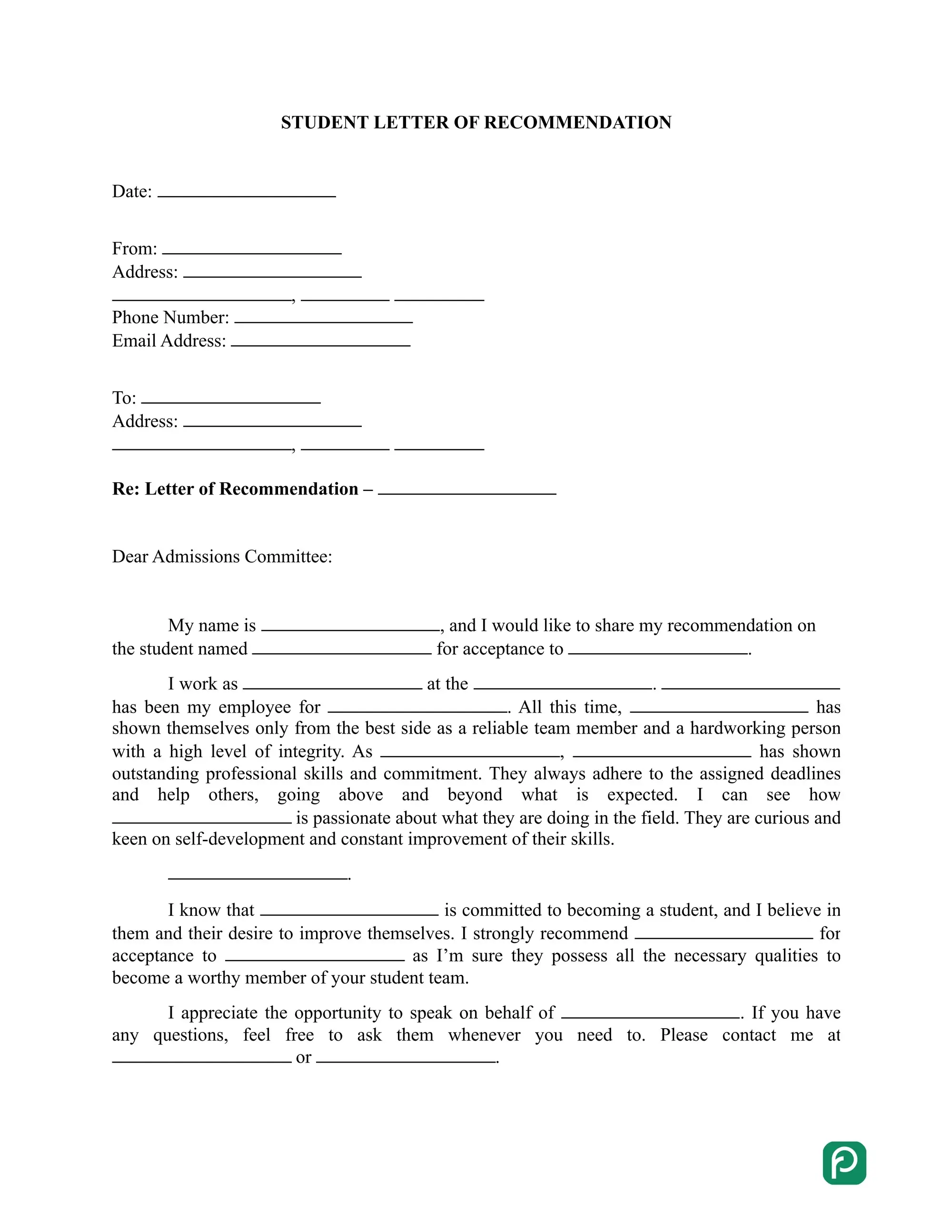
Student Recommendation Letter
To whom it may concern,
My name is _____________ (your name), and I work as a _______________ (teacher, professor, lecturer) at ________________ (the school's name). I have known _______________ (the student's name) for ___________ (the period) as (his/her) _______________ (teacher in a class, project supervisor, advisor).
_______________ (the student's name) has shown strong communication skills throughout the time we have worked together. In _______________ (a class or project), the student _______________ (a specific achievement). I recommend the student without reservation, because (he/she) has shown responsibility and care in every task given during studies.
If you have any questions or concerns, please do not hesitate to email or call me. My contact details are below.
_______________ (your signature) _______________ (the date of signing)
Email: _______________
Phone number: _____________
Student Recommendation Letter
To whom it may concern,
My name is _____________ (your name), and I am glad to recommend _______________ (the student's name), whom I have known for ________ (the period). I am a teacher at ____________ (the institution's name), and the student attended this institution from ______ to ______ (the years).
During that time we worked on several projects together, and ______________ (the student's name) showed _______________ (a skill or quality) when _______________ (a specific example). The student is a responsible worker with excellent manners who is passionate about everything (he/she) does.
I am ready to answer any questions about this recommendation. My contact details are below.
_______________ (your signature) _______________ (the date of signing)
Email: _______________
Phone number: _____________
Dear Scholarship Committee,
I am a biology teacher at Lakeview High School, and I taught Maria Lopez in two biology classes over two years. I recommend Maria for the Future Scientists Scholarship without reservation.
Maria designed her own experiment on water quality in the school pond, collected samples every week for a semester and presented the results at our science night. She asks sharp questions, helps classmates who fall behind and finishes what she starts.
Please contact me with any questions at j.carter@example.com or 555-0100.
Sincerely,
James Carter, Biology Teacher, Lakeview High School
October 2, 2026
A letter of reference works best when it points to the strengths that matter most to its reader, so the same student can need a different letter for each application. Name the program, employer or award if you know it.
| Application | Strengths to emphasize | Example to mention |
|---|---|---|
| College admission | Curiosity, effort and growth over time | A class where the student improved, or an activity the student led |
| Internship | Reliability, teamwork and practical skills | A group project, a lab or a task the student finished on time with little supervision |
| Grant or scholarship | Motivation, goals and good use of earlier opportunities | The project or field of study that the money would support |
| Graduate program | Academic ability, research and independent work | A thesis, a research paper or a class where the student stood out |
| First job | Work habits, communication and a willingness to learn | A presentation, part-time work on campus or a leadership role in a student group |
For letters aimed at one kind of program, see our templates for a college recommendation letter, a graduate school recommendation letter and a medical school recommendation letter.
Students need a recommendation letter when a reader wants a trusted view of them beyond grades and a resume, most often for internships, scholarships and grants, graduate programs and a first job after graduation.
Tip: Teachers write a stronger letter when the student shares a short list of projects, grades and goals first. Specific examples are more convincing than general praise.
A strong letter of recommendation for a student is honest, specific and sent on time, and it helps the student far more than a long or flowery one.
Precise words such as "independent", "curious", "reliable", "persistent", "thorough" and "collaborative" make a letter stronger when each one comes with an example. A word without an example reads as filler.
A college student's right to read a confidential letter placed in their education records can depend on a waiver under 34 CFR 99.12, but a person who has not attended the institution holding the letter has no right under these rules to read it there (34 CFR 99.3). Under 34 CFR 99.5(c), a current or former student who applies for admission to another component of the same institution has no rights under these rules over that component's records, unless the student is accepted and attends that component.
Under 34 CFR 99.12, a postsecondary institution does not have to let the student inspect confidential letters of recommendation placed in the student's education records after January 1, 1975, if the student has waived the right to inspect them and the letters relate to admission to an educational institution, an application for employment or an honor.
Whatever the student chooses, write a letter you would be comfortable for the student to read: honest, specific and fair.
Check the letter against this list before you hand it to the student or send it to the reader, because a careful check catches common slips such as a misspelled name.
Most fit on a single page, and many take only half a page. The letter needs room to say who you are, how you know the student, two or three strengths and how to contact you. There is no reason to pad it.
A short letter of recommendation keeps only the essentials: who you are, how you know the student, your clearest example of the student's strength, a direct recommendation and your contact details. The filled-in example above shows this shape.
Yes, a teacher can recommend a former student, as long as the letter says when and where you taught the student and sticks to the work you remember firsthand. The fill-in sample for a former student above is written for this case.
In most cases, yes. Both names describe a letter from someone who knows the student and vouches for their skills and personality. You can use either word in the heading, and the sample letters on this page work for both.
The best writer of a student recommendation letter is someone who knows the student well and has seen the student's work, such as a teacher, lecturer, professor, academic advisor or project supervisor. Such a writer can describe the student's skills with real examples instead of general praise.
Ask politely, in person or by email, and choose a teacher who knows you well and has seen your work over time. Ask well before the letter is due, and send the professor your resume, the program details and a reminder of the projects you did together.
Ask the teacher directly whether they feel able to write a positive, detailed letter. If the answer is unsure, turn to another teacher who knows your work better. A short, vague letter helps less than a detailed one from a different person.
General information, not legal or tax advice.
