
Updated:
A graduate school recommendation letter is a reference letter for a grad program applicant. The letter gives the admissions committee a first-hand account of the applicant’s academic work, research, and character. Applicants to master’s and doctoral programs ask professors, advisors, and managers for recommendation letters.
Key facts
Build Your Document
Answer a few simple questions to make your document in minutes
Save and Print
Save progress and finish on any device, download and print anytime
Sign and Use
Your valid, lawyer-approved document is ready
A graduate school recommendation letter is a signed reference from someone who has supervised or taught the applicant, written to an admissions committee. The letter describes how the applicant handled real academic or job tasks and which personal qualities helped them succeed. It gives the committee evidence that grades and test scores cannot show.
Most programs ask for several letters. Each letter works best when it adds new information instead of repeating the others: one professor may speak to coursework, a research advisor to lab work, and a manager to results on the job. The balance of academic and professional detail varies by school, so the program’s own admissions page is the place to confirm it.
A recommendation letter comes from another person, while a statement of purpose comes from the applicant. The statement of purpose explains the applicant’s goals and reasons for choosing the program in their own words. The recommendation letter confirms those goals from the outside, with examples the recommender saw first-hand. The two documents work together, so the details in both should match.
A strong grad school recommendation letter comes from someone who knows the applicant’s work well and can describe it with specific examples. A detailed letter from a professor who knows you well is stronger than a vague letter from a well-known name.
Good choices for a recommender include:
An applicant who has been out of school for some time can lean on managers and supervisors, and add one former professor where possible. Asking for a letter is a normal part of applying, and recommenders expect the request. If someone declines or is too busy, the next person on the list is the right move.
Ask recommenders who can describe specific examples of your work. A detailed letter from a professor who knows you well is stronger than a vague letter from a well-known name.
A good request for a letter of recommendation is early, polite, and specific, and it names the school, the program, and why you chose this recommender. You can make the request in person or by email.
The request works best well before the earliest due date on your list, because recommenders often write letters for many students in the same season. An early request gives the recommender time to write a thoughtful letter instead of a rushed one. Each program lists its own due date for letters, which can differ from the due date for the application itself.
A short packet gives each recommender everything needed in one place:
Use this short message to ask a recommender for help, and replace each blank with your own details.
Subject: Request for a letter of recommendation for grad school
Dear ____________ (recommender’s name),
I am applying to ____________ (program name) at ____________ (school name), and I would be grateful if you would write a recommendation for me. I valued working with you on ____________ (class, project, or job), and I believe you can speak to my ____________ (strengths).
I can send my resume, my application essay, and the due dates. Please let me know if you have time to support my application. Thank you for considering my request.
Sincerely,
____________ (your name)
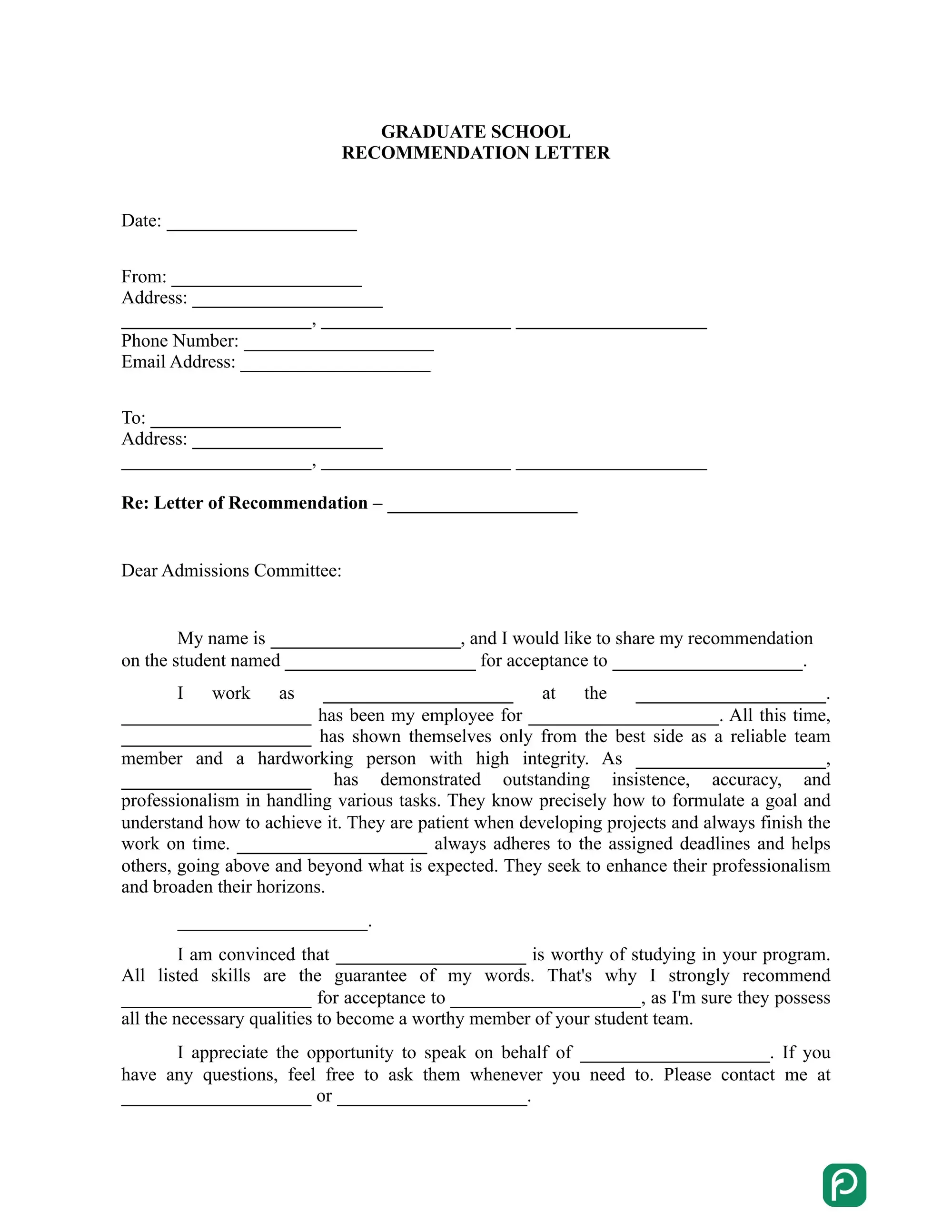
A graduate school recommendation letter includes a heading, an introduction, a main body, a conclusion, and a signature, in that order. The same structure fits a letter from a professor, an advisor, or an employer. The general letter of recommendation for a student follows the same order.
The heading gives the recommender’s name, title, and contact details, with the name and location of the institution or company they represent. A greeting such as “Dear Admissions Committee” follows, or the name of the program director when the program gives one.
The introduction says how long the recommender has known the applicant and in what role, such as instructor, thesis advisor, or supervisor. This line tells the committee how much weight the rest of the letter carries. The introduction also names the program the applicant is applying to.
The main body gives concrete evidence of the applicant’s ability: the courses they excelled in, their research or thesis work, and how they compare with other students the recommender has taught. Useful evidence includes:
The letter links the applicant’s past work to the graduate program they want to join. It shows that their path of study or work is consistent and that they have a clear goal. A sentence that names the program’s field and explains why the applicant is ready for it is more convincing than general praise.
The conclusion gives a clear overall recommendation and repeats the link between the applicant’s past work and the program. The last sentence offers to answer questions by email or phone.
The letter ends with a thank-you line, the recommender’s name, title, and signature. A letter on the institution’s or company’s letterhead carries more weight than a plain page.
Writing a recommendation letter for graduate school starts with the applicant’s packet and the program’s instructions, then moves through the five parts above. These steps are for the recommender.
A letter of about one page is a good aim. Present the person truthfully but positively: the admissions committee reads many letters and can tell a specific account from a general one.
A grad school application form often asks the applicant whether they waive the right to read the recommendation letters. Under 34 CFR § 99.12, a college or university does not have to let a student read confidential letters of recommendation about admission once the student has waived the right to inspect and review them.
The rule sets conditions on the waiver itself:
Many recommenders and committees see a waived letter as more candid, and some recommenders agree to write only confidential letters. The choice belongs to the applicant, and a frank talk with each recommender before applying helps.
A grad school recommendation letter usually goes straight from the recommender to the school, most often through the school’s online application portal. The applicant enters each recommender’s name and email in the application, and the portal sends the recommender a link.
Check each school’s website before you send anything. Schools often have their own instructions for how recommenders submit letters, so read them first.
A strong recommendation letter is specific, honest, and consistent with the rest of the application. These points apply to recommenders and to applicants who help draft a letter.
What you should do:
What you should avoid:
These three sample letters show how the structure works for different recommenders and programs. Replace each blank with your own details, then read the finished letter aloud to check that it sounds natural and specific.
Letter of Recommendation for Graduate School From a Supervisor
To whom it may concern:
As ____________ (your title) at ____________ (institution’s name), I have known ____________ (applicant’s full name) for ____________ (period). They showed outstanding qualities as a student, including ____________ (list the qualities). I am honored to recommend ____________ (applicant’s name) for your graduate program in ____________ (program name).
Throughout their time at ____________ (institution’s name), they showed a steady interest in ____________ (applicant’s area of interest). They received recognition for ____________ (what for). They also showed leadership, for example through their part in ____________ (a conference or project name).
During their studies, ____________ (applicant’s name) completed an internship at ____________ (internship name) for ____________ (period, for example a term). They also took part in an exchange program at ____________ (university name and country).
For these reasons, I highly recommend ____________ (applicant’s name) for admission to ____________ (program name). I am sure their abilities will be an asset to your program. If you would like to know more, please call me at ____________ (phone number) or email me at ____________ (email address).
Letter of Recommendation for Graduate School From an Employer
Dear Admissions Committee,
I supervised ____________ (applicant’s full name) at ____________ (company or internship name) for ____________ (length of time). I was impressed by their ability to carry out ____________ (the tasks they handled) with care and accuracy.
During this time, ____________ (applicant’s name) handled challenges under pressure well. Their main qualities are perseverance and patience, both when working alone and with colleagues. Thanks to ____________ (the applicant’s strengths), our team completed ____________ (specific tasks and goals).
____________ (Applicant’s name) balanced several goals in a working day. Although their main job was ____________ (main duty), they also took on ____________ (additional tasks). They were always reliable, and even when I was away, I knew the work would stay on course.
____________ (Applicant’s name)’s care and diligence make them one of the strongest people I have supervised. I am convinced their qualities will earn them a place among your graduate students. I would be glad to tell you more; please call me at ____________ (phone number) or email me at ____________ (email address).
Letter of Recommendation for a Master’s Program From an Employer
To whom it may concern:
I have the great pleasure of recommending ____________ (applicant’s full name) for ____________ (master’s program). They worked at ____________ (place of work) for ____________ (period) and showed persistence, accuracy, and professionalism in handling a wide range of tasks.
____________ (Applicant’s name) knows how to set a goal and how to reach it. They are patient in developing projects and always finish work on time. In our organization, ____________ (applicant’s name) worked on ____________ (type of work). In this area, they kept building their skills and attended training courses such as ____________ (full course names).
Beyond their professional skills, ____________ (applicant’s name) has strong personal qualities. They helped organize large company events, which shows real leadership. They work well with colleagues and managers, and they take responsibility for their duties.
I am convinced that ____________ (applicant’s name) is ready to study in your master’s program. If you would like to know more about their work, please contact me by phone at ____________ (phone number) or by email at ____________ (email address).
The number of letters is set by each program, and the program’s admissions page lists it. Ask one extra recommender in case a letter arrives late or a school accepts an optional letter.
Write a short email or speak to the professor in person. Name the school and the program, remind them which class or project you shared, and attach your resume and a draft of your application essay. Ask early so your recommender has plenty of time to write a thoughtful letter.
A letter of about one page is a good aim. Use an introduction, a main part, and a conclusion, and focus on specific examples of the applicant’s work instead of vague praise. Check each school’s website for advice on length.
A recommendation letter should come from the recommender, because the committee reads it as that person’s own account. A recommender may ask you for notes or a list of points to cover, and those notes help, but the letter and the signature belong to the recommender.
Yes. Sample 3 is written for a master’s program, and the other two work for many grad school applications. Fill in the blanks, remove anything that does not fit, and add real details about the applicant.
Send one polite reminder as each due date gets closer, and thank your recommender when the letter is in. If you ask several people, keep a simple list of who has sent a letter and who has not.
General information, not legal or tax advice.
