
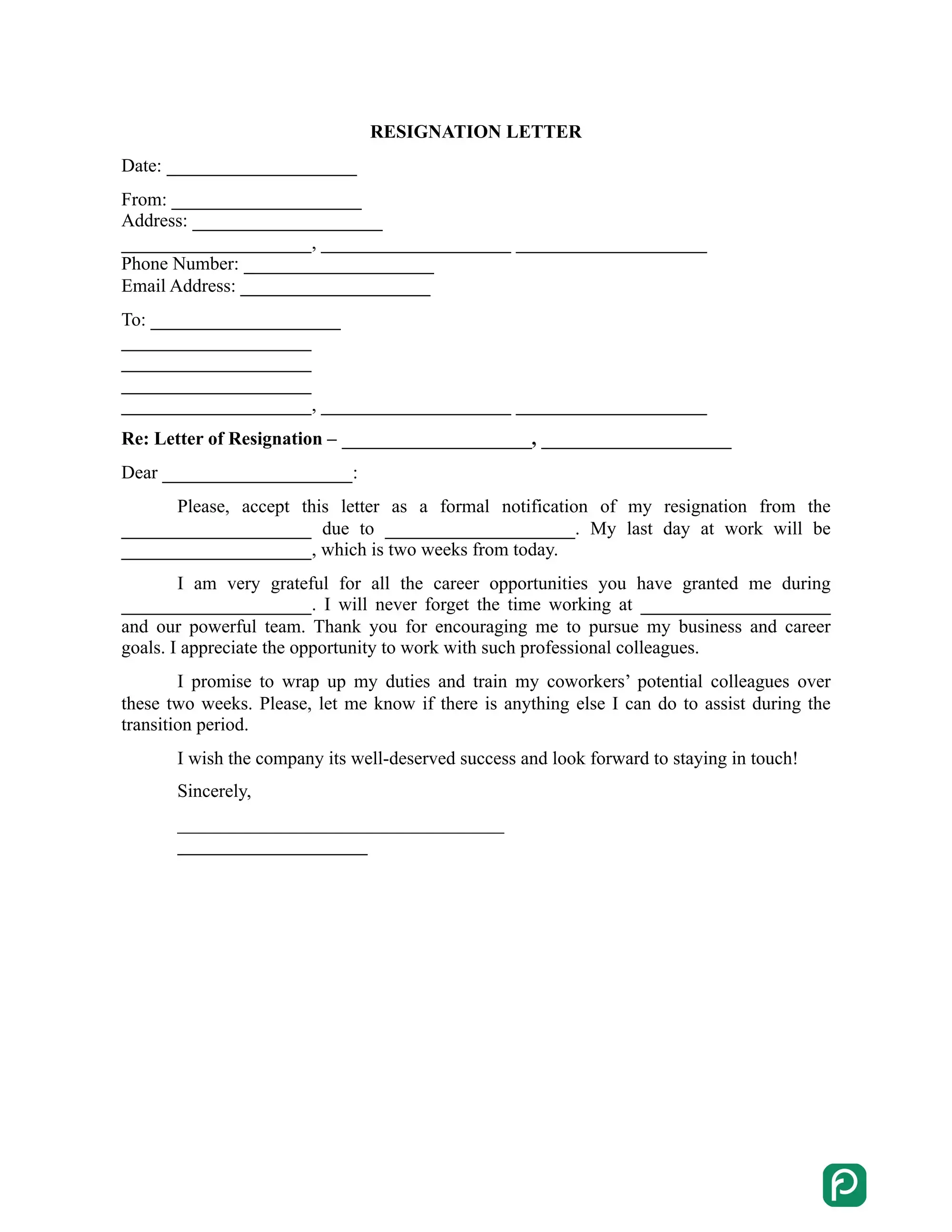
A letter of resignation is designed to officially inform your employer about your decision to quit the company. This official document is not required when you leave your job (unless your employer obliges you to write it), but it helps keep friendly relationships with your former team. With our free resignation letter template, you can prepare yours in minutes. Below you will find a step-by-step guide, tips on what to include and avoid, and two resignation letter samples.
Last Updated: October 2026. This guide is reviewed and updated regularly to reflect current law. If you notice an error or outdated information, please contact us.
Build Your Document
Answer a few simple questions to make your document in minutes
Save and Print
Save progress and finish on any device, download and print anytime
Sign and Use
Your valid, lawyer-approved document is ready
Usually, the main difference in resignation letters is the notice about the date of your last day at work. Pick the one that fits your situation. The three common types are:
With two (sometimes, four) weeks’ notice, you give your supervisor the opportunity to find or train a suitable specialist to perform your job duties. It’s a common and recommended practice to hand in a resignation letter with at least two weeks’ notice.
Short notice means that you quit the job earlier than in standard two weeks. If your employment agreement or employee handbook doesn’t provide otherwise, you can define a shorter period after which you will be leaving, for example, a week or five days. It’s useful to check whether the employment documents have special requirements on the issue.
An immediate letter of resignation means that you provide at least 24-hour notice about your departure. Sometimes, there can be circumstances beyond our control, such as health deterioration, or a person would like to change career paths or industries drastically. So, when you have to quit tomorrow, apologize and politely explain your situation to your supervisor.
Whatever the type, most resignation letters contain similar parts. If you look through some resignation letter templates, you will see that all of them have the following five paragraphs, in this order:
There are a few things to skip when you write your resignation letter:
A resignation may be a hard process for you, especially if you have good relationships with your boss and team members. These four steps help you finish your job smoothly, protect your reputation and stay on good terms.
Once you have decided to resign, it’s time to write your letter. Our resignation letter template covers the general information, and you can add anything else you need. Use the samples below for inspiration, and keep an amicable tone as you follow these steps:
Use these two samples as a starting point. Replace the names, dates and details with your own, and keep the letter short and polite. Both samples follow the same order:
11/16/2026
Company A
Sales Manager
Mary Smith
Dear Mr. Andersen
With deep regret, I am writing to inform you that I am resigning from my position as sales manager for personal reasons. My last day at work will be 11/30/2026.
I want to thank you for your encouragement and support for my career growth. I really appreciate you being my mentor and such a great leader. I am also grateful for the opportunity to work with such a powerful team. I have had a wonderful and fruitful time working at Company A.
I am determined to finish all my projects and complete all the current tasks. I understand that it can be hard to find a specialist in this position, so I can train the person who will take over my duties. Please, let me know if there is anything else I can do to assist during the transition period.
I wish the company its well-deserved success and look forward to staying in touch!
Sincerely,
Mary Smith
(signature)
11/16/2026
Company B
Assistant Manager
John Smith
Dear Mrs. Perkins
Please, accept this letter as a formal notification of my immediate resignation from the assistant manager position. I sincerely apologize for not providing notice. But due to the sudden deterioration in my health, I won’t be able to perform the work properly. My last day at work will be tomorrow, November 17, 2026.
I am very grateful for all the career opportunities you have granted me during these several years. I will never forget the time working at Company B and our support team. Thank you for encouraging me to pursue my business and career goals. I appreciate the opportunity to work with such professional colleagues.
Unfortunately, under the current circumstances, I cannot assist in the transition and hand my current tasks over to the next employee. However, please let me know if you have any questions. I will do everything in my power to help you.
I hope to stay in touch!
Kind regards,
John Smith
(signature)
A printed letter feels formal, while an email gives you a dated copy that is easy to forward to HR. Pick the format your workplace uses most, and keep the text short and polite either way. For an email, use a clear subject line and attach your letter.
Keep it to one page. A few short paragraphs are enough:
Address it to your direct manager. You can also send a copy to HR so your last day is on file.
A short, general reason is enough, such as a new opportunity or personal reasons. Skip details about conflicts or your next job, and keep the tone positive.
Select Create My Document at the top of this page and answer a few simple questions. FormsPal saves your progress, so you can finish on any device, then download and print the letter.
General information, not legal or tax advice.
