
Updated:
A resignation letter for health reasons is a formal letter you give your employer when you leave a job because of your health. Sometimes, people have to quit their jobs not because of a change in the financial condition or career change but because of their deteriorating health. In this case, your departure must be accompanied by a resignation letter for health reasons. Keep the letter short, polite and clear.
Build Your Document
Answer a few simple questions to make your document in minutes
Save and Print
Save progress and finish on any device, download and print anytime
Sign and Use
Your valid, lawyer-approved document is ready
If your health deteriorates or you become seriously ill, you may decide to leave your job. It tells your employer that you are stepping down because of your health. It gives your last working day and leaves a written record of your departure.
People do this for several reasons:
Some diseases can be cured in the initial stages if you give them sufficient attention and time. It is not known how they will affect your abilities later, so people decide to suspend their employment.
To begin your resignation process, you must serve your supervisor with a resignation letter for health reasons. You should state the reasons for your departure from work in the resignation letter template, specifying the last working day.
Submit it in person, after talking with your management, so the document backs up your words. This letter is considered your official resignation document from your job position.
Since it is an official document, you need to consider its preparation carefully. A short, polite resignation notice that includes the points below gives your employer everything needed to plan your departure and the handover of your work.
Use polite and respectful language and include these parts:
Writing it comes down to three steps: state your reason, give the date of your last working day, and hand it over. Keep each part brief and keep the tone calm and professional so your resignation is easy to act on.
This letter is an important document that informs the management of your resignation and is attached to your file. Therefore, when writing it, adhere to the generally accepted format. Use a plain business letter layout, with the header first, the body next and your signature last.
In the upper corner of the letter, add the following information:
Leave a blank line after the header, then add a respectful greeting to your addressee, such as “Dear Mr/Mrs.”
Keep the body short. One page is best, so aim for three or four paragraphs.
Cover these points:
Always stay polite. Your circumstances may change, and you may want to return to your job one day. That is harder after a bitter departure, so keep ties intact, stay professional and write concisely.
Close by thanking the management again, then sign the letter and print your name.
If you are unsure how to word a line, adapt one of these:
A short, calm conversation before you hand over your notice shows respect and avoids surprises. Choose a private moment, say that you are leaving for health reasons and give your last working day. Then hand it over and ask what happens next.
Points to cover in the conversation:
These tips reflect what experienced HR employees recommend and discourage when someone resigns for health-related reasons. Follow the dos to leave on good terms, and avoid the mistakes listed under Do not.
Dos:
Do not:
Use these three samples as a template. Sample 1 names a diagnosis, Sample 2 gives three weeks of notice, and Sample 3 keeps your diagnosis private. Replace each blank with your own details before you send any of them.
Before you copy a sample:
_________________
(Your name)
_________________
_________________
(Your address and contact number)
_________________
(The date)
_________________
(Head’s name)
_________________
_________________
(Company’s name and address)
Dear Mr/Mrs _________________ (Head’s name),
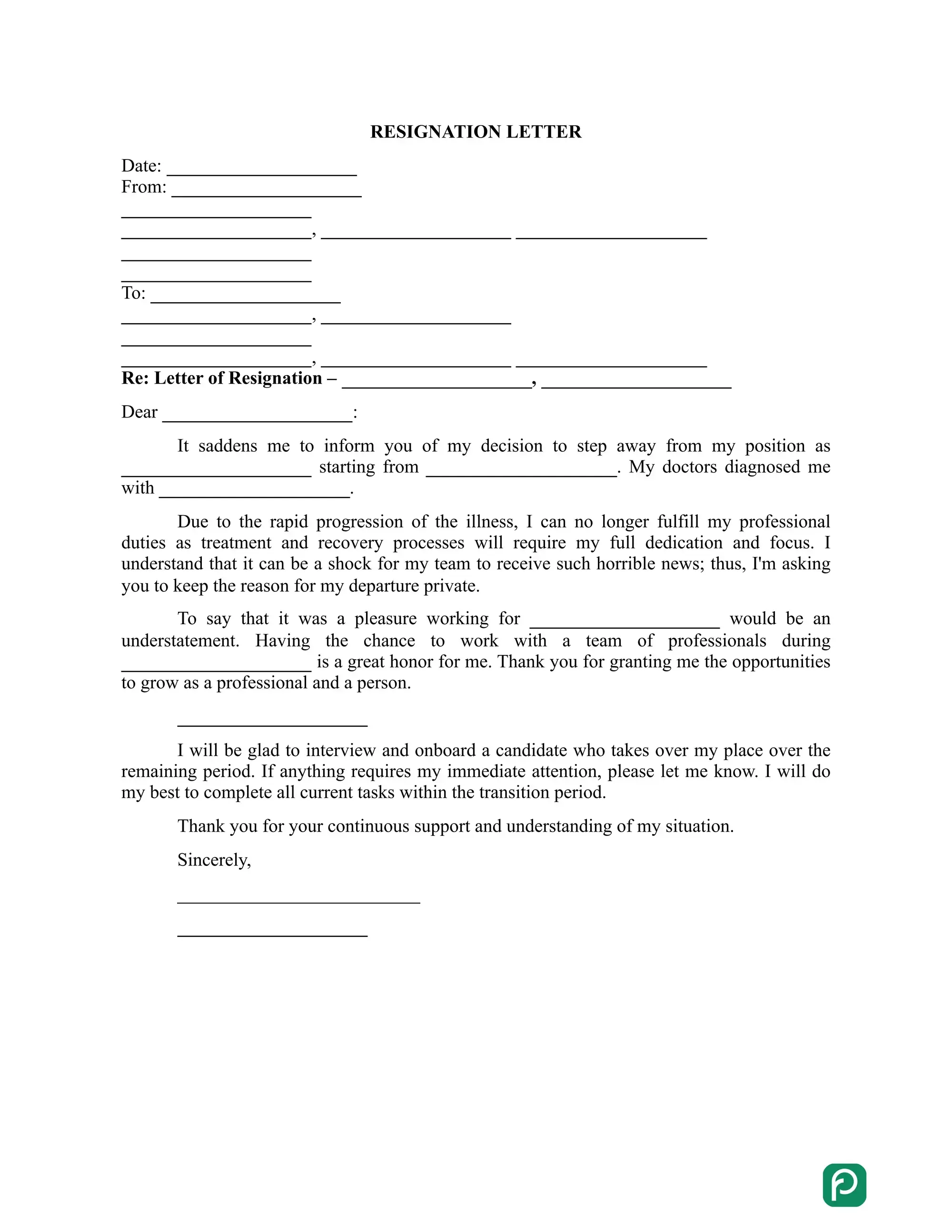
It is with deep regret that I inform you of my intention to stop working as _________________ (your position) at _________________ (name of the company) starting from _________________ (insert the date).
My doctors diagnosed me with _________________ (name of the disease). My doctor advised me to devote all my time to treatment if I want a chance at recovery. Furthermore, it has become difficult for me to carry out some of my duties due to rapid fatigue.
I want to thank you personally and all my colleagues for the time spent in the company. Working here has brought me joy and positive emotions. The experience gained while working is invaluable, and I am grateful for every minute of my work.
I have prepared a plan for all my unfinished projects to help the new employee adapt faster. If you need my help in this matter, I’d be happy to assist.
According to my employment contract, I can claim a part of the cost of my treatment. Therefore, I am asking for your assistance in this matter.
Thanks again for your support.
Sincerely,
_________________
(Your name)
_________________
(Your name)
_________________
_________________
(Your address and contact number)
_________________
(The date)
_________________
(Supervisor’s name)
_________________
_________________
(Company’s name and address)
Dear Mr/Mrs _________________ (Supervisor’s name),
With all regret, I am writing this letter to inform you of my resignation. Starting from _________________ (insert date), I will stop working for the company as _________________. The reason for my decision is severe deterioration in my health.
I was diagnosed with _________________ (indicate the disease). It is difficult for me to cope with my tasks with such a diagnosis, and I need more time to recover.
I express my deep gratitude to the company for the opportunity to work in an excellent team. I can call my work here one of the happiest periods of my life. However, I am deeply saddened by the fact that I have to suspend my professional activities.
During my next three weeks (my last) at the company, I’ll be honored to provide my assistance in training and handing over to a new employee.
According to company policy, I am entitled to a partial refund of my medication costs. Therefore, I would like to exercise this right, if possible.
Please let me know if there is anything I can do while in my position. Finally, I would like to thank you personally once again for the work provided.
Sincerely,
_________________
(Your name)
_________________
(Your name and contact details)
_________________
(The date)
Dear _________________ (Supervisor’s name),
I am writing to resign from my position as _________________ (your position), with my last working day on _________________ (insert the date). The reason is my health, and I would prefer to keep the details private.
Thank you for your support and for the opportunities I have had at _________________ (name of the company). I am glad to help with the handover of my work and with training my replacement, so that the transition is smooth.
Please let me know what steps I should take next and who I should contact in Human Resources.
Sincerely,
_________________
(Your name)
Mental health is a health reason too. If stress, anxiety or burnout is the reason you are leaving, you can write the same letter and keep the wording general, such as “for health reasons.” Keep the details to yourself if you prefer.
Helpful points when the reason is mental health:
Once it is delivered, a few practical steps keep your departure smooth. Most of them take only a few minutes, and they help you avoid loose ends with your employer during an already stressful time.
Leaving work due to an illness is perhaps one of the saddest and most difficult reasons. However, do not give in to despondency. Instead, try to leave on a positive note and leave only a good impression of yourself as a professional. Warn your superiors and devote your time to health recovery.
Read your employment contract carefully before writing a letter. Your company may have adopted policies to support critically ill employees. Check if you are eligible for such assistance and financial support.
We advise you to leave your workplace in good relations with colleagues and management. This will benefit your state of mind and leave the opportunity to return to your place after recovering.
Most people ask the same few questions when they resign for health reasons. They wonder how much to share, how much notice to give and who should get the letter.
That is your choice. Many people write only that they are leaving for health reasons and keep the details private.
Give as much notice as your health allows, so your employer has time to plan the handover. If you cannot give much, say so in the letter and offer to help in the time you have left.
One page is plenty. Use a header, three or four short paragraphs and your signature.
Hand it to your direct supervisor after you have talked with them, and send a copy to your HR department. Keep a signed copy for yourself.
General information, not legal or tax advice.

Last Updated: October 2026. This guide is reviewed and updated regularly to reflect current law. If you notice an error or outdated information, please contact us.