
A durable power of attorney (DPOA) is a legal document in which you, the principal, name an agent to manage your finances even if you become incapacitated. Your agent, also called an attorney-in-fact, does not have to be a lawyer or a family member. Not sure which type you need? Compare every kind of power of attorney form.
Last Updated: October 2026. This guide is reviewed and updated regularly to reflect current law. If you notice an error or outdated information, please contact us.
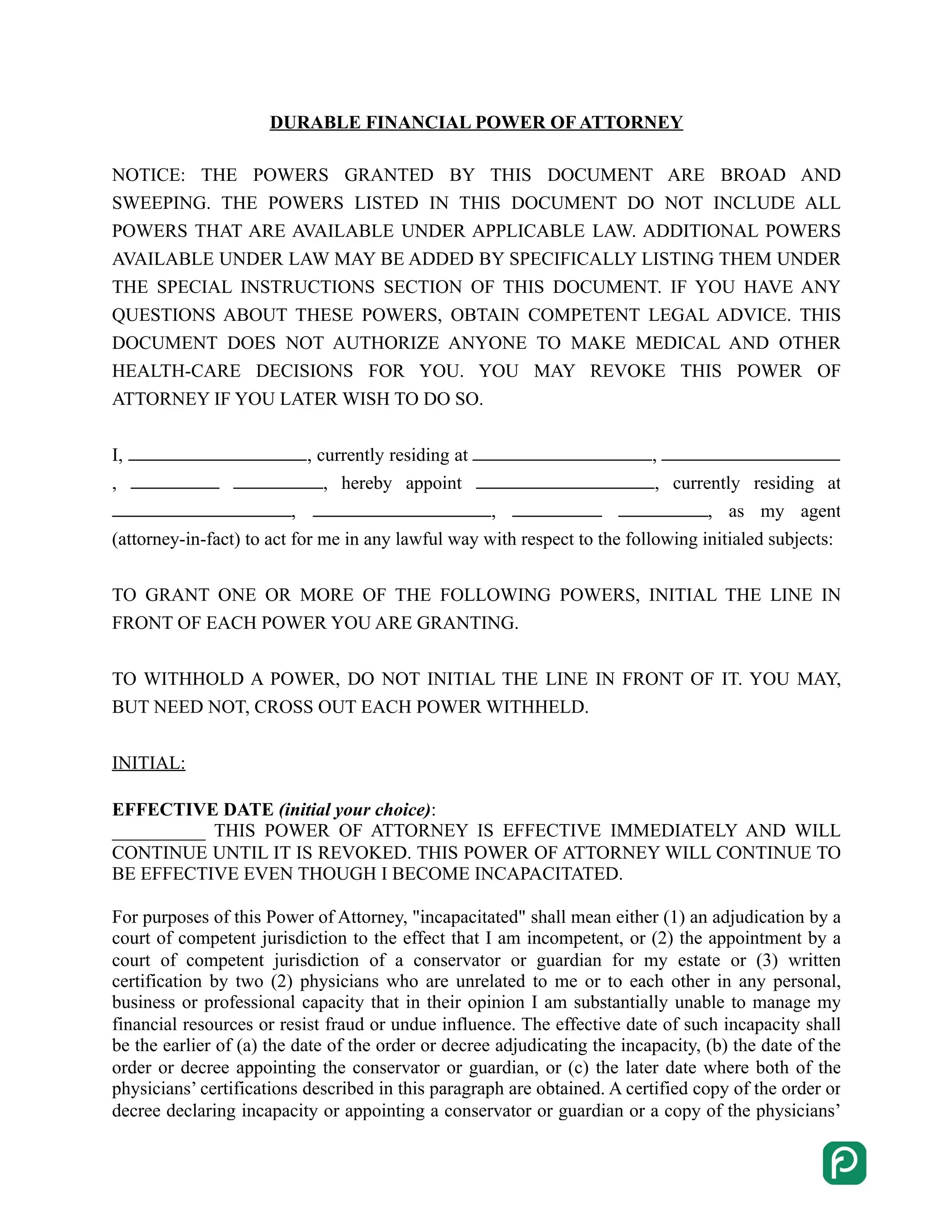
Build Your Document
Answer a few simple questions to make your document in minutes
Save and Print
Save progress and finish on any device, download and print anytime
Sign and Use
Your valid, lawyer-approved document is ready
A durable power of attorney is a document that gives someone you trust, your agent, the right to handle your money and property for you. It is called durable because it is written to keep working if you become incapacitated and cannot make those choices yourself. Our free durable power of attorney form covers finances only.
A financial agent makes decisions about the accounts and property your document covers. Depending on what you grant, that can include paying bills, signing checks, managing investments, and handling real estate. Because the agent can act when you cannot speak up, choose someone who knows how you want your finances handled.
Your agent can manage the accounts and property your document covers, which is one piece of estate planning. Depending on what you grant, you can give your attorney-in-fact access to:
You can limit the powers you give. You can also name different people to handle different matters, or add a successor agent. For example, you might let someone sign checks and pay bills without letting them change your investments or handle real estate.
A general power of attorney that is not durable ends when you become incapacitated. A durable power of attorney keeps working after that point, which is why people use it to plan ahead.
How a power becomes durable depends on the state. In many states a power of attorney is durable unless it says it ends at incapacity. In others it stays in effect only if it contains durable wording. Either way, include clear durable wording in your document.
A durable power of attorney does not last forever. It ends in situations like these:
If you want a former spouse to keep the role after a divorce, say so in the document or sign a new one.
Any adult who wants someone they trust to handle their money if they cannot may want a durable power of attorney. Incapacity can happen at any age, from an accident, a stroke, or an illness, and nobody can predict when. Without a document, your family may have to ask a court for authority to act for you.
A durable power of attorney helps in situations like these:
Naming an agent in advance lets you decide who acts for you. Talk with the people you trust about what you would want if you became incapacitated. An agent who knows your wishes is better prepared than one who has to guess.
A financial durable power of attorney does not cover medical decisions. Health care choices, such as which treatment you receive, take a separate document, and its name and rules vary by state. Our form is for finances only, so use the documents below to plan for your care.
A DNR order, short for do not resuscitate, is a medical order that tells health care workers not to start CPR if your heart or breathing stops. A physician or another clinician your state authorizes signs it, with your consent or your representative's consent. Detailed wishes about other treatment go in a living will, described below.
A health care power of attorney, also called a medical power of attorney, names someone to make medical decisions for you when you cannot. Depending on the state, it may also be called a health care proxy.
A health care agent may be asked to decide on matters such as:
The rules for this document differ by state, so check yours before you sign.
A living will describes the kind of medical care you want at the end of life. It is not the same as a last will and testament, which covers what happens to your property after you die. A living will can say when your care providers should switch to comfort care instead of trying to prolong life.
For example, many organ donors ask that doctors avoid any step that would make donation impossible. Another common choice is whether pain control matters more to you than staying mentally alert. Give your health care agent a copy of your living will and talk through your wishes with them.
Getting a durable power of attorney takes three steps. Choose your agent, decide what the document should cover, and sign it the way your state requires. Our free durable power of attorney form walks you through the choices, and the steps below explain each one in plain terms.
1. Decide Who to Designate as Your Agent

Before you create a DPOA, decide whom you will name as your agent. Talk with the person before you fill out the form, so you know they are willing to act and feel up to the job.
Ask yourself whether this person:
2. Decide Between Financial, Medical, or Both

Our form is financial. Decide which powers you want your agent to have, and share the information they need to make good choices on your behalf. You can limit the document to specific tasks.
If you want both, you need two documents: this financial durable power of attorney and a separate health care document. Each one names its own agent, and they can be the same person.
3. Sign It the Way Your State Requires and Keep Copies

Signing rules differ, so check your state's row in the table below. Depending on the state, your signature may need to be:
You do not generally file a durable power of attorney with a state office. If your agent will use it for a real estate deal, it is usually recorded with the county. Keep copies for yourself, your agent, and anyone who may need to see it.
This table shows how each state wants a durable power of attorney signed (before a notary, before witnesses, either one, or both) and names the state law behind each entry. Some states have no statutory signing rule. A notarized signature is usually easier for banks and county recorders to accept. Laws change, so check your state's page before you rely on a row.
| STATES | Signing requirements | STATE LAW |
| Alabama | Notary Public | Alabama Code, Section 26-1A-105 |
| Alaska | Notary Public | Alaska Statutes, Section 13.26.600 |
| Arizona | Notary Public and One Witness | Arizona Revised Statutes, Section 14-5501 |
| Arkansas | Notary Public | Arkansas Code Annotated, Section 28-68-105 |
| California | Notary Public OR Two Witnesses | California Probate Code, Section 4121 |
| Colorado | Notary Public | Colorado Revised Statutes, Section 15-14-705 |
| Connecticut | Notary Public and Two Witnesses | Connecticut Revised Statutes, Chapter 15c, Section 1-350d |
| Delaware | Notary Public and One Witness | Delaware Code, Title 12, Section 49A-105 |
| Florida | Notary Public and Two Witnesses | Florida Statutes, Section 709.2105 |
| Georgia | Notary Public and One Witness | Georgia Code, Section 10-6B-5 |
| Hawaii | Notary Public | Hawaii Revised Statutes, Section 551E-3 |
| Idaho | Notary Public | Idaho Statutes, Section 15-12-105 |
| Illinois | Notary Public and One Witness | Illinois Compiled Statutes, Chapter 755, Section 45/3-3 |
| Indiana | Notary Public OR Two Witnesses | Indiana Code, Section 30-5-4-1 |
| Iowa | Notary Public | Iowa Code, Section 633B.105 |
| Kansas | Notary Public and Two Witnesses | Kansas Statute, Section 58-652 |
| Kentucky | Notary Public and Two Witnesses | Kentucky Revised Statutes, Section 457.050 |
| Louisiana | No statutory signing or notary rule | No Statute |
| Maine | Notary Public | Maine Probate Code, Title 18-C, Section 5-905 |
| Maryland | Notary Public and Two Witnesses | Maryland Annotated Code, Section 17–110 |
| Massachusetts | No statutory signing or notary rule | Massachusetts General Laws, Chapter 190B, Section 5-501 |
| Michigan | Notary Public OR Two Witnesses | Michigan Compiled Laws, Section 556.205 |
| Minnesota | Notary Public | Minnesota Statutes, Section 523.01 |
| Mississippi | Notary Public | Mississippi Annotated Code, Section 87-3-105 |
| Missouri | Notary Public | Missouri Revised Statutes, Section 404.705 |
| Montana | Notary Public | Montana Annotated Code, Section 72-31-305 |
| Nebraska | Notary Public | Nebraska Revised Statutes, Section 30-4005 |
| Nevada | Notary Public and Two Witnesses | Nevada Revised Statutes, Section 162A.220 |
| New Hampshire | Notary Public | New Hampshire Revised Statutes, Section 564-E:105 |
| New Jersey | Notary Public and One Witness | New Jersey Statutes, Section 46:2B-8.9 |
| New Mexico | Notary Public | New Mexico Annotated Statutes, Section 45-5B-105 |
| New York | Notary Public and Two Witnesses | New York Consolidated Laws, Section 5-1501B |
| North Carolina | Notary Public | North Carolina General Statutes, Section 32C-1-105 |
| North Dakota | No statutory signing or notary rule | No Statute |
| Ohio | Notary Public | Ohio Revised Code, Section 1337.25 |
| Oklahoma | Notary Public; Two Witnesses for the statutory form | Oklahoma Statutes, Section 58-1072.2 |
| Oregon | No statutory signing or notary rule | No Statute |
| Pennsylvania | Notary Public and Two Witnesses | Pennsylvania Consolidated Statutes, Title 20, Section 5601 |
| Rhode Island | Notary Public | Rhode Island General Laws, Section 18-16-2 |
| South Carolina | Notary Public and Two Witnesses | South Carolina Code of Laws, Section 62-8-105 |
| South Dakota | Notary Public | South Dakota Codified Laws, Section 59-12-4 |
| Tennessee | No statutory signing or notary rule | No Statute |
| Texas | Notary Public | Texas Statutes, Estates Code, Section 751.0021 |
| Utah | Notary Public | Utah Code, Section 75A-2-105 |
| Vermont | Notary Public and One Witness | Vermont Statutes, Title 14, Section 4005 |
| Virginia | Notary Public | Virginia Code, Section 64.2-1603 |
| Washington | Notary Public OR Two Witnesses | Washington Revised Code, Section 11.125.050 |
| West Virginia | Notary Public | West Virginia Code, Section 39B-1-105 |
| Wisconsin | Notary Public | Wisconsin Statutes and Annotations, Section 244.05 |
| Wyoming | Notary Public | Wyoming Statutes, Section 3-9-105 |
Our DPOA form is designed for finances, not health care, so medical decisions need a different document. Follow the six steps below to complete the form, check each choice against your state's rules, and then sign it in front of the notary or witnesses your state requires.
1. Fill Out Personal Information About Yourself (the Principal) and your Attorney-in-Fact
Start with your own details and your agent's details. Use your full legal name, even if you go by a different name.
If you own property or spend time in another state, ask whether that state will accept your document. In some states, the law named in the document or the law of the state where you signed it decides what the document means. You can also ask a lawyer to customize the form, though you will need similar information.

2. Specify the Granted Powers
List exactly which powers you want your agent to have. If your form uses initials, initial next to each power you grant and leave the others blank. Financial forms commonly list powers such as:
Banks and other institutions may ask you to complete their own forms as well. That is separate from the DPOA, but it helps to ask about it while you are working on this one.

3. Indicate Effective Date
In many states a durable power of attorney takes effect when you sign it, unless it names a later date or event. Some states let you write it to take effect only if you become incapacitated, often called a springing power.
If you choose that, the document should say who decides that you are incapacitated, such as a physician. Without that wording, it can be unclear when your agent may start to act.

4. Choose an Alternative Agent
Name a successor attorney-in-fact in case the first agent cannot or will not serve. Enter the first agent's name and the details of the alternate.

5. Review the Information and Sign the Form
Go over your entire DPOA form before you sign it in front of the notary or witnesses your state requires. A clerical error can cause problems if you become incapacitated before it is fixed.
Once the information is correct, enter the date, write your name, and sign the document. You can update your DPOA later.

6. Sign Before a Notary or Witnesses and Share Copies
Sign the form the way your state requires, in front of a notary, witnesses, or both. Your agent may have a part too. In many states an agent accepts the role simply by acting, but a few states require the agent to sign an acknowledgment of duties before acting.
Keep copies and share them with:
If your agent will handle real estate, record the document with the county.

Choose someone you trust who understands your wishes and knows how you want your finances handled. Ask whether they are organized, willing to keep records, and likely to act the way you would. It also helps to name a successor agent.
A power of attorney ends when the principal dies. In many states, an agent or third party who acts in good faith without knowing of the death is still protected.
After death, the estate is handled under the will or the state's probate rules. A coma is not death, and a durable power of attorney continues during incapacity.
An agent can resign by giving notice. The notice usually goes to the principal. If the principal is incapacitated, it goes to a guardian or conservator or another person the state names. A successor agent named in the document may then act.
FormsPal's durable power of attorney form is free. Other costs depend on how you sign it and what you do with it. Notary fees, county recording fees, and lawyer fees vary.
Yes. An agent must act in your interest, and in some states must keep records and report to you. A court can hold an agent to account, and some states end an agent's authority after a conviction or a founded report of abuse or exploitation.
In many states it takes effect when you sign it, unless it names a later date or event. Some states let you write it as a springing power that starts only if you become incapacitated. If you choose that, say in the document who decides that you are incapacitated.
In many states it does not, unless the new document says so. Revoke the old one in writing, tell your agent and anyone who holds a copy, and keep the new document current.
General information, not legal or tax advice.
