
A Washington durable power of attorney is a written legal document that lets you, the principal, name a trusted agent to handle financial matters on your behalf under Washington’s power of attorney law, Wash. Rev. Code Chapter 11.125. It stays in effect after you become incapacitated only when the document contains the durability wording that Washington law calls for, which is what makes it durable.[1] You can use the durable power of attorney form for tasks such as banking, paying bills, or handling real property transactions when you cannot manage them yourself, and you choose exactly which powers to grant.
Last Updated: September 2026. This guide is reviewed and updated regularly to reflect current Washington law. If you notice an error or outdated information, please contact us.
Build Your Document
Answer a few simple questions to make your document in minutes
Save and Print
Save progress and finish on any device, download and print anytime
Sign and Use
Your valid, lawyer-approved document is ready
This form does not cover health care decisions. For those, use a separate medical power of attorney so you can name different people for financial and health matters if you want to.
Washington power of attorney forms – visit to get more Washington-specific power of attorney forms that you may need.
The form is called “durable” because it stays valid and effective if you become incapacitated, which in Washington happens only when the document contains the durability wording the statute calls for.[1] Having a durable power of attorney is important if you cannot take care of your matters yourself.
The durable power of attorney in Washington may become effective upon signing after two witnesses have signed it or after notarization. You will need to specify in the form whether you agree with this or want it to become effective only in case you have been proclaimed incapacitated by your medical provider. The power of attorney will stop being effective upon the death of the person who creates it or if they decide to revoke it.
Washington law requires a durable power of attorney to be signed and dated by the principal, then either acknowledged before a notary public or attested by two or more competent witnesses. The document stays valid after the principal becomes incapacitated only if it uses the words the statute sets out. Washington calls the person granted authority the agent, or attorney-in-fact, and the person who grants it the principal.
You can also name a coagent or a successor agent, who steps in only if the original agent cannot serve. As mentioned above, durable means the form's power continues even if the principal becomes incapacitated, but only if the document says so in specific terms.
This power of attorney shall not be affected by disability of the principal.
You may instead write the form so it takes effect only once you become incapacitated, sometimes called a springing power of attorney, using words such as "This power of attorney shall become effective upon the disability of the principal."[1]
Washington also treats a principal as incapacitated in certain other circumstances.
If you use witnesses instead of a notary, Washington requires at least two competent witnesses. The witnesses cannot be home care providers for the principal, or care providers at an adult family home or long-term care facility where the principal lives. They also cannot be related to the principal or the agent by blood, marriage, or state registered domestic partnership. They must sign the form in the presence of the principal and at the principal's direction.[2]
The principal must sign and date the power of attorney. The signature must be acknowledged before a notary public or another individual authorized by law to take acknowledgments, or attested by the witnesses described above. Washington law provides specific alternatives if the principal cannot physically sign. A signature is presumed genuine if the principal acknowledges it before a notary public, which is why notarization is often the simpler path.[2]
Instead of signing before witnesses, the principal may sign the document before a notary public.[2] Notarization is not the only valid option, but it gives your signature a legal presumption of genuineness, which is why many principals choose it over the witness route.
Choose your agent and successor agent carefully. Because this form can give broad authority over your finances, many principals name someone they trust completely, such as a spouse or adult child, and discuss the role with that person before signing.
| Document Name | Washington Durable Power of Attorney Form |
| Other Names | Washington Financial Durable Power of Attorney, WA DPOA |
| Relevant Laws | Washington Revised Code, Chapter 11.125 |
| Signing Requirements | Notary Public or Two Witnesses |
| Avg. Time to Fill Out | 10 minutes |
| # of Fillable Fields | 37 |
| Available Formats | Adobe PDF |
Popular Local Durable POA Forms
DPOA docs are probably the most widely downloaded ones in the USA. Take a look at some of the more requested durable POA documents.
A Washington durable power of attorney ends when the principal dies, when the principal revokes it, when its own terms say it ends, or when its purpose is accomplished. If it is not durable, it also ends when the principal becomes incapacitated. A lapse of time alone does not end the agent's authority.[3]
The agent's own authority ends separately in several situations.[3]
If the agent's authority ends because of a divorce or separation filing, it comes back immediately if that action is dismissed with both parties' consent or the petition is withdrawn.[3]
None of this happens instantly for someone who does not know about it. Termination of the power of attorney, or of the agent's authority, is not effective against an agent or another person who acts in good faith without actual knowledge of it. An act performed in good faith before that knowledge still binds the principal and their successors.[3]
If the power of attorney is not durable, the principal's incapacity does not cancel it as to an agent or other person who, without actual knowledge of the incapacity, acts in good faith under it. Signing a new power of attorney does not automatically cancel an earlier one unless the new document says so.[3]
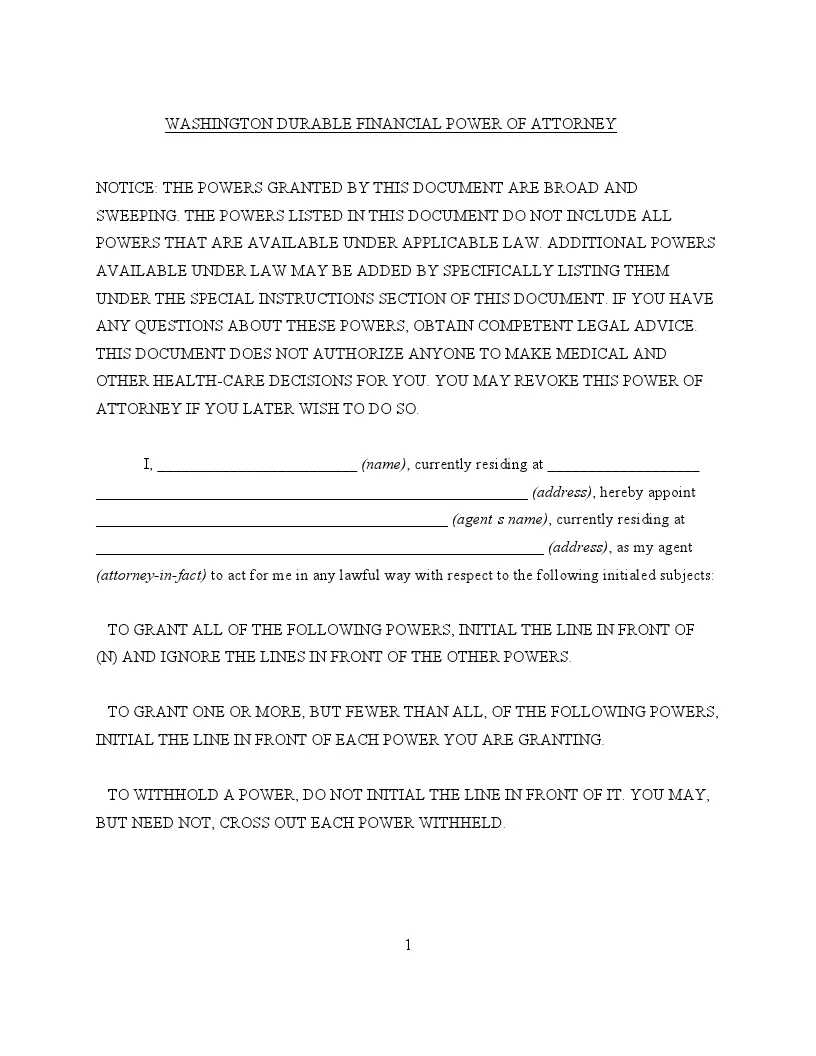
To complete your Washington durable power of attorney, use our free document builder or fill in the downloaded PDF by hand. Follow these six steps in the order the form presents them, from naming your principal and agent through completing your notary acknowledgment.
State your name and address as the principal, then the name and address of the person you are naming as your agent.


Initial the option to grant all listed powers, or initial each specific power you want your agent to have and leave the rest blank.

Initial one of the effective-date options: immediate and durable, effective on a stated date, or effective only once you become incapacitated.

If your original agent cannot or will not serve, name a successor agent and their address so someone can still act on your behalf.

Enter the date, then sign and print your name as the principal.

Sign before the notary in the acknowledgment on page 5, where the notary records the county, date, and their name and title. If you sign before two witnesses instead of a notary, follow the witness requirements described above.


This is the same Washington durable power of attorney template covered on this page, ready to download as a fillable PDF or complete online with our free document builder. Print or save it once you have entered your information, then get it signed under the requirements described above.
This page is general information about Washington durable power of attorneys, not legal advice. For advice on your situation, talk to a Washington attorney.
Unless noted otherwise, the sources below are from the Revised Code of Washington.
