
A Missouri durable power of attorney is a written document in which a principal names an agent, called an attorney in fact, to manage financial matters on his or her behalf. Under Missouri law, this authority continues even if the principal later becomes disabled or incapacitated, or if there is later uncertainty about whether the principal is alive, which is what makes the power "durable."[1]
Last Updated: September 2026. This guide is reviewed and updated regularly to reflect current Missouri law. If you notice an error or outdated information, please contact us.
Build Your Document
Answer a few simple questions to make your document in minutes
Save and Print
Save progress and finish on any device, download and print anytime
Sign and Use
Your valid, lawyer-approved document is ready
The durable power of attorney form lets a principal choose in advance who will manage his or her finances if a serious illness or accident leaves him or her unable to act.
This document covers only financial matters. Decisions about medical care and treatment belong in a separate power of attorney form, not this one.
Missouri power of attorney forms – click for more Missouri-related power of attorney documents that you might need.
This document is also called a Missouri Financial Durable Power of Attorney or an MO DPOA.
To obtain a DPA, a person has to choose someone who will represent him or her if an accident or a disease occurs. This should be an agent (a hired professional) or the closest person from your family who you trust. If you want to appoint your family member as an attorney, you can opt for your spouse, child, brother, sister, or another relative.
While signing such a document, all participants should be in good conscience. Every US state has its own rules and laws that regulate the DPA form. The requirements and the form’s length also vary. In practice, some states expect the form to be notarized or witnessed.
Missouri law requires a durable power of attorney to be signed by the principal, dated, and acknowledged before a notary in the same way a deed to real estate is acknowledged. The document does not need to be recorded to be valid between the principal and the agent, or between the principal and third parties, though recording is required for certain real estate transactions.[1]
An agent named under this power of attorney has no duty to act, whether or not the principal has become incapacitated, unless the agent has agreed in writing, expressly, to serve. Other requirements for the DPA form in Missouri are set out in Chapter 404, including Section 404.705, of the Missouri Revised Statutes.[1]
As in other states, you may delegate numerous financial matters to your agent or attorney in Missouri. Here are some of the actions that he or she will be able to conduct:
And other numerous responsibilities that include dealing with finances and properties.
In Missouri, the DPA form allows you as a principal to opt for all of the matters listed. Please note that this paper is extremely important, so choose the points wisely. Take your time to choose a trusted person from your relatives or professionals as your attorney or agent. If something is unclear, consult a lawyer.
The signing of no less than three copies of the form is recommended in Missouri, as well as in the majority of the US states. The DPA form in Missouri spans five pages.
| Document Name | Missouri Durable Power of Attorney Form |
| Other Names | Missouri Financial Durable Power of Attorney, MO DPOA |
| Relevant Laws | Missouri Revised Statutes, Sections 404.700 to 404.735 |
| Signing Requirements | Notary Public |
| Avg. Time to Fill Out | 10 minutes |
| # of Fillable Fields | 37 |
| Available Formats | Adobe PDF |
Popular Local Durable POA Forms
Durable POA forms enable you to choose a proxy who can deal with your financial affairs even if you end up incapacitated. Below are the states DPOA documents are downloaded most frequently.
This durable power of attorney ends automatically on several events set out in Mo. Rev. Stat. Section 404.717, including the principal's death, a date stated in the document, and the filing of a divorce between the principal and the agent if the two were married to each other. The principal can also revoke it directly, orally or in writing.[2]
Sometimes an event ends only the authority of the specific person named as agent, not the power of attorney itself. If the document names a successor or contingent agent, or describes how to choose one, the authority passes to that successor agent.[2]
To revoke the document, the principal or the principal's legal representative files a written notice of modification or termination with the recorder of deeds. This filing happens in the city or county where the principal or the agent lives, or where property named in the document is located.[2]
An agent who acts in good faith is not liable to the principal or the principal's successors for those acts. This protection applies as long as the agent has no actual or constructive knowledge that the principal has died or that the power of attorney has been suspended, modified, or terminated.[2]
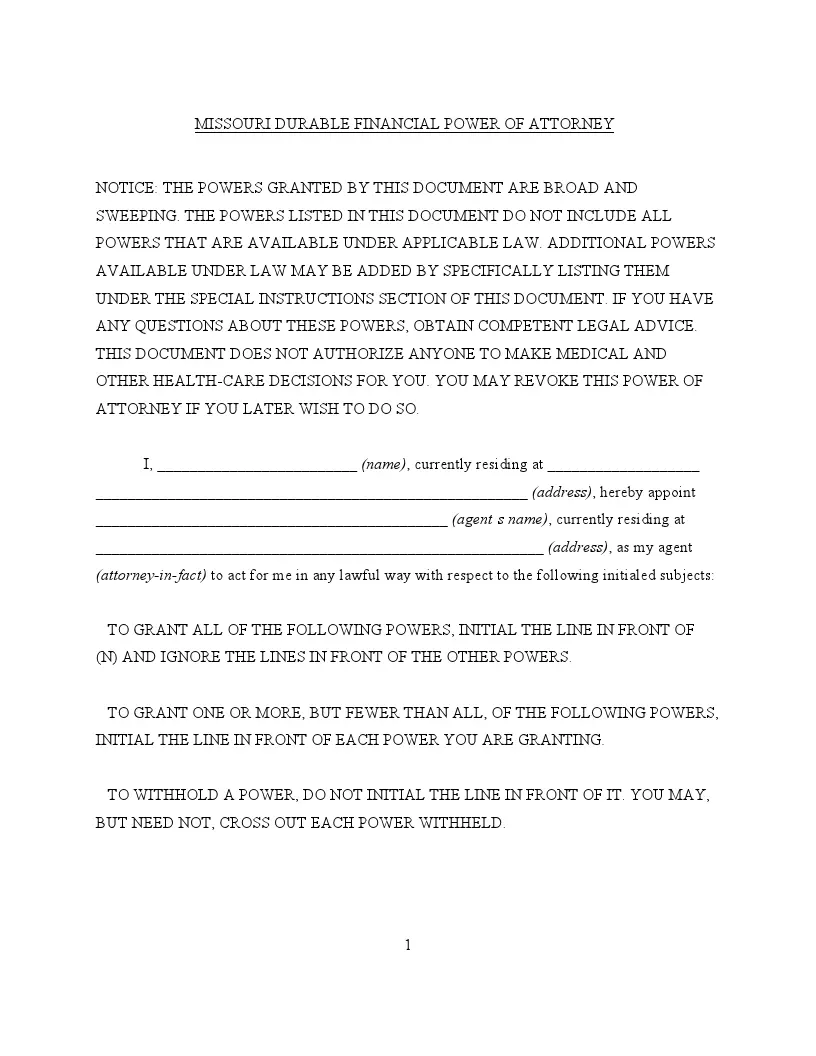
To complete this Missouri DPA form, download the template, then fill in the principal's and agent's details. Next, choose which powers to grant, add any special instructions, select an effective date, name a successor agent if desired, and sign before a notary. The steps below follow the form's own page order.
1. Download the DPA Form Template for Missouri
Completing the form starts with downloading the template. You may use our form building software that helps to download the form on your laptop easily and quickly.
2. Name the Principal and Agent
The Missouri form begins with the names and addresses of the principal and the agent, who is also called the attorney in fact. Enter your name and full address, including the county, in the first line if you are the principal, then add the state. Repeat the process for your agent in the lines that follow.

3. Choose Which Powers to Grant
The next section lists 13 lettered powers you may delegate to your agent. Initial next to each power you want to grant, or initial the line for all of the powers listed to grant every power at once. The form lets you choose from these categories:
Each power has a short description on the form to help you understand what it covers.

4. Add Special Instructions
Below the list of powers, the form has blank lines for special instructions. Add any if you have them, or leave the lines blank and continue to the next section.

5. Choose the Effective Date
The next section asks you to choose when the power of attorney takes effect. Read both options carefully and initial the blank field next to the one you want.

6. Name a Successor Agent
If you want a backup agent in case your first choice cannot or will not serve, the form lets you name a successor agent and address on page 4. This step is optional but worth completing, since Missouri law lets the authority pass to a named successor if the original agent's authority ends.[2]
7. Sign and Date the Form
As the principal, add the date and sign the form. Include the state and county where you are signing.

8. Complete the Acknowledgment Before a Notary
Missouri law requires this form to be acknowledged in the manner used for real estate deeds, so the final page has a notary acknowledgment block. Sign in front of a notary public, who then completes the county, date, and officer fields and signs.[1]


Download the free, fillable Missouri DPA template from FormsPal, or use the online builder to create and print the document in minutes. The template follows the same page order as the steps described above.
Yes. Under Mo. Rev. Stat. Section 404.705, this document must be signed by the principal and acknowledged in the same manner as a deed to real estate, which in practice means signing before a notary public.[1] The template on this page includes a notary acknowledgment block for that purpose.
This page is general information about Missouri durable powers of attorney, not legal advice. For advice on your situation, talk to a Missouri attorney.
Unless noted otherwise, the sources below are from the Mo. Rev. Stat.
