
An Indiana durable power of attorney is a written document that lets a principal name an agent to manage their finances under Ind. Code Article 30-5, and that stays in effect even if the principal later becomes unable to make decisions. It differs from a living will, which directs medical care instead of money matters. Indiana sets its own rules for signing, witnessing, and revoking the document.
Last Updated: September 2026. This guide is reviewed and updated regularly to reflect current Indiana law. If you notice an error or outdated information, please contact us.
Build Your Document
Answer a few simple questions to make your document in minutes
Save and Print
Save progress and finish on any device, download and print anytime
Sign and Use
Your valid, lawyer-approved document is ready
Below you will find Indiana’s signing requirements, what keeps the document "durable," how to revoke it, and a step-by-step guide to the free form.
Indiana power of attorney templates – click to get more Indiana-specific power of attorney templates that you might require.
An Indiana power of attorney becomes valid once it meets a short list of conditions that Indiana Code § 30-5-4-1 sets out, covering how the document is written, who it names, and how the principal signs it.[2.1] Meeting every condition below is what makes the document enforceable. The document must:
The Indiana Durable Power of Attorney Form is a legal document that gives an agent the right to manage the principal’s financial affairs. The Attorney in Fact is the trusted adult the principal names to act on their behalf, and more than one agent may be named, each carrying the authority the principal grants them. The Principal is the person who signs the document and hands over that authority.
The principal signs before either a notary public or witnesses, not both. Under Ind. Code § 30-5-4-1, the signing must happen in the presence of a notary public, or in the presence of witnesses. If someone else signs at the principal’s direction in front of a notary, the notary must state in the document that the signer acted at the principal’s direction.[2.1]
Choosing the witness option instead of a notary means signing in front of at least two witnesses.[2.3] Indiana law says any person competent to be a witness in the state may serve as a witness.[2.2]
A witness who becomes incapacitated after signing does not undo a power of attorney that was already properly executed. One exception carries real weight: if a witness has an interest in the power of attorney and the document cannot be proved without that witness’s testimony or signature, the power of attorney executed that way is void.[2.2]

Indiana also allows the principal and witnesses to sign separate paper counterparts of the same power of attorney, as long as an attorney or a directed paralegal supervises the process. That supervising attorney or paralegal must then sign a sworn affidavit of compliance, under penalty of perjury, confirming the signing was done correctly.[2.3]
Once every counterpart is signed, the principal, or someone acting at the principal’s specific direction, must physically assemble all of the separately signed pages within five business days.[2.3] Most people signing a single original in one sitting will not need this option, but it is available for signings that cannot happen in one room at one time.
The Indiana Durable Power of Attorney Form is also known as the Indiana Financial Durable Power of Attorney or IN DPOA. All three names refer to the same document.
| Document Name | Indiana Durable Power of Attorney Form |
| Other Names | Indiana Financial Durable Power of Attorney, IN DPOA |
| Relevant Laws | Indiana Code, Title 30, Article 5 |
| Signing Requirements | Notary public, or at least two witnesses |
| Avg. Time to Fill Out | 10 minutes |
| # of Fillable Fields | 37 |
| Available Formats | Adobe PDF |
Popular Local Durable POA Forms
DPOA forms are probably the most widely used ones within the USA. The following are some of the most requested durable power of attorney papers.
A power of attorney is "durable" when it keeps working even if the principal later becomes unable to make decisions. Under Ind. Code § 30-5-10-3(a), a power of attorney is not terminated by the principal’s incapacity unless the document itself says otherwise.[1.1] That single rule is what separates a durable POA from an ordinary one, which can end the moment the principal loses capacity.
Indiana also lets the principal decide when the agent’s authority starts. A power of attorney may take effect immediately, on a specific date the principal names, or only once a stated event happens.[2.4] The Indiana form used on this page turns that choice into three initialed options:
A lapse of time on its own does not end an agent’s authority, and that authority stays extended for as long as the document allows. Unless the document says otherwise, the agent may keep acting until the POA terminates under Indiana law, even if a long time has passed since it was signed.[1.2]
Revoking an Indiana POA ends the agent’s authority to act for the principal, but only once specific legal conditions are met. An Indiana power of attorney is revoked with a signed written instrument that identifies the POA being revoked, unless the document itself sets a different method.[1.3] A verbal statement alone does not revoke it under Indiana law.
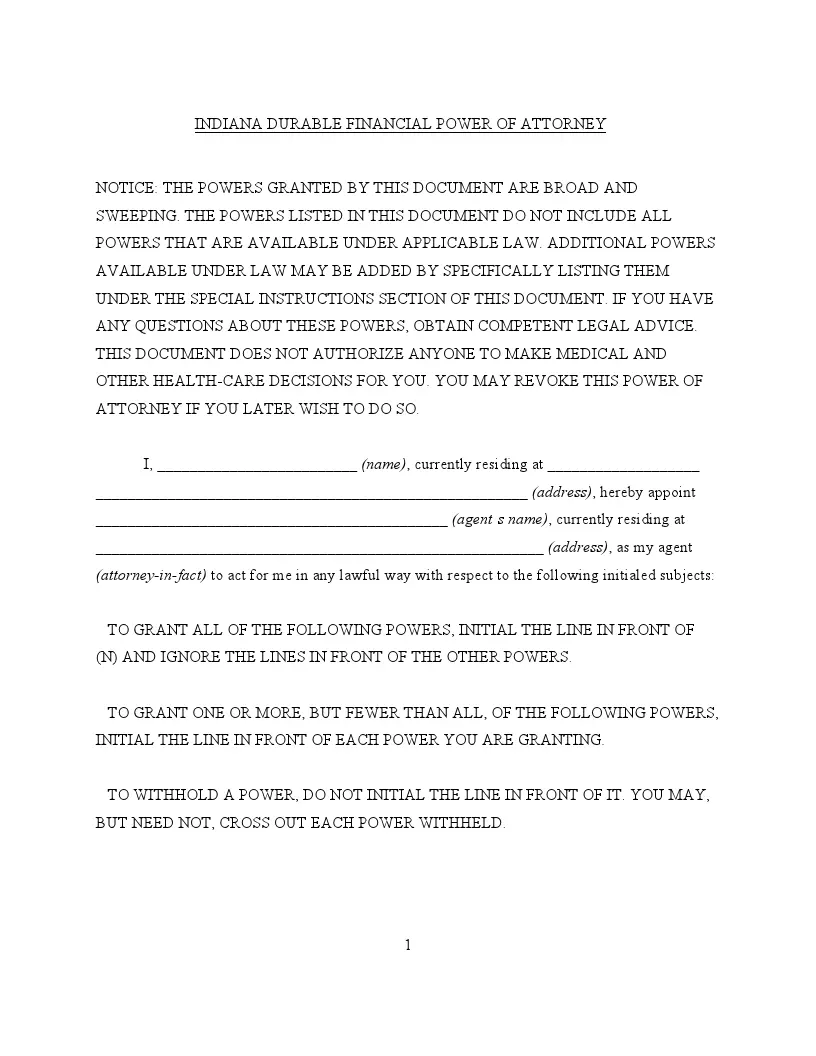
You get a durable power of attorney in Indiana by downloading the form, naming your principal and agent, initialing the powers you want to grant, and signing it the way Indiana law requires. The walkthrough below follows the form’s own seven parts in order.


The Indiana durable power of attorney form is available below as a free, ready-to-fill Adobe PDF. It includes the signing, witnessing, and notary sections described above, so you can complete it correctly the first time and start managing financial affairs for the principal.
No, not always. Indiana law gives the principal a choice: sign in the presence of a notary public, or sign in the presence of witnesses instead.[2.1] Choosing the witness option means signing in front of at least two witnesses rather than a notary.[2.3] In practice, many people still choose notarization because it is a single appointment instead of arranging two witnesses. A medical advance directive in Indiana also allows a notary or witnesses, but under a different statute, Ind. Code § 16-36-7-28, which calls for two adult witnesses or a notarial officer.[3.1]
General information, not legal or tax advice.
