
An Indiana living will is a written declaration that tells doctors whether to use life-prolonging procedures if a person becomes terminally ill and unable to communicate. It is part of the state's advance directive process. Under Indiana law, an adult of sound mind may sign one to direct that such procedures be withheld or withdrawn.[1.1]
Last Updated: September 2026. This guide is reviewed and updated regularly to reflect current Indiana law. If you notice an error or outdated information, please contact us.
A living will form is useful for anyone managing a serious illness, not only older adults. A sudden event such as a stroke or an accident can take away the ability to communicate at any age. Having the declaration in place lets your own wishes guide your care instead of leaving the decision to someone else.
Under Ind. Code § 16-36-4-8, a person may make a living will declaration if they are of sound mind and at least eighteen (18) years of age. The declaration must be in writing, dated, and signed by the declarant, or by another person in the declarant's presence and at the declarant's express direction. It must also be made voluntarily.[1.1]
The declaration uses a few terms worth knowing before you fill it out:
The declaration must be signed in the presence of at least two competent witnesses who are at least eighteen (18) years of age, or acknowledged before a notary public. A witness may not be any of the following:[1.1]
"The declarant has been personally known to me, and I believe (him/her) to be of sound mind. I did not sign the declarant's signature above for or at the direction of the declarant. I am not a parent, spouse, or child of the declarant. I am not entitled to any part of the declarant's estate or directly financially responsible for the declarant's medical care. I am competent and at least eighteen (18) years of age."
The declarant must notify their attending physician that the declaration exists. Once notified, the physician must make the declaration, or a copy of it, part of the declarant's medical records. If the attending physician has diagnosed the declarant as pregnant, the declaration has no effect during the pregnancy.[1.1]
Tip: Tell a family member, your doctor, or your attorney where you keep your signed living will so it can be found and followed when it is needed.
| Document Name | Indiana Living Will Form |
| State Form Name | Indiana Living Will Declaration |
| Signing Requirements | Two Witnesses or a Notary Public |
| Validity Requirements | Section 16-36-4-8 |
| Specific Powers | Section 16-36-4-10 |
| Avg. Time to Fill Out | 13 minutes |
| # of Fillable Fields | 48 |
| Available Formats | Adobe PDF; Microsoft Word |
| State Laws: Ind. Code §§ 16-36-4-8, 16-36-4-10 | |
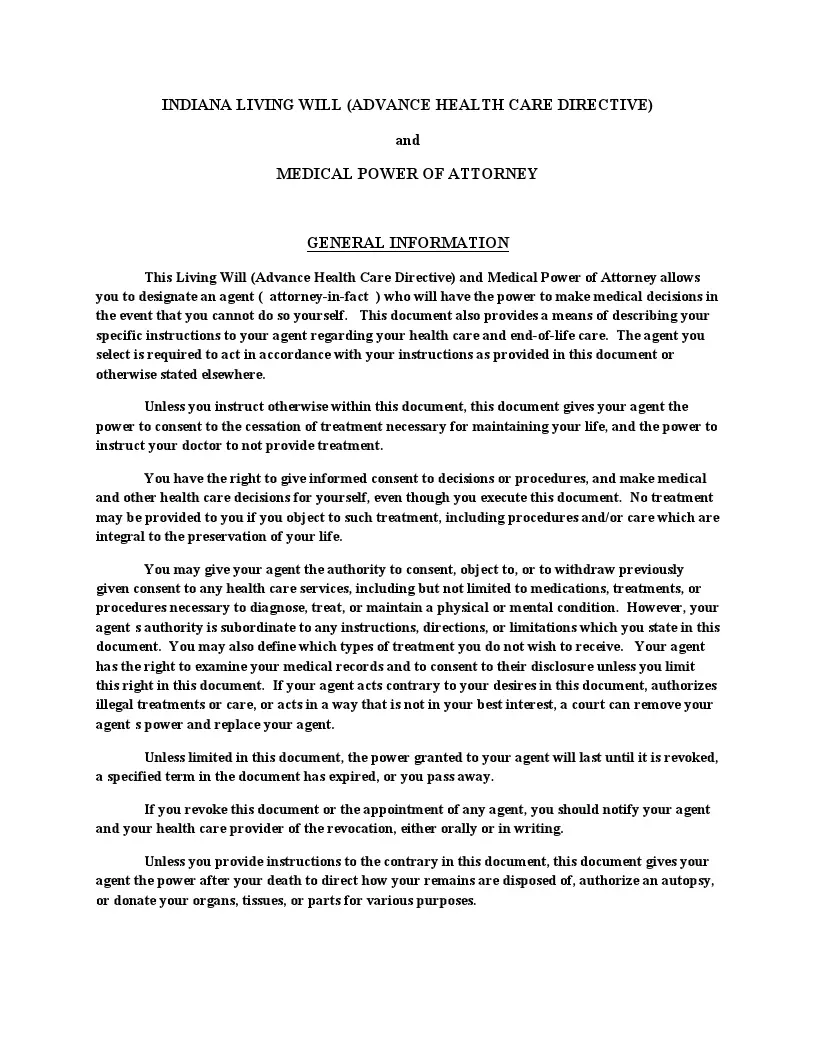
The Indiana living will and medical power of attorney packet runs eight pages with 48 fillable fields. It covers your health care wishes and, if you choose to include it, an agent to make health care decisions for you. Follow the steps below in the order the form presents them.


To make a valid Indiana living will, sign and date the declaration while of sound mind and at least eighteen (18) years old, made voluntarily and in writing. Sign it in the presence of at least two competent witnesses at least eighteen (18) years old, or before a notary public. Notify your attending physician once the declaration is complete.[1.1]
The witnesses cannot be your spouse, parent, or child, or a person who stands to inherit from you.[1.1]
No. Indiana does not require a living will to be notarized. Some people also ask whether a living will has to be notarized in Indiana, and the answer is the same either way. The declaration is valid if it is signed in the presence of at least two competent witnesses, or, as an alternative to witnesses, acknowledged before a notary public.[1.1]
General information, not legal or tax advice.
