
A Georgia living will, known under state law as an advance directive for health care, is a written document under O.C.G.A. §§ 31-32-4 to 31-32-6.[1.1] It lets you name a health care agent and record your wishes for end-of-life medical treatment for when you cannot decide for yourself.
Last Updated: September 2026. This guide is reviewed and updated regularly to reflect current Georgia law. If you notice an error or outdated information, please contact us.
You may also let your health care agent decide, after your death, on an autopsy, organ donation, body donation, and the final disposition of your body.[1.1] A living will is different from a last will and testament, which distributes property after death.
Georgia's Advance Directive for Health Care Act, O.C.G.A. §§ 31-32-4 to 31-32-6, sets the signing and witness rules for a Georgia living will. Any person of sound mind who is emancipated (a minor who is legally independent of a parent or guardian) or 18 years of age or older may sign one. Another person may sign on the declarant's behalf if they do so in the declarant's presence and at the declarant's express direction.[1.2]
The document does not need to be notarized, but it must be attested and subscribed by two qualified witnesses.[1.1][1.3]
Georgia's own witnessing rule, quoted directly from the statute below, calls you the declarant.
An advance directive for health care shall be attested and subscribed in the presence of the declarant by two witnesses who are of sound mind and at least 18 years of age.
In plain terms, both witnesses must sign the document in front of you and confirm that they saw you sign it.
A Georgia Advance Directive for Health Care requires the following:
Limits on your agent's power. Your health care agent cannot decide for you on sterilization, involuntary hospitalization, or involuntary treatment for a mental or emotional illness, a developmental disability, or an addictive disease. A physician or other health care provider directly involved in your care cannot serve as your health care agent.[1.1]
You may revoke your living will at any time. If you are receiving care in a health care facility, the revocation takes effect only once you, or someone acting at your direction, tell your attending physician.[1.4]
| Document Name | Georgia Living Will Form |
| State Form Name | Georgia Advance Directive for Health Care |
| Signing Requirements | Two Witnesses |
| Validity Requirements | Section 31-32-5 |
| Avg. Time to Fill Out | 13 minutes |
| # of Fillable Fields | 48 |
| Available Formats | Adobe PDF; Microsoft Word |
| State Laws: Georgia Code, O.C.G.A. §§ 31-32-4 to 31-32-6 | |
Georgia law also sets out an optional statutory advance directive form with four parts: naming a health care agent, stating your treatment preferences, nominating a guardian, and the signatures of you and two witnesses.[1.1] You are not required to use that exact form. Other advance directive formats, including this one, are valid as long as they meet the same signing requirements.
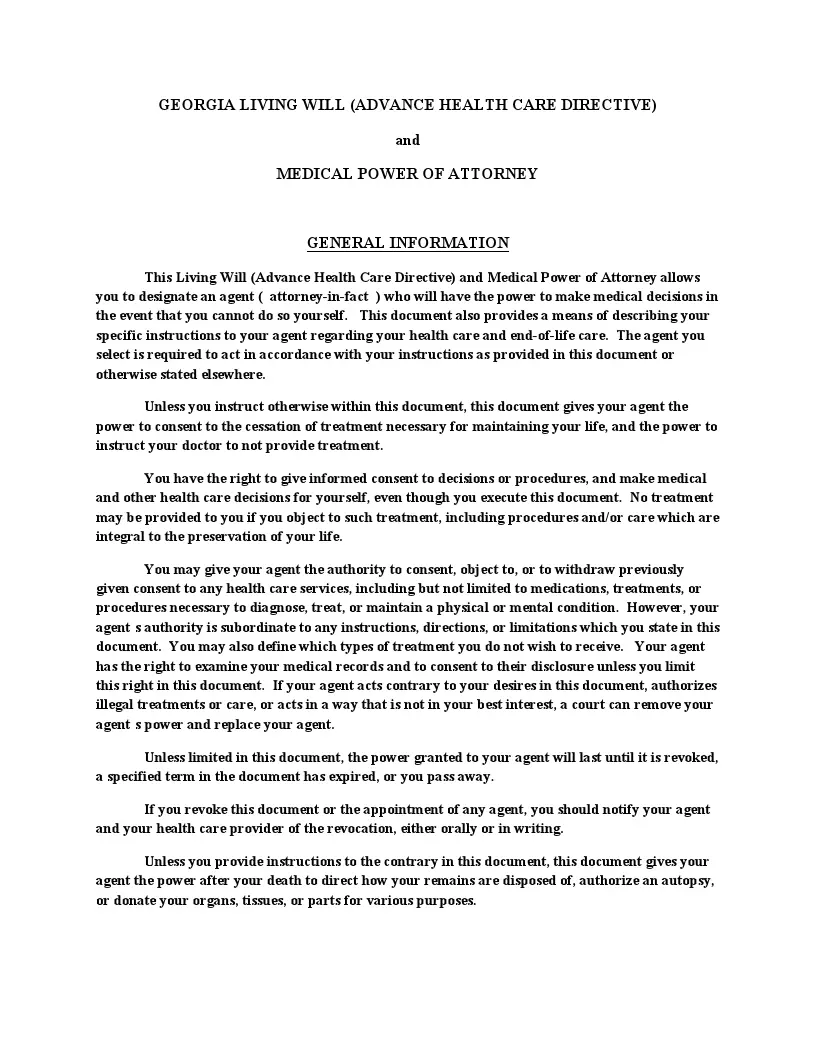
Georgia's living will and medical power of attorney form runs eight pages and asks for your health care wishes, your health care agent's details, and your signature. Fill it out in the order below, then sign it in front of two witnesses who meet Georgia's eligibility rules.[1.1]


Give a signed copy of your living will to your health care agent, your family, and your doctor, and keep the original where it can be found easily. Review it from time to time and complete a new one if your wishes change.
No. A Georgia advance directive for health care, including a living will, does not need to be notarized.[1.1] It becomes valid once you sign it, or have someone sign at your direction, in the presence of two qualified witnesses who are not entitled to inherit from you or otherwise benefit financially from your death.[1.1][1.2]

To make a living will in Georgia, first confirm you are 18 or older, or a legally emancipated minor, and of sound mind. Fill out the form, naming a health care agent and stating your treatment preferences, then sign and date it, or have someone sign at your direction, in front of two qualified witnesses.[1.1][1.2][1.3] The document does not need to be notarized.[1.1]
General information, not legal or tax advice.
