
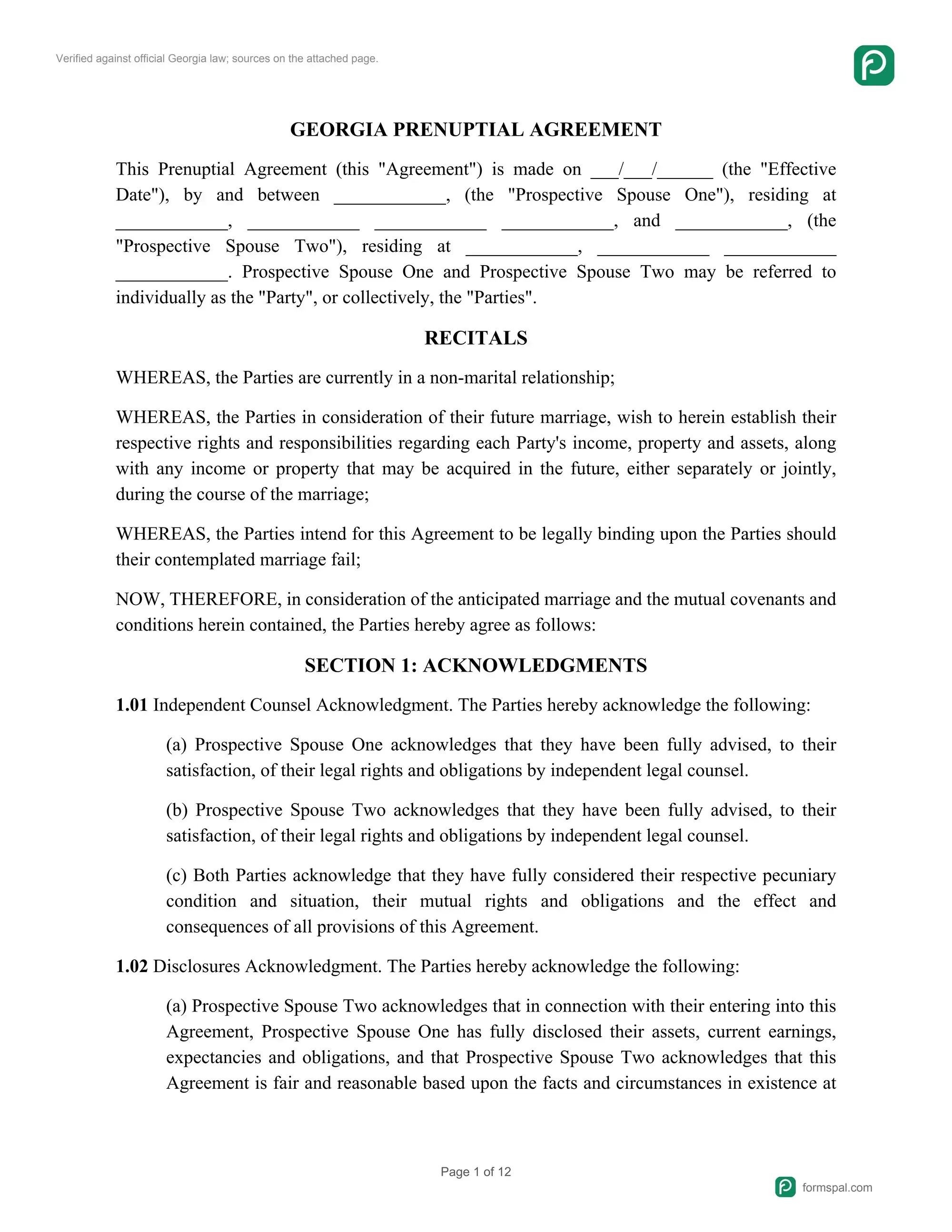
A Georgia prenuptial agreement is a written contract signed before the wedding that sets out how a couple's property, debts, and spousal support will be handled if the marriage ends. Georgia law calls it an antenuptial agreement. To be valid it must be in writing, signed by both parties who agree to be bound, and attested by at least two witnesses, one of whom is a notary public.[1]
The prenuptial agreement template sets the rules that will govern:
The agreement has no effect until the couple marries. Most Georgia prenups attach a financial disclosure from each partner listing assets and debts.
Build Your Document
Answer a few simple questions to make your document in minutes
Save and Print
Save progress and finish on any device, download and print anytime
Sign and Use
Your valid, lawyer-approved document is ready
Last Updated: September 2026 This guide is reviewed and updated regularly to reflect current Georgia law. If you notice an error or outdated information, please contact us.
Popular Local Prenuptial Agreement Forms
A Georgia prenuptial agreement is a contract two people sign before they marry that determines property rights or settles future questions such as spousal support and the division of property. The Georgia Code calls it an antenuptial agreement. Marriage itself is the consideration that supports the contract, which is why the agreement takes effect on the wedding day and not before.
Georgia prenuptial agreements are governed by Title 19, Chapter 3, Article 3 of the Official Code of Georgia Annotated, at Sections 19-3-60 through 19-3-66. Section 19-3-62 carries the signing formalities, and Section 19-3-64 confirms that a person may execute an antenuptial agreement voluntarily. Georgia also treats a signer's age generously. Under Section 19-3-61, the minority of either party does not invalidate the agreement, so long as that party is of lawful age to contract marriage.
A Georgia prenuptial agreement must meet three formal requirements. It has to be in writing, it has to be signed by both parties who agree to be bound, and the signatures have to be attested by at least two witnesses, one of whom must be a notary public.[1] An oral promise made before the wedding does not qualify, and neither does a written agreement that only one partner signed.
An antenuptial agreement shall be in writing, signed by both parties who agree to be bound, and attested by at least two witnesses, one of whom shall be a notary public.
Sign the document before the wedding. An agreement signed after the ceremony is a postnuptial agreement and follows different rules.
Yes. Georgia courts enforce antenuptial agreements that meet the Section 19-3-62 formalities and were entered into freely. The statute tells courts to read these agreements generously: antenuptial agreements are to be liberally construed to carry into effect the intention of the parties, and no want of form or technical expression invalidates them.[1] A drafting slip will not sink an agreement whose meaning is clear to the court.
Both partners must sign without coercion or duress. A court of equity can enforce the agreement at the request of the spouses, and after a spouse dies, at the request of the children of the marriage and their heirs.
Georgia prenuptial agreements cover money and property. It can define what each spouse owns separately, what the couple owns together, how debts are allocated, and what spousal support looks like if the marriage ends. It can also limit what one spouse inherits from the other, which matters when either partner has children from an earlier relationship.
A prenuptial agreement cannot decide anything about the children. Child custody and child support are set by the court at the time the question arises, based on the child's best interest and the parents' incomes, so a clause fixing either one has no effect. Terms that break state or federal law, and terms that try to reward or punish personal behavior during the marriage, are also unenforceable.
A clause setting child support or naming a custodial parent does not bind a Georgia court, even if both spouses signed it. Leave those questions out and the rest of your agreement stays intact.
A Georgia judge can set aside a prenuptial agreement even when it was signed correctly. Courts look at three things: how the agreement was obtained, whether its terms are unconscionable, and whether the couple's circumstances have changed so much that enforcing it would be unfair. A spouse challenging the agreement has to prove one of them.
Full financial disclosure is the best protection against the first ground. Attach a financial affidavit from each partner listing assets, debts, and income.
The Georgia prenuptial agreement template on this page is free to download in PDF, Word, and OpenDocument format. Georgia does not require either partner to hire an attorney to draft or sign a prenup, so a couple with straightforward finances can prepare one at no cost beyond the notary fee. Legal review costs more and is worth it when one partner owns a business, holds significant separate property, or expects a large inheritance.
Write the agreement down, exchange a full financial disclosure with your partner, and sign it in front of two witnesses before the wedding, with one of those witnesses acting as notary. Start early. A prenup signed weeks before the ceremony is harder to attack as rushed or coerced than one produced the night before the rehearsal dinner.

Other Prenuptial Agreement Forms by State