
A Georgia LLC operating agreement is a written agreement that sets out how a limited liability company is run. Georgia's LLC law defines an operating agreement as any agreement of the member or members on the conduct of the company's business and affairs.[1] This free template is written for an LLC with one member. Fill it out online, then download it as a PDF, Word or OpenDocument file.
Last Updated: October 2026. This guide is reviewed and updated regularly to reflect current Georgia law. If you notice an error or outdated information, please contact us.
Build Your Document
Answer a few simple questions to make your document in minutes
Save and Print
Save progress and finish on any device, download and print anytime
Sign and Use
Your valid, lawyer-approved document is ready
Popular Local Operating Agreement Forms
An LLC (limited liability company) operating agreement enables you to structure your financial and operating procedures with your co-owners in a manner that agrees with your business. Here are the local operating agreements our users read about most often.
Section 14-11-101 of the O.C.G.A. is part of the Georgia Limited Liability Company Act, which is Title 14, Chapter 11 of the O.C.G.A.[1] It defines an operating agreement as any agreement, written or oral, of the member or members as to the conduct of the business and affairs of a limited liability company.[1] An oral agreement among the members can be an operating agreement too. A written one is easier to prove.
"Operating agreement" means any agreement, written or oral, of the member or members as to the conduct of the business and affairs of a limited liability company.
The same section also says:
The company itself does not have to sign its operating agreement. Members still usually put their signatures on it, so each person has proof of what they agreed to.
A single-member LLC operating agreement is for an LLC with one owner. A multi-member LLC operating agreement is for an LLC with several owners. Georgia's definition covers both, because it speaks of the member or members.[1] This template is written for an LLC with one member.
A single-member LLC operating agreement records who owns the company, who manages it, and what the owner put in. Many owners write one even though there is no co-owner to share duties with. The form has a schedule for the owner's initial capital contribution.
Many multi-member LLCs also write down how profits are shared and how members join or leave. In practice, each member keeps a signed copy. If any wording is unclear, ask a lawyer to review it before signing. You can find the template for other states on our LLC operating agreement template page.
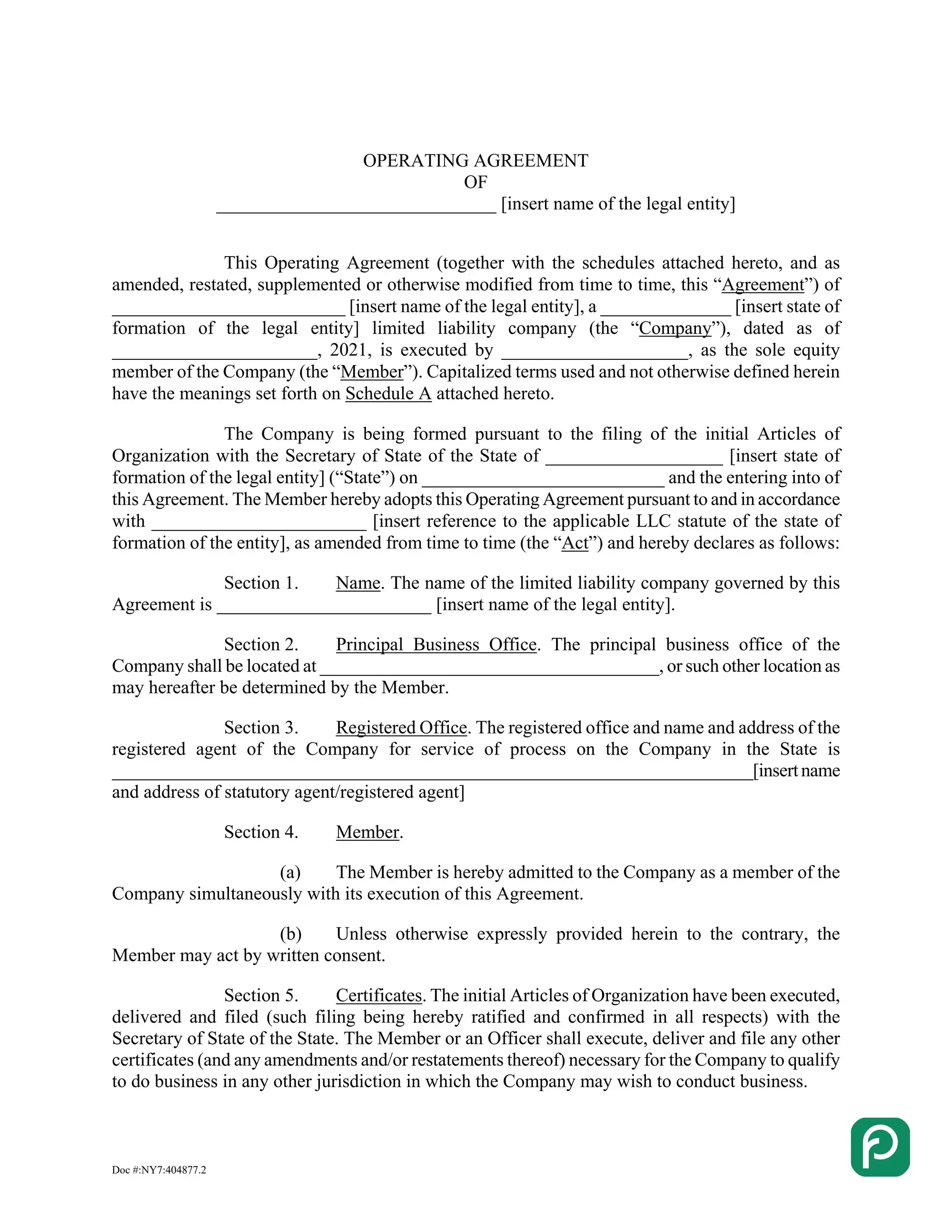
The Georgia template is a 31-section single-member LLC operating agreement with three schedules. It sets out who owns the LLC, how it is managed, how money moves between the LLC and its Member, and what happens if the Member leaves or the LLC ends. It is a ready-to-use legal document, so you only fill in the blanks. Here is what each part does:
Schedule A defines the terms used in the LLC operating agreement. Schedule B lists the Member, the Managers and the Officers. Schedule C describes the initial capital contribution. Read the whole LLC operating agreement first, because the fixed text is legally part of the contract. If you want legal advice on how it fits your plans, ask a lawyer before signing.
Gather these details before you fill out the Georgia template. Each one matches a blank in the form, and having them ready lets you complete the LLC operating agreement in one sitting, then download it as a PDF, Word or OpenDocument file:
The steps below follow the form page by page. Keep your Articles of Organization nearby, because the first page and Section 30 ask for the filing date. If you are unsure how to answer a choice on the form, such as whether the LLC has Officers, ask a lawyer before you finalize it.
The Articles of Organization are the filing that forms your LLC. Section 14-11-101 defines them as the articles filed under Code Section 14-11-203, while the operating agreement is a separate document that you do not file.[1]
The Georgia template is a single-member LLC operating agreement. Most of it is fixed text, so you only fill in the parts below, in the order they appear on the form. Complete it online, or download the PDF and fill it in with our PDF editor.
Georgia law says a limited liability company is not required to execute (sign) its operating agreement. Unless the agreement says otherwise, the company is bound by it whether or not the company signs.[1] A written agreement still gives the members one clear record of how the company runs.
Under Section 14-11-101 of the O.C.G.A., a limited liability company is not required to execute its operating agreement. The statute also counts an agreement among the members as an operating agreement, written or oral.[1] Putting yours on paper is the easiest way to show what the members agreed.
Yes. In an LLC with only one member, a writing signed by that member stating that it is intended to be a written operating agreement counts as a written operating agreement. It is not unenforceable because only one person is a party to it.[1]
General information, not legal or tax advice.

