
A California LLC operating agreement is the agreement of all the members of a limited liability company (LLC), including a sole member, about how the company is run. It can be oral, in a record, implied, or any mix of those.[1] Our free California form is a written agreement for an LLC with one member. Fill it out online or download it as a PDF, Word, or OpenDocument file.
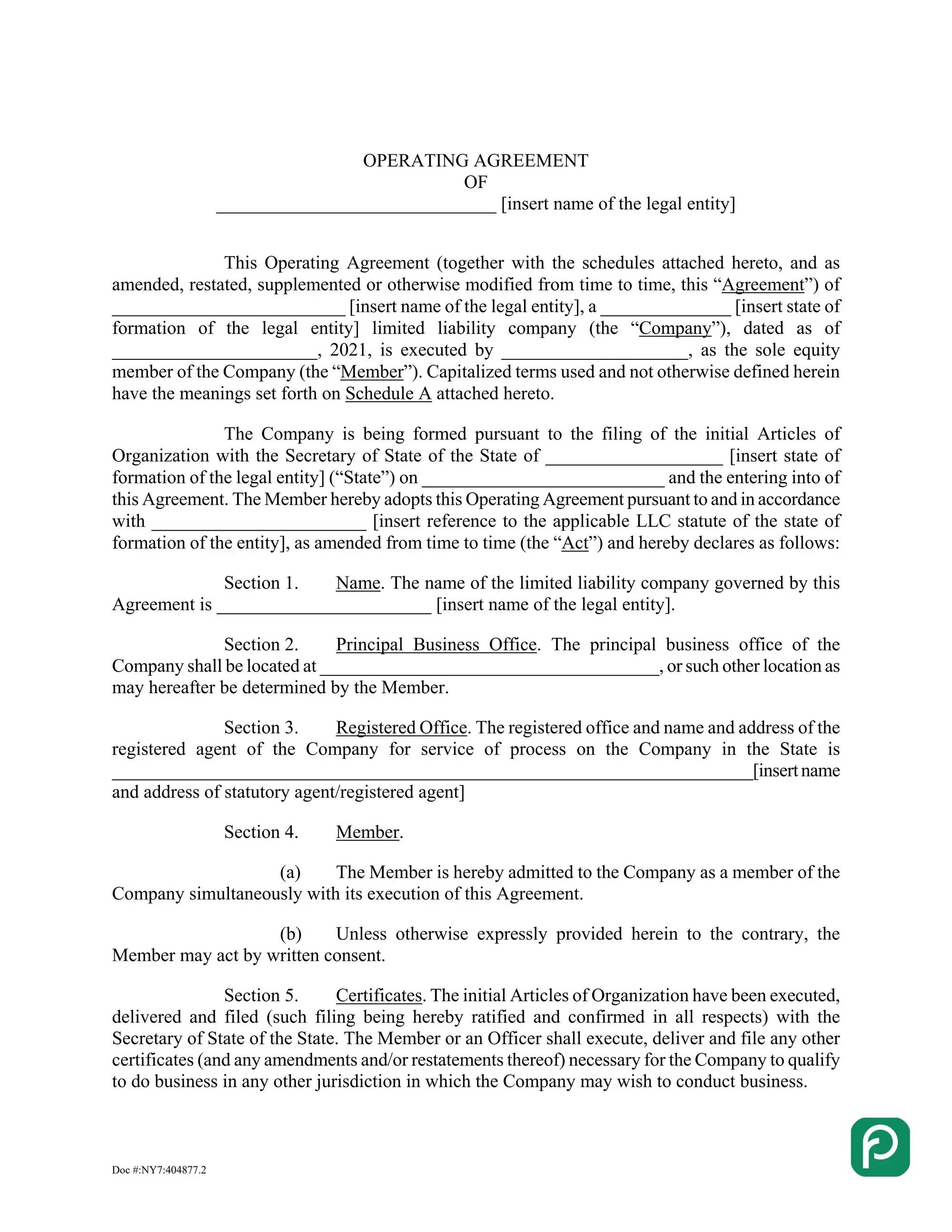
Last Updated: October 2026. This guide is reviewed and updated regularly to reflect current California law. If you notice an error or outdated information, please contact us.
Build Your Document
Answer a few simple questions to make your document in minutes
Save and Print
Save progress and finish on any device, download and print anytime
Sign and Use
Your valid, lawyer-approved document is ready
Use the builder above to fill in the California form online. You can also download the PDF, Word, or OpenDocument file and complete it with our PDF editor or by hand.
LLC operating agreements come in two types: a single-member agreement for an LLC with one owner, and a multi-member agreement for an LLC with two or more owners. California law covers both. An operating agreement of an LLC with only one member is not unenforceable just because only one person is a party to it.[1]
Whichever type you use, it is common for each member to keep a signed copy.
California also puts a record-keeping duty on the LLC itself. The company must keep a copy of a written operating agreement, and any amendments to it, at its designated office (Section 17701.13(d)(5) of the Cal. Corp. Code).[3.1]
Our California form has 31 numbered sections and three schedules. They set out the business entity’s name, office, and registered agent, the member, the company’s purposes and powers, and its management structure. The list below shows where each topic sits.
California counts an agreement that is oral, in a record, or implied.[1] In practice, a written agreement is the clearest proof of what the members agreed.
California defines an operating agreement as the agreement of all the members of an LLC, including a sole member. It can be oral, in a record (such as a signed document), implied, or any combination of those.[1] The agreement governs the members’ relations, the managers’ rights and duties, the company’s activities, and how the agreement is amended.[2.1] The sections below cover each rule.
California’s LLC statute is the California Revised Uniform Limited Liability Company Act, Sections 17701.01 to 17713.13 of the Cal. Corp. Code, enacted in 2012. Under it, you do not need to notarize an operating agreement, which can even be oral or implied.[1.1]
Section 17701.10 of the Cal. Corp. Code says the operating agreement governs four things.[2.1]
Section 17701.10 also sets limits. An operating agreement may not do any of the following.[2.1]
A matter your agreement does not cover does not go unanswered. The statute’s own words are quoted below.
To the extent the operating agreement does not otherwise provide for a matter described in subdivision (a), this title governs the matter.
In plain words, anything the agreement leaves out is governed by the default rules of California’s LLC statute.[2.2]
Section 17701.10 sets three rules about written agreements and informed consent.[2.1]
The operating agreement may alter or eliminate the indemnification (repayment of costs) the statute gives a member or manager under subdivision (a) of Section 17704.08. It may also eliminate or limit a member’s or manager’s liability to the LLC and its members for money damages. The statute lists exceptions the agreement cannot remove.[2.1]
These answers come from California’s LLC statute and cite the section behind each rule. They describe what the statute provides, not what your own LLC must do. For advice about your company, ask a California attorney.
California’s LLC statute provides for an operating agreement that governs these matters.[2.1]
What the agreement leaves out is governed by the statute’s default rules.[2.2] Our free California form gives you a starting point to fill in.
A California LLC with only one member can have an operating agreement. The statute says that agreement is not unenforceable because only one person is a party to it, and its definition includes a sole member.[1]
To the extent the operating agreement does not provide for a matter, California’s LLC statute governs that matter.[2.2] The statute also recognizes oral and implied agreements, so an LLC may have an agreement even without a written one.[1]
Popular Local Operating Agreement Forms
An LLC Operating Agreement describes the managing procedures of a Limited Liability Company. It outlines the regular processes as well as what happens if a disagreement arises or a member needs to walk out on the business. The following are some of the most demanded operating agreement documents.

Other LLC Operating Agreement Forms by State
General information, not legal or tax advice.
Unless noted otherwise, the sources below are from the Cal. Corp. Code, published by the California Legislative Information.
