
A Michigan LLC operating agreement is a written agreement about the affairs of a limited liability company (LLC) and the conduct of its business.[1.1] Our free Michigan operating agreement template is built for an LLC with one member. Fill it out online or download it as a PDF.
Last Updated: October 2026. This guide is reviewed and updated regularly to reflect current Michigan law. If you notice an error or outdated information, please contact us.
Build Your Document
Answer a few simple questions to make your document in minutes
Save and Print
Save progress and finish on any device, download and print anytime
Sign and Use
Your valid, lawyer-approved document is ready
Use the builder above to fill in the Michigan form online. For a general overview that applies in any state, read our guide to the LLC operating agreement.
This template names one Member. If your LLC has two or more members, use our multi-member LLC operating agreement template instead.
Popular Local Operating Agreement Forms
An LLC operating agreement sets guidelines for an LLC in the same way articles of incorporation govern the operation of a corporation. Below are some of the most requested regional operating agreements looked up by our visitors.
Michigan's Limited Liability Company Act (Act 23 of 1993) defines the operating agreement. It is a written agreement by the member of a one-member LLC, or between all of the members of an LLC with more than one. The agreement is about the affairs of the LLC and the conduct of its business.[1.1] The statute's own words follow.
"Operating agreement" means a written agreement by the member of a limited liability company that has 1 member, or between all of the members of a limited liability company that has more than 1 member, pertaining to the affairs of the limited liability company and the conduct of its business.
Distributions of cash or other assets are shared among the members the way the operating agreement provides. If the agreement does not provide for an allocation, the Act divides distributions in equal shares among all members, except as subsection (2) of the same section provides.[1.4]
If there is a conflict between the articles of organization and your operating agreement, the articles control.[1.2] Check that the two documents agree before you sign.
Keep the articles of organization and the signed operating agreement together with your LLC records, and compare them whenever either one changes.
Under Section 450.4203 of the Act, your articles of organization must contain the LLC's name, its purposes, the street address of its initial registered office and the name of its initial resident agent there, and a statement if managers will manage the business. They also give the LLC's duration if it is not perpetual.[1.5]
Under Section 450.4204, the LLC's name may not imply a purpose other than those its articles allow, may not contain the word corporation or incorporated or the abbreviation corp. or inc., and must be distinguishable in the state administrator's records from other entity names.[1.6]
Under Section 450.4207, the resident agent may be a Michigan resident, including a member or manager, whose business office or home is the registered office. It may also be a domestic corporation or LLC, or a foreign one authorized to do business in Michigan, with a business office at the registered office. Legal process, notices and demands against the LLC may be served on that agent.[1.7]
Most operating agreements record who owns the company, how the business is run, and how money is shared. A multi-member LLC has more to settle than a one-member LLC, but both can put their terms in writing. The list shows what owners commonly include.
Many owners also ask a licensed attorney to review the agreement before they sign. Members should all read every part of it and agree on the terms.
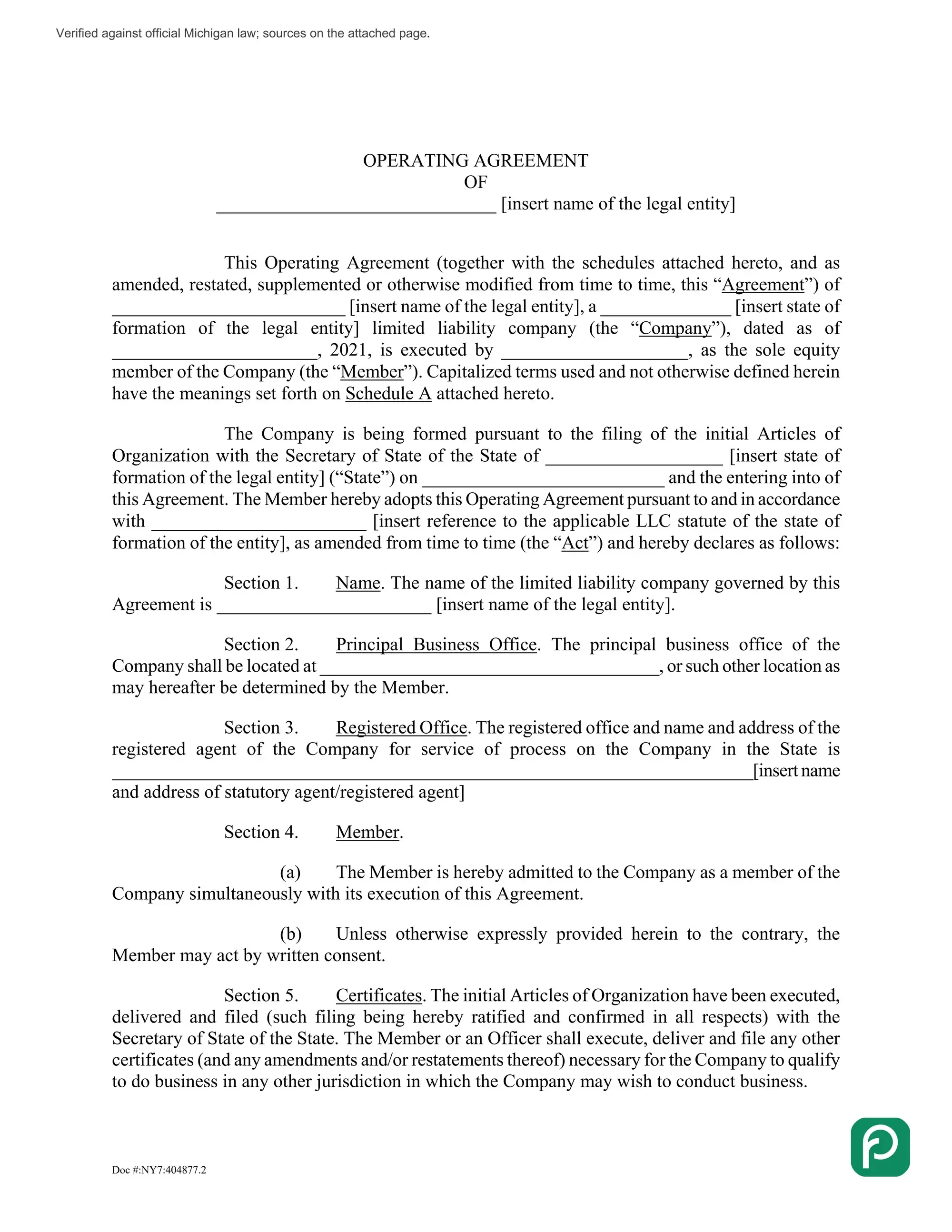
Our template is a 15-page operating agreement with 31 numbered sections and three schedules. Each section has a title, so you can see what the business agreement covers before you fill it in.
The template is one standard form for a single Member. You choose between printed options in a few places, such as purposes, Manager compensation, and Officers.
Our Michigan LLC operating agreement template is a 15-page form written for an LLC with one member. Fill in the blanks in the order they appear, from the preamble on page 1 to Schedule C on page 15. Keep the date your Articles of Organization were filed handy, because the form asks for it more than once.
These are the questions people ask most about the Michigan LLC operating agreement. Each answer cites the section of the Michigan LLC Act behind it. For advice about your own LLC, ask a Michigan attorney.
Michigan's LLC Act defines the operating agreement as a written agreement about the affairs of the LLC and the conduct of its business. It is made by the member of a one-member LLC or between all the members of a larger one.[1.1] Many owners put the terms in writing so that every member works from the same text.
The Act covers the one-member LLC directly. Its operating agreement is not unenforceable because only one person is a party to it.[1.3] If the agreement conflicts with the articles of organization, the articles control.[1.2]
Four points from the Michigan LLC Act:
General information, not legal or tax advice.

Other LLC Operating Agreement Forms by State
