
A Michigan small estate affidavit is a sworn statement made by or on behalf of a person claiming to be a deceased person's successor. The successor presents it, with the death certificate, to anyone who owes the decedent money or holds the decedent's property. Under Mich. Comp. Laws § 700.3983, that person must then pay or deliver once 28 days have passed since the decedent died. The statement must say the estate has no real property and a net value of $50,000 or less, adjusted as provided in section 1210.[1]
Last Updated: October 2026. This guide is reviewed and updated regularly to reflect current Michigan law. If you notice an error or outdated information, please contact us.
Build Your Document
Answer a few simple questions to make your document in minutes
Save and Print
Save progress and finish on any device, download and print anytime
Sign and Use
Your valid, lawyer-approved document is ready
The rules for this affidavit come from Mich. Comp. Laws § 700.3983. The statute calls for a sworn statement from the successor and the decedent's death certificate. That statement must confirm the conditions below.[1]
The estate does not include real property and the value of the entire estate, wherever located, net of liens and encumbrances, does not exceed $50,000.00, adjusted as provided in section 1210.
A false statement on the affidavit may subject the person swearing to it to prosecution for perjury. The statute requires the form to carry this notice.[1]
This affidavit is also known as the affidavit of decedent's successor. The court form PC 598 prints the full title, Affidavit of Decedent's Successor for Delivery of Certain Assets Owned by Decedent, at the top of the page. Our small estate affidavit overview links to the pages for other states. If you are also planning your own affairs, see our Michigan will template and the other Michigan affidavit forms.
You can use the sworn statement whether or not the decedent left a will. A successor is anyone, other than a creditor, who is entitled to the decedent's property under the will or under Michigan's probate code (Mich. Comp. Laws § 700.1107(g)).[2]
Vehicles have their own route. When the owner leaves no other property that requires probate, the surviving spouse or an heir may apply to the Secretary of State for the vehicle's title with proof of death (Mich. Comp. Laws § 257.236(2)).[3]
| Max. Estate | $50,000, net of liens and encumbrances, adjusted as provided in section 1210[1] |
| Time to Wait After Death | 28 days after the decedent's death[1] |
| Property Type | The estate does not include real property[1] |
| Personal Representative | No application or petition for appointment is pending or granted in any jurisdiction[1] |
| State Law | Mich. Comp. Laws § 700.3983 |

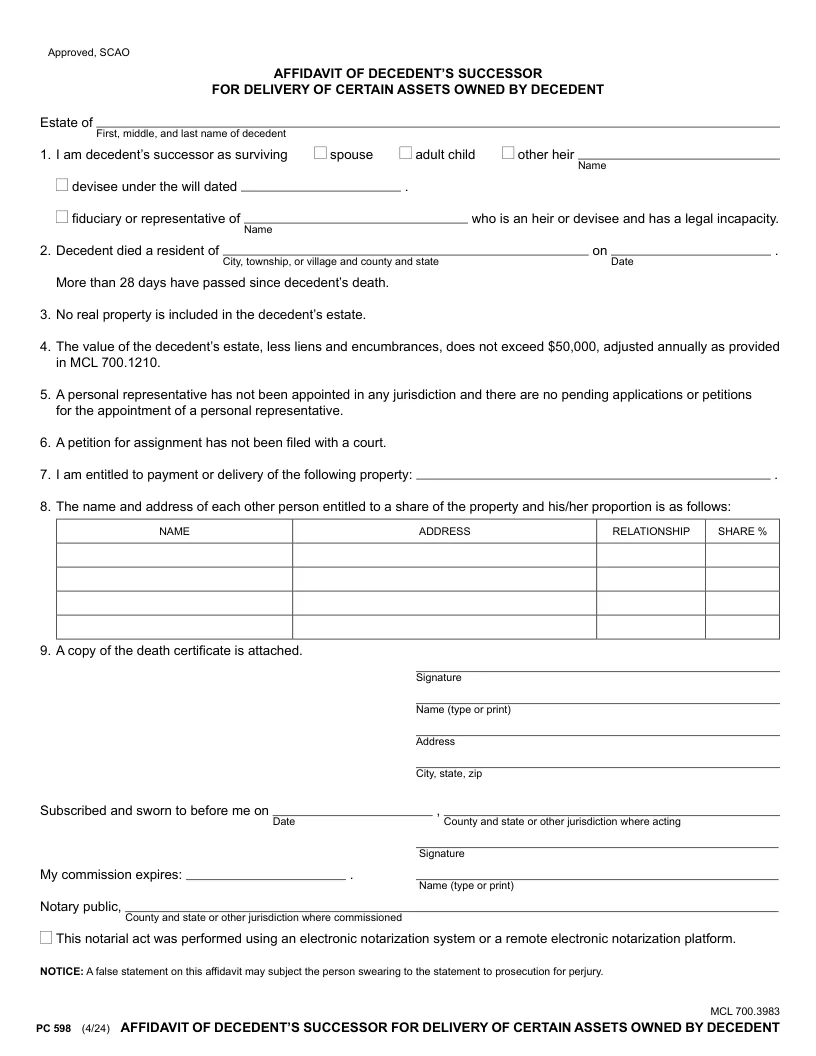
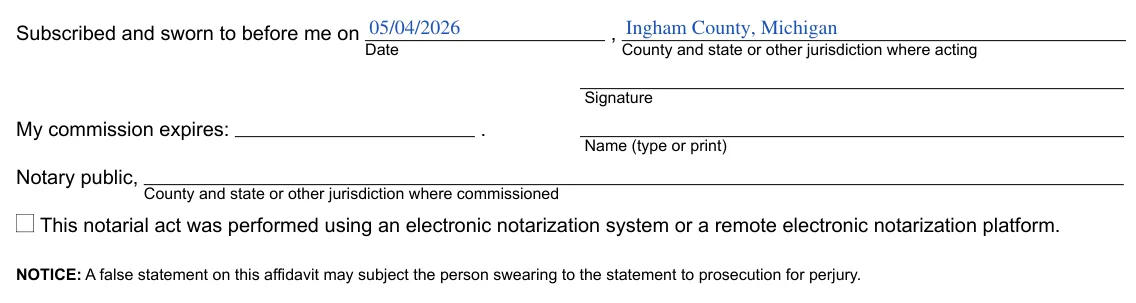
The PDF on this page is the court's current form, PC 598 (4/24), Affidavit of Decedent's Successor for Delivery of Certain Assets Owned by Decedent, approved by the Michigan State Court Administrative Office.[4] It is one page with items 1 to 9, followed by your signature and the notary block. Item 4 prints the limit as $50,000, adjusted annually as provided in MCL 700.1210, the same figure the statute sets.[1] Fill it in with our online PDF editor, or print it and write the answers by hand. Each step names the part of the form it covers.
Have these ready before you start:
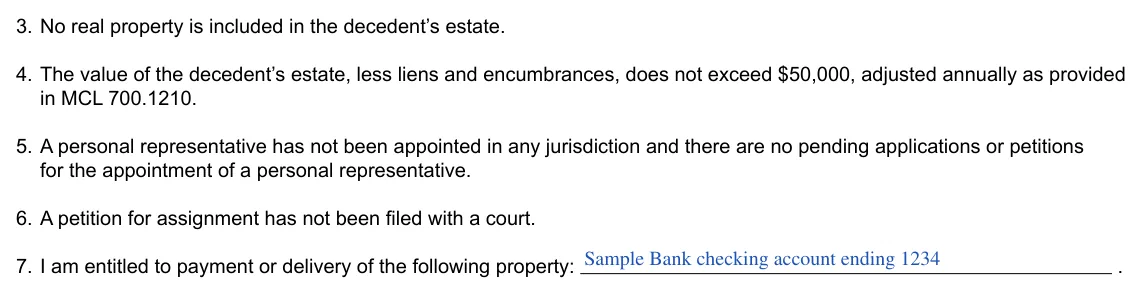
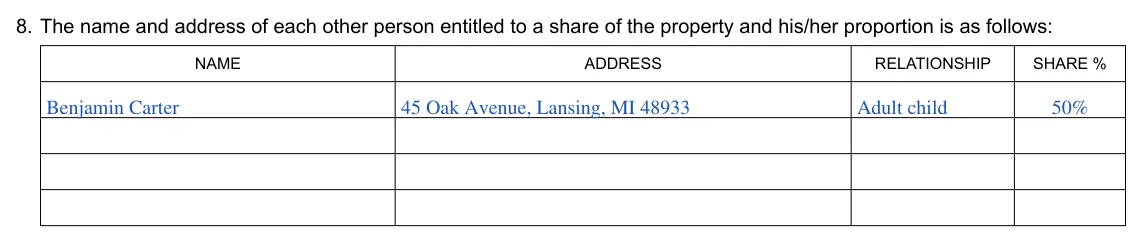
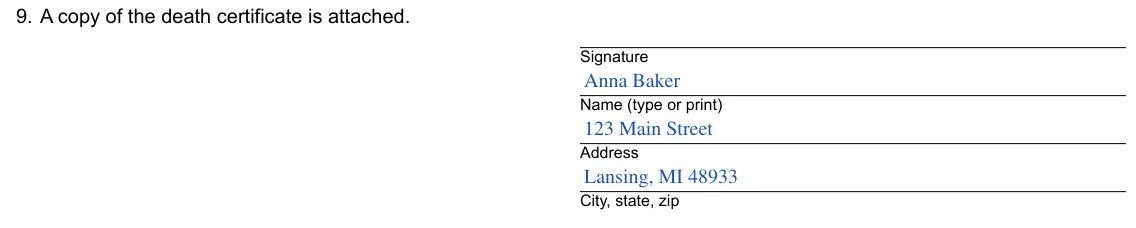
The screenshots under each step show PC 598, the official Michigan form, filled with sample entries in blue, so you can see where each answer goes. The names, addresses, dates and account details are examples only.


A few habits keep the sworn statement consistent and easy for the person holding the property to review. These are practical suggestions, not legal requirements. Use them alongside the six steps above.
Read items 3 to 6 once more before you sign. Each one is a sworn statement, and a false statement may subject the person swearing to it to prosecution for perjury.[1] If one of them is not true for the estate you are handling, pause and talk to a qualified professional before you use this form.
After the notary signs, give the sworn statement to the person who owes the decedent money or holds the decedent's property, together with the certificate the statute asks for.[1] Count the 28 days from the decedent's passing, and keep your own copy of everything you hand over.
These answers cover the dollar limit and the conditions that decide whether a Michigan estate fits the affidavit route. Each one rests on Mich. Comp. Laws § 700.3983, and the $50,000 figure is net of liens and encumbrances and adjusted as provided in section 1210.[1]
Michigan's procedure turns on the conditions in Mich. Comp. Laws § 700.3983. A person holding the decedent's property must pay or deliver it to the successor who presents the death certificate and a sworn statement, after 28 days.[1] The statement must confirm three things:
The value of the entire estate, wherever located and net of liens and encumbrances, cannot exceed $50,000, adjusted as provided in section 1210. The estate also cannot include real property.[1]
The affidavit route covers an estate worth $50,000 or less, net of liens and encumbrances and adjusted as provided in section 1210, with no real property.[1] An estate above that figure does not meet the conditions the sworn statement must confirm.
General information, not legal or tax advice.
