
A Michigan lease agreement is a written contract between a landlord and a tenant that sets the rent amount, the security deposit, and the rules for renting residential or commercial property in Michigan. The document names both parties, describes the property, and lists the duties each side agrees to follow. Michigan law, mainly Chapter 554 of the Michigan Compiled Laws, limits the deposit amount and sets deadlines for returning it. It is not a court filing or legal advice, so read every clause and understand your rights before signing.
Last Updated: September 2026. This guide is reviewed and updated regularly to reflect current Michigan law. If you notice an error or outdated information, please contact us.
Build Your Document
Answer a few simple questions to make your document in minutes
Save and Print
Save progress and finish on any device, download and print anytime
Sign and Use
Your valid, lawyer-approved document is ready
In Michigan, both parties can enter into various types of rental agreements depending on the type of rental deal at hand. They can choose from at least seven different forms:
Some of the forms differ in the period of time for which the premises are rented out. Others are meant only for tenants, for instance if a tenant wants to lease a room when they are renting the property from another owner.
To get acquainted with all specific terms of each form, or to create one of them, you are welcome to use our form-building software. It also helps make the downloading process quicker.
The Michigan lease agreement is also known as a Michigan rental agreement or a Michigan residential lease agreement. All three names describe the same document.
Before you sign a lease agreement, you should know the rules that govern the relationship between landlord and tenant in Michigan. These rules vary from state to state. In Michigan, most rules about renting appear in Chapter 554 of the Michigan Compiled Laws.
A security deposit is money a tenant gives a landlord to cover unpaid rent or damage beyond normal wear and tear. Michigan law limits how much a landlord can charge, where the money must be kept, and how quickly it must be returned after the tenancy ends.
A security deposit shall be required and maintained in accordance with the terms of this act and shall not exceed 1 1/2 months' rent.
These rules involve several separate deadlines, each counted in calendar days. Our deadline calculator can help you count the days correctly for any of the notices above.
Before entering a rented unit, most landlords give the tenant advance notice, often by phone, text, or email. They also explain the reason for the visit, such as a repair or other common maintenance issue. Giving notice helps both sides avoid disputes and confirms the visit is for a legitimate purpose. A lease agreement can also set its own notice period and list the entry rules both landlord and tenant agree to follow.
How much notice ends a Michigan tenancy depends on how the rental period is set up. A month-to-month, week-to-week, or year-to-year tenancy each carries its own statutory notice period. A tenant who has lived in the unit more than 13 months also gains an extra right to end the lease early with proper notice.
Michigan law bars most landlords from turning away an otherwise qualified applicant or current tenant because of how they pay rent. This includes turning someone away for using a housing voucher or other public assistance. The law lists the specific actions a landlord may not take based on source of income. This protection does not apply to a landlord who, counting all related entities, owns fewer than 5 rental units in Michigan.[2.3]
In Michigan, a rental deal is rarely made without providing several disclosures. When drafting a Michigan lease agreement, plan to include the following:
Truth in Renting Act notice. Every Michigan rental agreement must also state, in a prominent place in type no smaller than 12-point (or legible print with letters at least 1/8 inch), a notice in substantially this form: 'NOTICE: Michigan law establishes rights and obligations for parties to rental agreements. This agreement is required to comply with the Truth in Renting Act. If you have a question about the interpretation or legality of a provision of this agreement, you may want to seek assistance from a lawyer or other qualified person.' (Section 554.634(2)).[3.2]
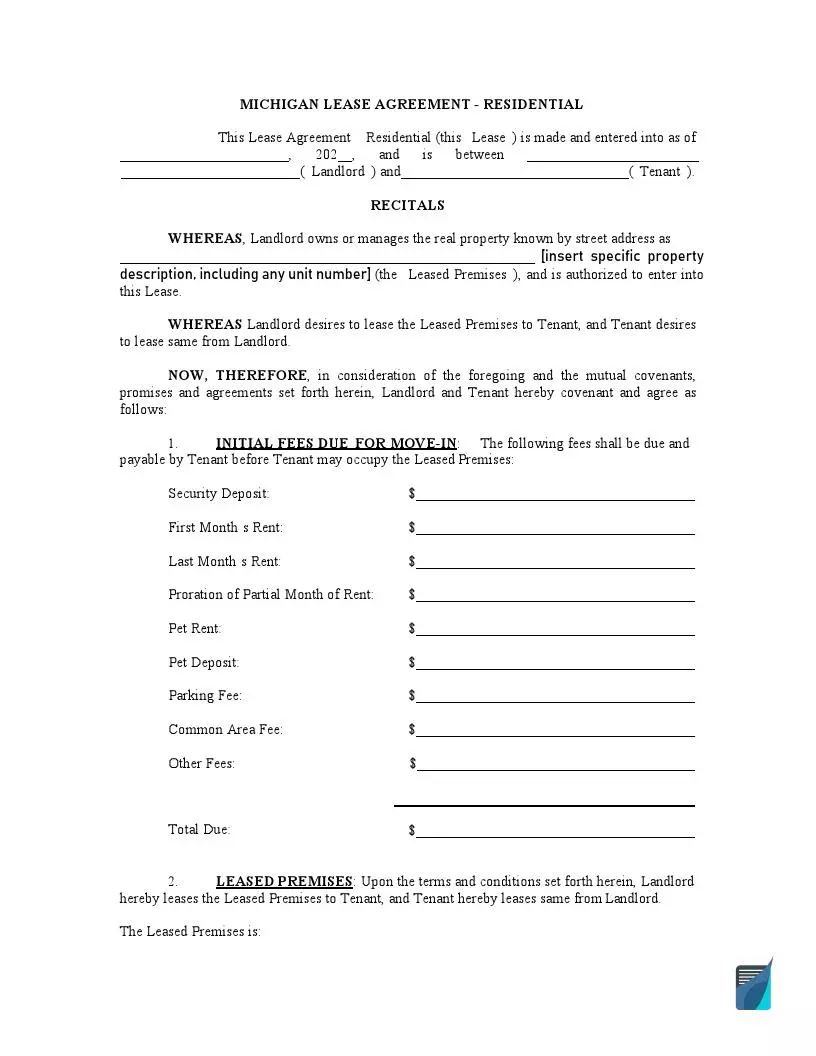
The table below summarizes the key details of this Michigan lease agreement form, including the property description, the security deposit terms, and the average time it takes to fill out.
| Document Name | Michigan Rental Lease Agreement Form |
| Other Names | MI Rental Lease, Michigan Residential Lease Agreement |
| Relevant Laws | Michigan Compiled Laws, Chapter 554 |
| Security Deposit Amount | One and a half months' rent |
| Security Deposit Return | Thirty (30) days from end of occupancy |
| Avg. Time to Fill Out | 18 minutes |
| # of Fillable Fields | 119 |
| Available Formats | Adobe PDF |
After the tenancy ends, the landlord must mail the tenant an itemized list of any damage claims within 30 days. The landlord must also send the balance of the deposit that is not being withheld for those claims.[2.8]
Michigan law does not use the word escrow. Instead, it requires a security deposit to be deposited in a regulated financial institution, unless the landlord instead provides the surety the law allows.[2.6]
A landlord has 30 days after the tenancy ends to mail the tenant an itemized list of damage claims and the deposit balance.[2.8] If the two sides still disagree, the landlord then has up to 45 days after the tenancy ends to sue for the damages claimed or return the balance.[2.11]
General information, not legal or tax advice.

Other Rental Lease Agreement Forms by State
Unless noted otherwise, the sources below are from the Mich. Comp. Laws.
