
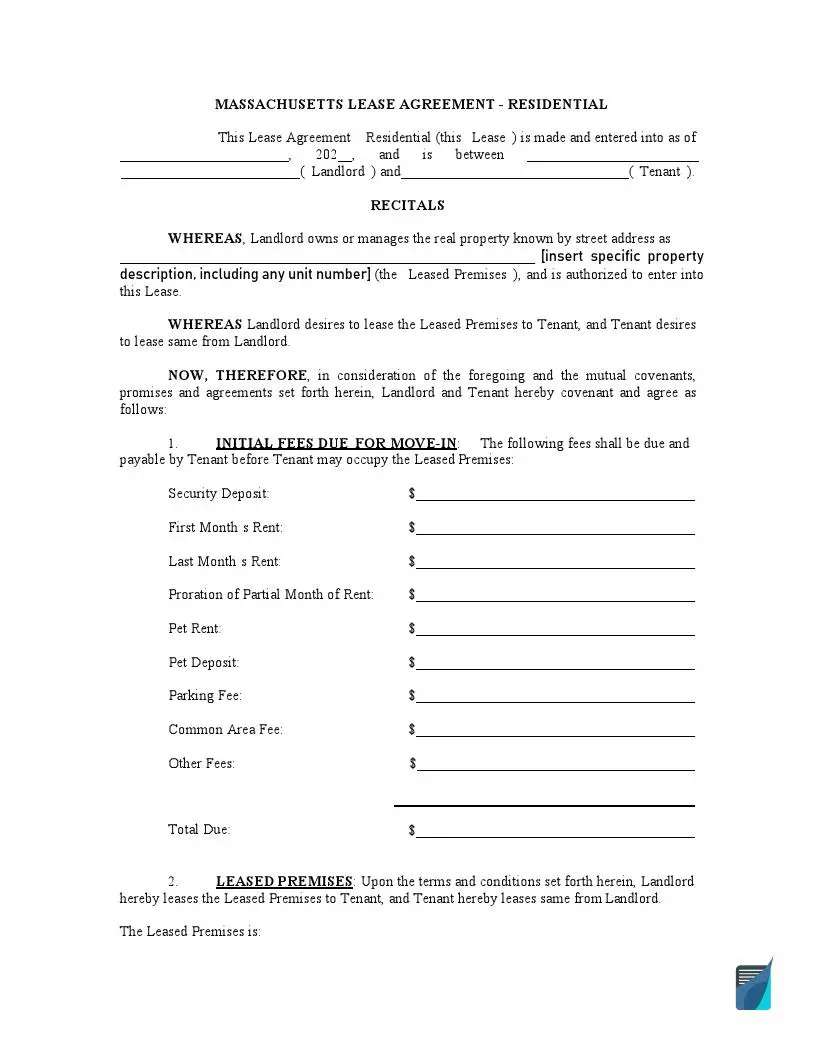
A Massachusetts lease agreement is a written contract between a landlord and a tenant. It sets the rent, the lease term, and the security deposit rules under Massachusetts General Laws Chapter 186. Landlords and tenants use it for a house, apartment, or commercial space, and it takes effect once both parties sign. FormsPal offers nine versions, including a standard residential lease, a month-to-month agreement, a sublease, and a termination letter. Pick the version that matches your rental, then fill in the property, rent, and tenant details.
Last Updated: September 2026. This guide is reviewed and updated regularly to reflect current Massachusetts law. If you notice an error or outdated information, please contact us.
Build Your Document
Answer a few simple questions to make your document in minutes
Save and Print
Save progress and finish on any device, download and print anytime
Sign and Use
Your valid, lawyer-approved document is ready
Massachusetts lease agreements must follow Massachusetts General Laws Chapter 186, which caps the security deposit at one month’s rent and requires the landlord to return it within thirty days after the tenancy ends.[2] Below you will find the most popular versions of the Massachusetts lease agreement and the rules that apply to each.
There are nine versions of the Massachusetts Rental Lease Agreement:
The first most popular version of the Massachusetts Rental Lease Agreement is the Month-to-Month Rental Agreement. Monthly rent of premises is one of the most convenient ways of renting, both for the renter and landlord. With this version of the lease, the landlord receives monthly rent payments. The renter can extend the lease one month at a time, since each payment extends it by a month.
The second most popular version of the Massachusetts Rental Lease Agreement is the Termination Lease Letter. This document lets either the renter or the landlord give written notice that they plan to end a month-to-month lease.
Sending this letter early is common practice because it gives the landlord time to find a new renter and gives the tenant time to find a new place to live. See Notice to End a Tenancy below for the exact notice period Massachusetts law requires.
Popular Local Rental Lease Agreement Forms
The Standard Residential Lease Agreement is the most common version for renting a house or apartment for a fixed term, typically one year. It sets a start and end date for the tenancy, so neither the landlord nor the tenant can end it early without cause or a mutual agreement.
A Sublease Agreement lets a current tenant rent all or part of the property to someone else for a portion of the original lease term. The original tenant stays responsible to the landlord, so most landlords require their written consent before a sublease takes effect.
Massachusetts law calls a month-to-month rental an estate at will. Either the landlord or the tenant may determine, or end, an estate at will. Doing so takes three months’ written notice given to the other party for that purpose. When the rent reserved is payable at periods of less than three months, for example once a month, the notice period is shorter. It is sufficient if it equals the interval between rent due dates or thirty days, whichever is longer.[1.2]
When a tenant does not pay rent, Massachusetts law lets the landlord end the tenancy with fourteen days’ written notice to quit for nonpayment. A tenant who has not received a similar notice in the twelve months preceding this one is not determined out of the tenancy if the tenant pays or tenders the full amount due within ten days after receiving it. Payment can go to the landlord, the landlord’s attorney, or the person the tenant customarily pays rent to.[1.1] Count that ten-day window with our deadline calculator.
Massachusetts limits a security deposit to the first month’s rent. The landlord must return it, or the balance left after lawful deductions, within thirty days after the tenancy ends. That deadline applies whether the tenancy is a tenancy-at-will or occupancy under a valid written lease.[2]
During the tenancy, the deposit stays the tenant’s money, not the landlord’s. Massachusetts calls the landlord the lessor in this statute. State law requires the lessor to hold the deposit in a separate, interest-bearing bank account located in Massachusetts. The deposit may not be commingled with the lessor’s own assets.[2]
If the landlord holds the deposit for a year or more, the law requires paying the tenant interest. The rate is five percent per year, or the lesser rate the bank actually pays.[2]
The same interest rule applies to last month’s rent paid up front. If a landlord collects last month’s rent in advance, state law requires paying five percent yearly interest on it too, starting from the first day of the tenancy.[2]
Massachusetts law also sets these deadlines for handling a security deposit:[2]
The security deposit rules do not apply to a vacation or recreational rental of one hundred days or less.[2]
Know the penalty. A landlord who fails to follow the rules on returning the deposit, holding it separately, or giving the required notices faces a real penalty. The tenant can recover damages equal to three times the deposit, plus interest, court costs, and reasonable attorney’s fees.[2]
| Document Name | Massachusetts Rental Lease Agreement Form |
| Other Names | MA Rental Lease, Massachusetts Residential Lease Agreement |
| Relevant Laws | Massachusetts General Laws, Chapter 186 |
| Security Deposit Amount | One month’s rent |
| Security Deposit Return | Thirty (30) days after vacation of tenant |
| Avg. Time to Fill Out | 18 minutes |
| # of Fillable Fields | 119 |
| Available Formats | Adobe PDF |
Massachusetts renters and landlords ask several questions most often about security deposits, ending a tenancy, and how much eviction notice the law requires. The answers below cover how much a landlord can collect up front, and what state law requires for returning the deposit, holding it, and paying interest on it.
A landlord can ask for first month’s rent, last month’s rent, and a security deposit at move-in. The security deposit portion is capped at one month’s rent under Massachusetts law. The total up-front payment is lawful as long as the deposit itself does not exceed that limit.[2]
Massachusetts security deposits are governed by Chapter 186, Section 15B of the Massachusetts General Laws.[2] The statute:

Other Rental Lease Agreement Forms by State
General information, not legal or tax advice.
