
An Illinois lease agreement is a written contract between a landlord and a tenant. It sets out the terms for renting a home or a business, including the lease period, the rent, and what each side must do. Illinois landlords and tenants work out these terms directly. Putting the deal in writing gives both sides a clear record of what was agreed, and makes the terms easier to enforce if a dispute comes up later.
Last Updated: September 2026. This guide is reviewed and updated regularly to reflect current Illinois law. If you notice an error or outdated information, please contact us.
Build Your Document
Answer a few simple questions to make your document in minutes
Save and Print
Save progress and finish on any device, download and print anytime
Sign and Use
Your valid, lawyer-approved document is ready
Illinois law shapes an Illinois lease agreement in a few specific ways: how a security deposit must be handled and returned, how much notice a landlord must give to end a tenancy, and what the lease itself should cover. The sections below explain each rule in plain language, with a citation to the Illinois Compiled Statutes for every specific requirement.
A lease for a term longer than one year must be in writing and signed to be enforceable, so a lease of one year or less may be oral (740 ILCS 80/2).[3.1]
Illinois sets clear deadlines for handling a tenant’s security deposit after the lease ends. If the landlord withholds any part of the deposit, the landlord must furnish the tenant an itemized statement of the damage allegedly caused to the leased premises, with paid receipts for the cost to repair or replace each item. That statement is due within 30 days of the date the tenant vacated the leased premises, or within 30 days of the date the tenant’s right of possession ends, whichever is later.[2.1]
If no such statement and receipts are furnished, the landlord must return the security deposit in full within 45 days of the date the tenant vacated the premises.[2.1]
When the landlord’s statement gives an estimated cost, the landlord must furnish the tenant paid receipts, or copies of them, within 30 days from the date that estimate was given.[2.1]
A landlord who has refused to supply the itemized statement, or has supplied it in bad faith, is liable for a penalty if the deposit is not returned within these time limits. That penalty equals twice the amount of the security deposit due, together with court costs and reasonable attorney’s fees.[2.1]
Counting exactly 30 or 45 days from the move-out date can be easy to get wrong. Use FormsPal’s deadline calculator to confirm the exact date each of these deadlines falls on.
If the rental property is sold, leased, transferred, or otherwise disposed of, the new owner (other than a lienholder) becomes liable to the tenant for the security deposit. That liability covers the deposit itself, any statutory interest, and any prepaid rent the tenant already paid to the prior landlord. The original landlord remains jointly and severally liable with the new owner for that deposit or prepaid rent.[2.2]
When a security deposit changes hands this way, the party that receives it must post a written notice on the primary entrance of each affected unit. That notice is due within 21 days after the transfer, and after the new holder receives the tenant’s name and address.[2.3]
Illinois sets minimum notice periods for ending certain tenancies without special agreement, under Sections 9-205 and 9-207 of the Illinois Compiled Statutes (735 ILCS 5), the Code of Civil Procedure.[1] The notice must be in writing, and how much is required depends on the type of tenancy.
Right of entry is one of the points Illinois landlords and tenants often settle directly in the lease itself. Many leases include a clause that requires the landlord to give notice before entering the rental unit for repairs, upkeep, or showings. Landlords often pick around 24 hours, except in an emergency. Spelling out the notice period in the lease helps both landlords and tenants avoid disputes over unannounced visits.
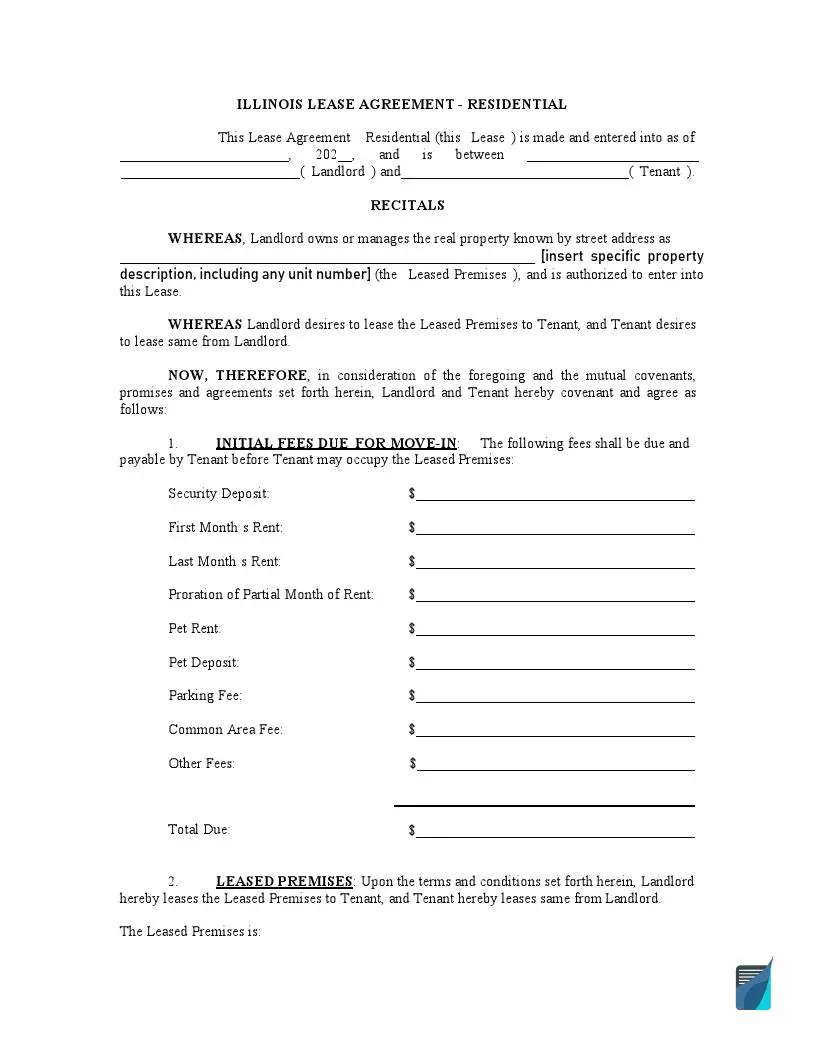
A written Illinois lease agreement works best when it spells out several key details about the rental property and the tenancy, so both landlords and tenants have a clear record of what was agreed. Address these points directly in the document:
Before signing, many landlords ask a prospective tenant to fill out a rental application, so the landlord can review the tenant’s rental history and ability to pay rent. Once both the landlord and the tenant are ready to move forward with the property, they sign the lease agreement.
There are many other paragraphs in a typical lease agreement that the landlord and the tenant usually agree on, such as whether the tenant can sublet. Reviewing the full PDF carefully before signing, for example with FormsPal’s chat with PDF tool, helps both sides catch anything unclear before it becomes a dispute. Once the PDF is filled out, print two copies so each side can sign and keep one for their records.
For housing built before 1978, federal law (42 U.S.C. 4852d) requires the landlord to disclose any known lead-based paint or lead hazards, give the tenant the EPA lead hazard pamphlet, and include a Lead Warning Statement in or attached to the lease before the tenant is bound.[4.1]
| Document Name | Illinois Rental Lease Agreement Form |
| Other Names | IL Rental Lease, Illinois Residential Lease Agreement |
| Relevant Laws | Illinois Compiled Statutes, 765 ILCS 710/1 |
| Security Deposit Return | Thirty (30) days (if deductions), or forty-five (45) days (if no deductions) |
| Avg. Time to Fill Out | 18 minutes |
| # of Fillable Fields | 119 |
| Available Formats | Adobe PDF |

Other Rental Lease Agreement Forms by State
These are the questions Illinois landlords and tenants ask most often about lease agreements, security deposits, and notice periods. Each answer below is drawn from the Illinois Compiled Statutes and cited in the Sources section at the end of this guide.
Illinois law requires a landlord who withholds any part of a security deposit to send the tenant an itemized statement of the damage and repair costs, with receipts. That statement is due within 30 days of move-out, or of the date the tenant’s right to possession ended, whichever is later. If that statement is not sent, the full deposit is due back within 45 days of move-out.[2.1]
Thirty days is the deadline for the itemized statement, not automatically for the money itself. A landlord who refuses to provide that statement, or provides it in bad faith, is liable for a penalty if the deposit is not returned within the time the law allows. That penalty equals twice the amount of the deposit due, plus court costs and reasonable attorney’s fees.[2.1]
A landlord who is withholding part of the deposit has 30 days to send an itemized statement of damage and costs. That deadline runs from move-out, or from the date the tenant’s right to possession ended, whichever is later. If no such statement is sent, the full deposit is due back within 45 days of move-out.[2.1]
Yes. The required notice period depends on the type of tenancy, and it must be in writing.[1]
General information, not legal or tax advice.
Unless noted otherwise, the sources below are from the Illinois Compiled Statutes.
