
Updated:
A Chicago lease agreement is a written contract to rent a Chicago home. Under 740 ILCS 80/2, a lease longer than one year supports a court action only if written. This guide covers what it holds, how to fill it out and Illinois deposit rules.
Key facts

Build Your Document
Answer a few simple questions to make your document in minutes
Save and Print
Save progress and finish on any device, download and print anytime
Sign and Use
Your valid, lawyer-approved document is ready
A Chicago residential lease sets out the lease term, the monthly rent, the security deposit and the people who live in the rental, for an apartment or a house in Chicago, Illinois. The lease also holds the landlord's details, the disclosures and a signature line for each tenant and each landlord. The form runs to 20 pages, and most of them need only the tenant's initials in the footer.
The City of Chicago has its own Residential Landlord and Tenant Ordinance, which adds rules for many Chicago rentals on top of the Illinois statutes on this page. Read the ordinance alongside this lease before you sign it.
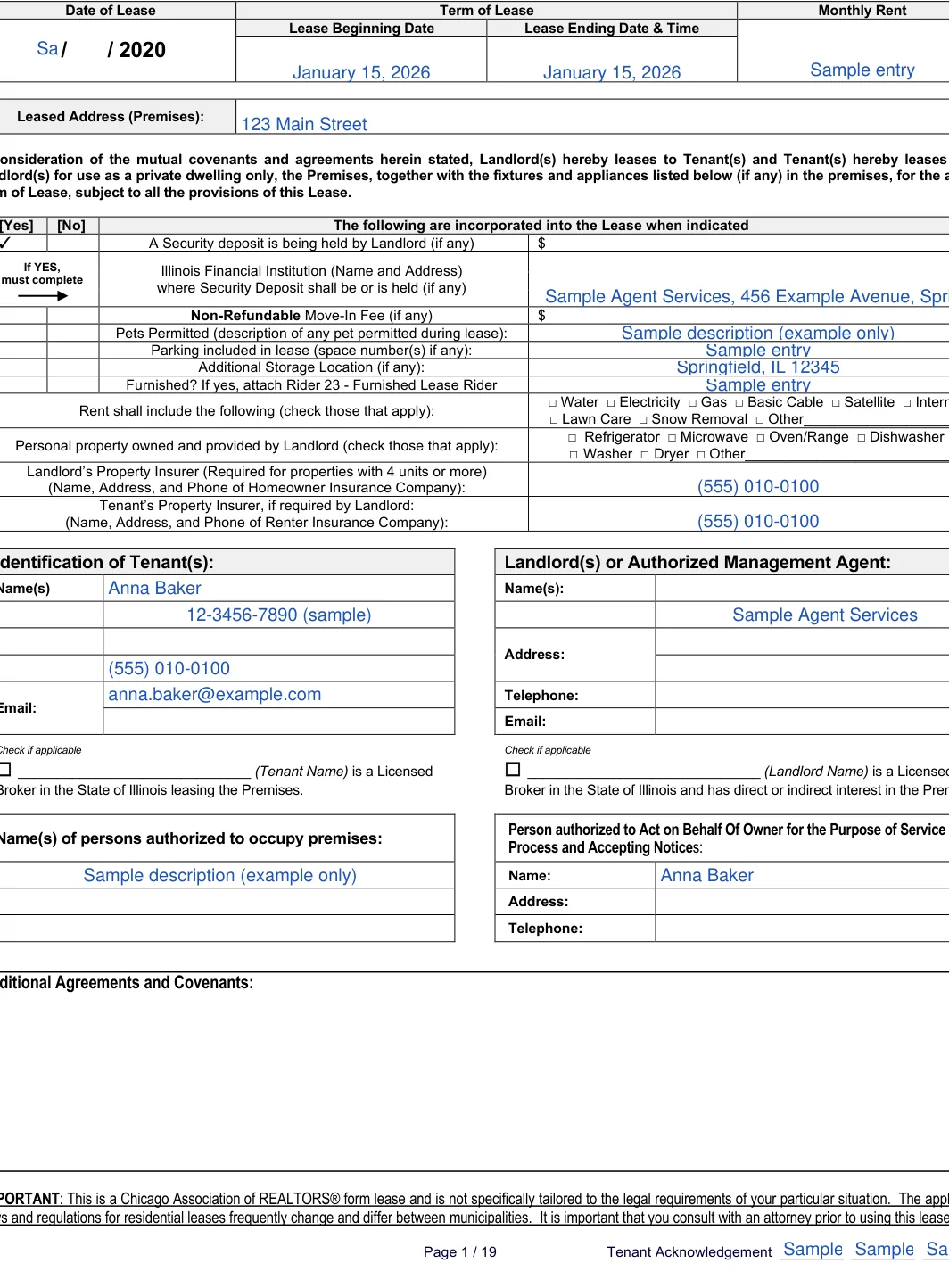
The first part of the lease names the beginning and ending dates, the monthly rent and the leased address. The same page lists pets, parking, storage, furnished items, the utilities included in the rent, the landlord's property and the insurers. An unfurnished apartment lease leaves the furnished items line marked N/A.
The security deposit question takes a Yes or No answer. A Yes answer adds the deposit amount and the Illinois financial institution that holds the money. A lease with no deposit says None on that line.
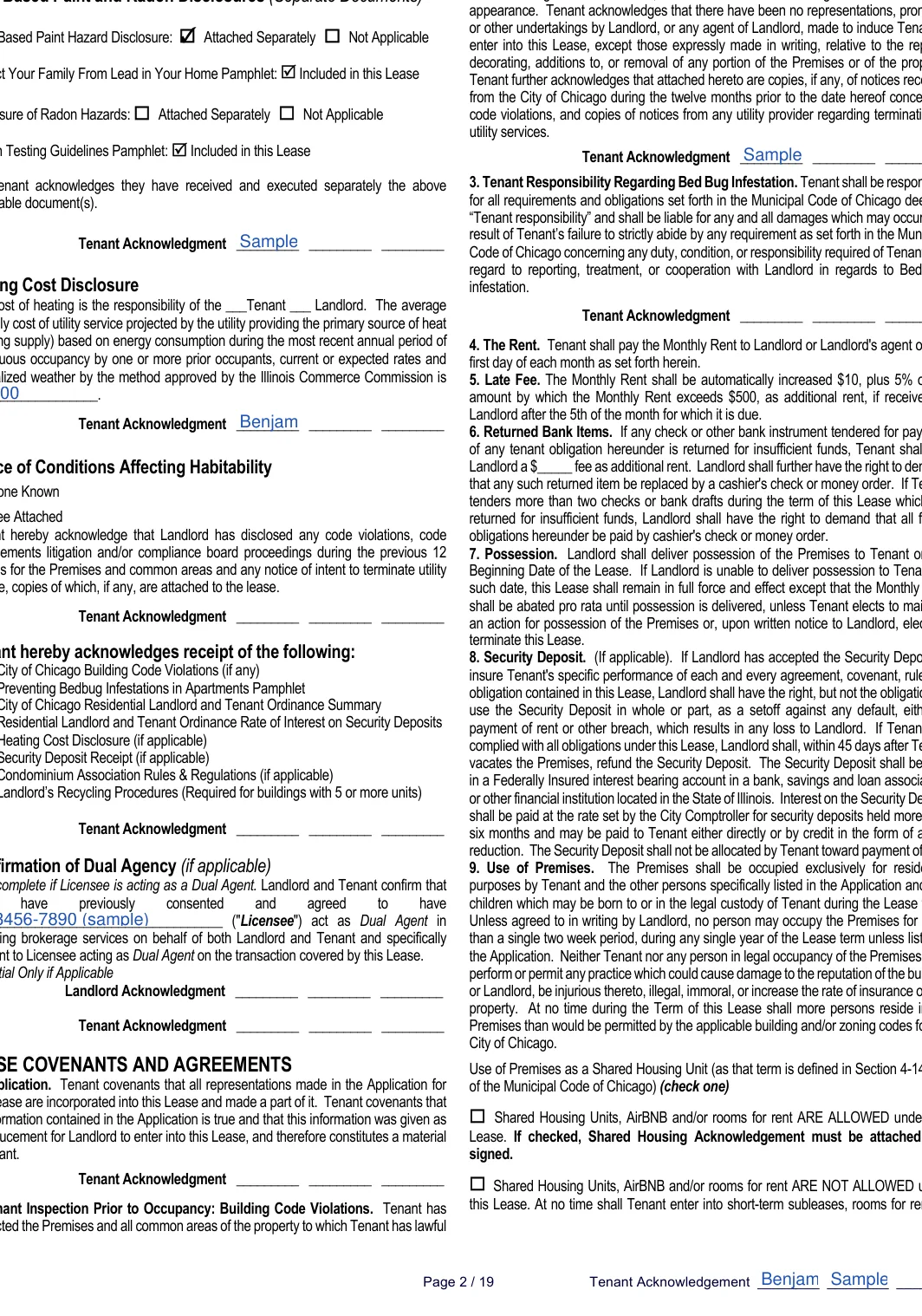
The disclosure page carries four checks. The lead-based paint and radon lines each take Attached Separately or Not Applicable. The heating line names who pays for heat and the monthly cost, and the habitability section takes None Known or See Attached.
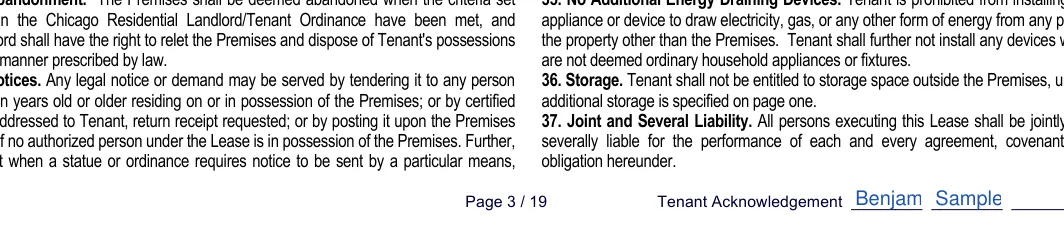
Covenants 10 to 37 are the lease's standing terms and have no blanks. Every page has Tenant Acknowledgement boxes in the footer, and the tenants initial each one to show they read that page. A clause that is unclear can be checked line by line with Chat with PDF before anyone signs.
The guaranty is optional. A guarantor, when one is used, adds a name, address, phone and email and signs the guaranty. The Designated Agent lines name the tenant's broker and the landlord's broker, and the dual agency line is completed only if dual agency applies.
Need a different lease than this Chicago lease agreement? Browse all rental lease agreement templates or see the Illinois rental lease agreement templates for the rest of the state.
| Document Name | Chicago Residential Lease Agreement Form |
| Other Names | Chicago Apartment Lease, Chicago Rental Lease |
| Relevant Laws | Illinois Compiled Statutes 735 ILCS 5/9-205 and 735 ILCS 5/9-207, 740 ILCS 80/2 and 765 ILCS 710/1, and 42 U.S.C. § 4852d |
| Avg. Time to Fill Out | 20 minutes |
| # of Fillable Fields | 198 |
| Available Formats | Adobe PDF |
A Chicago lease agreement is filled out from the first page to the last: page 2 holds the terms and the parties, page 3 the disclosures and page 5 the signatures. The other pages take only initials. The answers can go into the online builder above or into the downloaded PDF with the PDF editor.
The screenshots under each step show the FormsPal Illinois Chicago residential lease agreement template filled with sample entries in blue, so you can see where each answer goes. The names, addresses, dates and amounts are examples only.
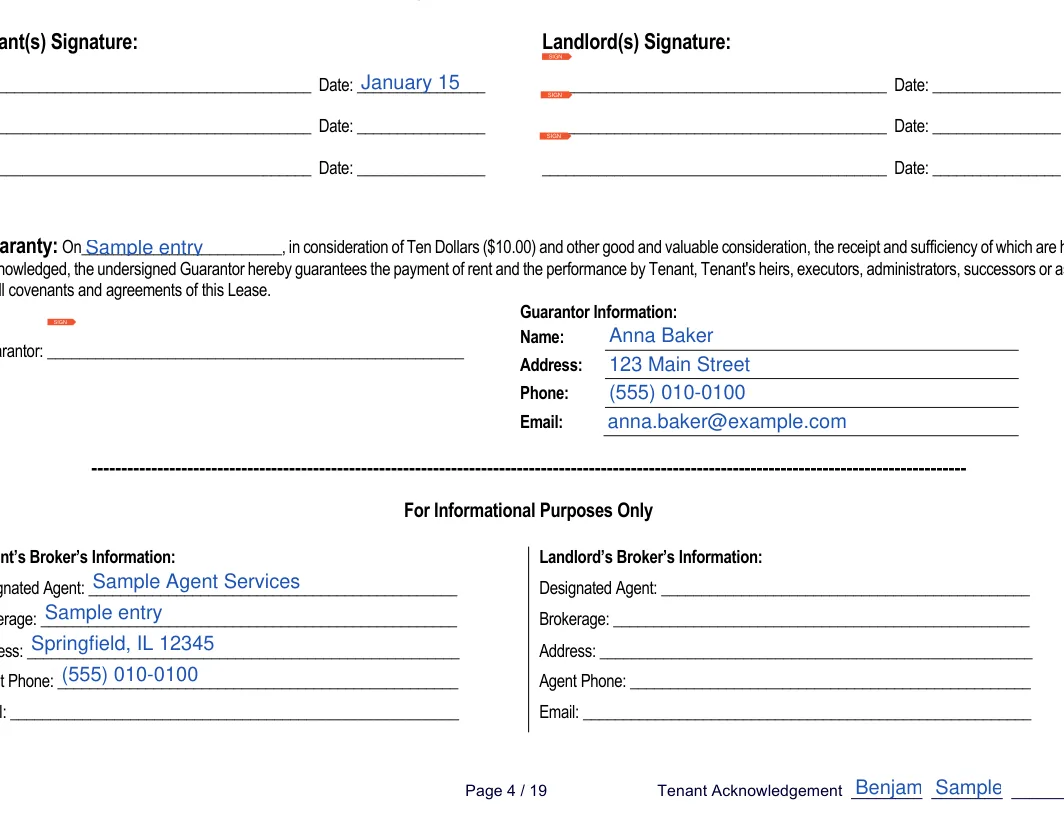











The signature page of the Chicago lease takes one signed and dated line per tenant and per landlord, plus the guarantor's line when a guaranty is used.
The security deposit in a Chicago lease is governed in part by 765 ILCS 710, the Illinois statute that sets when a landlord returns the money and when part of it may be kept for damage. For many Chicago units, the City of Chicago's Residential Landlord and Tenant Ordinance also sets its own deposit rules, which this page does not summarize; read both before you take or pay a deposit. The official text of 765 ILCS 710/1 also says which buildings its deadlines cover, so check it before relying on the steps below.
A landlord who wants to keep part of the deposit for property damage sends an itemized statement within 30 days of the date the tenant vacated or the date the tenant's right of possession ends, whichever is later (765 ILCS 710/1). If no statement and receipts are furnished, the landlord returns the deposit in full within 45 days of the date the tenant vacated (765 ILCS 710/1).
The itemized statement lists each item of damage and the estimated or actual cost of repairing or replacing it, with the paid receipts or copies attached, when the landlord keeps part of the deposit (765 ILCS 710/1). If the statement gives an estimated cost, the landlord furnishes the paid receipts or copies within 30 days from the date the statement was furnished (765 ILCS 710/1).
When the landlord furnishes the statement, 765 ILCS 710/1 allows three ways to deliver it:
If a circuit court finds that a landlord refused to supply the itemized statement or supplied it in bad faith, and failed or refused to return the deposit due within the time limits, the landlord is liable for twice the amount of the deposit due, together with court costs and reasonable attorney's fees (765 ILCS 710/1).
A Chicago lease that has run out and continues with the tenant holding over ends by written notice, and the notice period depends on the type of tenancy (735 ILCS 5/9-205; 735 ILCS 5/9-207). Both periods below apply only where the tenant holds over without special agreement.
| Tenancy | Landlord's written notice | Condition | Source |
|---|---|---|---|
| Week to week | 7 days' notice, in writing | Only where the tenant holds over without special agreement | 735 ILCS 5/9-205; 735 ILCS 5/9-207 |
| Any term less than one year, other than week to week (such as month to month) | 30 days' notice, in writing | Only where the tenant holds over without special agreement | 735 ILCS 5/9-205; 735 ILCS 5/9-207 |
The periods in the table are the Illinois ones from 735 ILCS 5/9-205 and 735 ILCS 5/9-207. The City of Chicago's Residential Landlord and Tenant Ordinance sets its own notice periods for some Chicago tenancies, which can differ from these, so read it before giving or accepting notice to end a month to month lease.
After that notice, the landlord may maintain an action for eviction or ejectment where the tenant holds over without special agreement (735 ILCS 5/9-205; 735 ILCS 5/9-207). A landlord who goes on to that step uses an Illinois eviction notice.
A Chicago lease for a term longer than one year has to be in writing, because no court action can be brought on such a lease unless the lease, or a memorandum or note of it, is in writing (740 ILCS 80/2). A written lease of any length also keeps the rent, the deposit and the covenants in one signed record for both sides.
The lead paint disclosure applies to target housing, which means any housing constructed prior to 1978, except housing for the elderly or persons with disabilities or any 0-bedroom dwelling, unless a child under 6 years of age resides or is expected to reside there (42 U.S.C. § 4851b).
For target housing, the landlord gives the tenant a lead hazard information pamphlet (42 U.S.C. § 4852d). The landlord also discloses any known lead-based paint or lead-based paint hazards and provides any lead hazard evaluation report available to the landlord (42 U.S.C. § 4852d). The Chicago lease records this with the Attached Separately or Not Applicable boxes on page 3.
The Chicago lease agreement is a residential lease for a home in the City of Chicago, and a few rentals call for another form:
The Chicago lease agreement is written for a home in the City of Chicago, so a rental elsewhere in Cook County fits the general Illinois lease agreement better. Both forms cover the same core terms: the parties, the rent, the term and the deposit.
The Chicago residential lease covers apartments and houses only. Its disclosures, habitability section and occupant lines are written for a home, not for an office or a store.
When a landlord who received a security deposit or prepaid rent sells or otherwise transfers the property, the new owner is liable to the tenant for the deposit, including statutory interest, or for the prepaid rent (765 ILCS 710/1.1). The previous owner remains jointly and severally liable with the new owner when the transfer happens (765 ILCS 710/1.1).
When a holder or purchaser acquires actual possession of the security deposits through a foreclosure of the property, it posts a written notice on the primary entrance of each dwelling unit within 21 days after the transfer of the deposits and receipt of the name and address of any tenant who paid one (765 ILCS 710/1.2).
A studio, as a 0-bedroom dwelling, is outside the federal lead paint disclosure unless a child under 6 years of age resides or is expected to reside there (42 U.S.C. § 4851b). If the studio was built before 1978 and a young child lives there or is expected to, the pamphlet and the disclosure apply (42 U.S.C. § 4852d).
General information, not legal or tax advice.

Unless noted otherwise, the sources below are from the Illinois Compiled Statutes.
