Illinois Promissory Note Template

An Illinois promissory note is a written promise to repay a loan, signed by the borrower and made out to the lender. This Illinois promissory note template records the amount borrowed, the interest rate and the payment dates. Fill it out online or download the PDF.

Last Updated: October 2026. This guide is reviewed and updated regularly to reflect current Illinois law. If you notice an error or outdated information, please contact us.
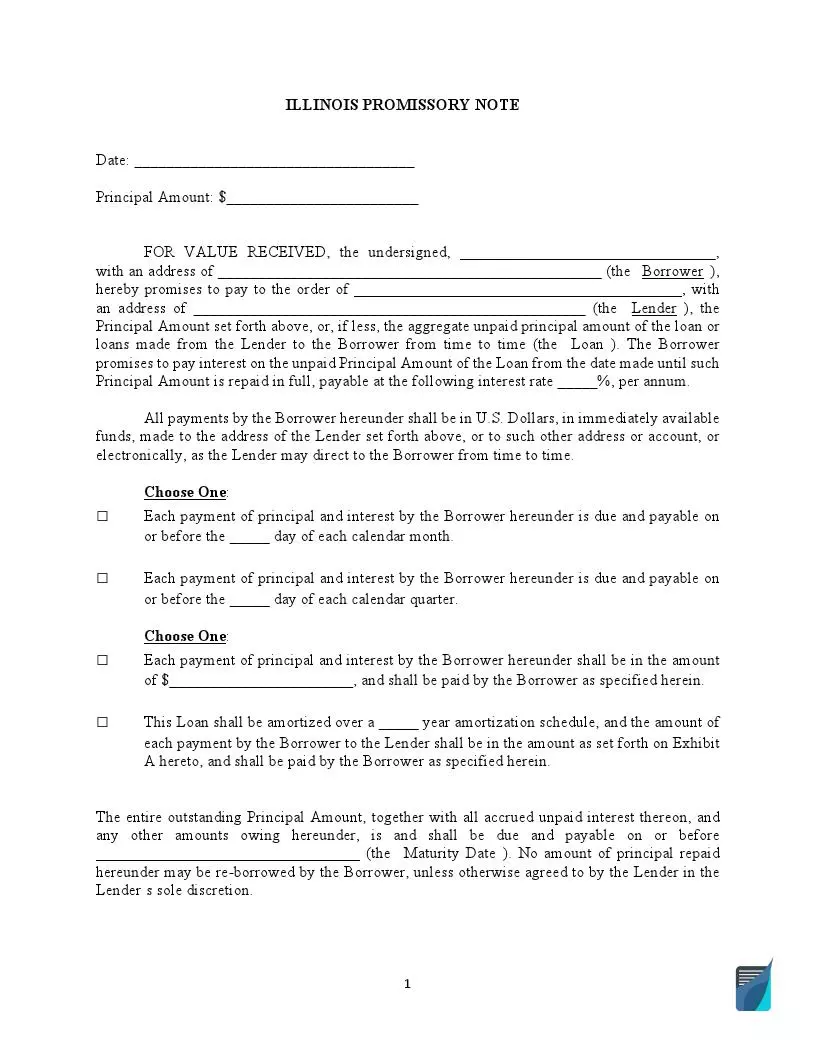
Illinois promissory note form preview

Create a free high quality Illinois Promissory Note online now!

Build Your Document

Answer a few simple questions to make your document in minutes

Save and Print

Save progress and finish on any device, download and print anytime

Sign and Use

Your valid, lawyer-approved document is ready

... or download your Illinois Promissory Note Template as a  PDF file

A promissory note names the borrower and the lender, the sum lent, the interest rate and the due date, and the borrower signs it. This holds for a free printable promissory note for a personal loan as well. The Illinois template lets you pick one of two types.

  • A secured note: the borrower pledges an asset, called collateral, to back the loan. The asset stands behind the loan if the borrower does not repay in money.
  • An unsecured note: no asset backs the loan. People often use it when the borrower and lender know each other well or the sum is small.

Apart from the collateral lines, both types ask for the same details.

What Is the Maximum Interest Rate on an Illinois Promissory Note?

The Illinois Interest Act, 815 ILCS 205, sets the interest a promissory note may charge. In a written contract, the parties may agree to an annual percentage rate of 9%, or any less sum, unless a statute provides otherwise. The maximum rate of interest that may lawfully be contracted for is determined by the law in force when the contract is made.[1.2]

In all written contracts it shall be lawful for the parties to stipulate or agree that an annual percentage rate of 9%, or any less sum, shall be taken and paid upon every $100 of money loaned or in any manner due and owing from any person to any other person or corporation in this state

815 ILCS 205/4

In plain words, a written note may carry interest of up to 9% a year, and any lower rate is fine too. Two other rules cover particular kinds of credit:

  • Installment loans: interest may be computed at a rate of up to 9% per year on the entire principal, for the period from the date the loan is made until the last installment is due. The statute sets no limit on the rate for Illinois banks and savings institutions.[1.5]
  • Revolving credit: a lender whose charges no other provision of law governs may collect interest of up to 1 1/2% per month. The interest is figured on the average daily unpaid balance during the billing cycle, or on the unpaid balance on about the same day of each billing cycle.[1.3]
Tip: write the rate you agreed on in the interest rate blank of the form, as a percentage per year. Keep it at or below the ceilings above.

Illinois Promissory Note Form Details

Document NameIllinois Promissory Note Form
Other NameIL Promissory Note
Max. Rate9% annual percentage rate in a written contract (general limit)
Relevant LawsIllinois Interest Act, 815 ILCS 205/4
Avg. Time to Fill Out10 minutes
# of Fillable Fields28
Available FormatsAdobe PDF
Template Preview
Create a free high quality Illinois Promissory Note online now!

Popular Local Promissory Note Forms

A promissory note (often referred to as just note) is considered a simple lending tool used by both individuals and companies through all states as a funds resource and a substitute for banks. Discover more about the most popular states searched by our website users concerning promissory note templates.


Other Interest Rules That Can Affect an Illinois Promissory Note

Beyond the general 9% ceiling, the Illinois Interest Act sets rules on how interest is counted, who may collect it, when a prepayment charge is unlawful and how a service member's loan is limited. Each rule below is cited to its section.

  • Counting interest: a month means a calendar month, and a year is twelve calendar months. For any period shorter than a month, a day counts as one thirtieth part of a month. These rules apply in all computations of time, interest and discounts.[1.8]
  • Collection by an assignee or agent: if the creditor and the debtor have no agreement on interest charges, an assignee or agent of the creditor may charge and collect interest on the creditor's behalf upon 30 days' written notice to the debtor.[1.1]
  • Prepayment: where the rate exceeds an annual percentage rate of 8% on a residential real estate installment contract or mortgage loan, the contract may not provide for a prepayment penalty or other charge for prepayment.[1.2]
  • Military service: subject to the federal Servicemembers Civil Relief Act, a creditor may not charge or collect interest or finance charges above 6% per annum from a service member during the period of military service. This covers an obligation entered into after the rule took effect and before the service began.[1.4]
  • Military notice: to get that limit, the service member must give the creditor written notice and a copy of the orders calling the service member to military service. Notice is due no later than 180 days after the service member's termination of or release from service.[1.4]

Penalty for Unlawful Interest on an Illinois Promissory Note

A lender who knowingly contracts for or receives unlawful interest, discount or charges in connection with a loan of money can owe the borrower a penalty. The borrower may recover twice the total of the interest, discount and charges set by the loan contract or paid by the borrower, whichever is greater, plus reasonable attorney's fees and court costs that a court assesses against the lender.[1.6]

A borrower must raise usury by plea or in writing. The defense of usury is not allowed unless the borrower relying on it sets it up by plea or files in the case a written notice stating the intent to defend on the ground that the contract is usurious.[1.7]

What Terms Does the Illinois Promissory Note Template Contain?

The FormsPal Illinois promissory note template is a three-page document. Page 1 holds the loan details and the payment terms, page 2 holds the security terms and the default terms, and page 3 holds the signature blocks. This section summarizes what the printed text of the template says, so you know what you are signing.

Payment terms in the template

The borrower promises to pay the principal amount, or the unpaid principal of the loans made if that is less. Interest runs on the unpaid principal from the date the loan is made until it is repaid in full, at the per annum rate you enter.

  • Payments are made in U.S. dollars, in immediately available funds, to the lender's address or to another address or account the lender names, or electronically.
  • Each payment of principal and interest is due on a day you choose of each calendar month or each calendar quarter.
  • The payment is either a fixed dollar amount or an amount set out on Exhibit A for a loan amortized over a number of years.
  • The whole outstanding principal and accrued interest is due on the maturity date.
  • Principal that has been repaid cannot be borrowed again unless the lender agrees, in the lender's sole discretion.

Secured or unsecured in the template

On page 2 you initial one of two choices. An unsecured promissory note rests on the borrower's promise alone. A secured promissory note lists the collateral, meaning the asset or assets that back the loan.

If you choose a secured note, the template makes the borrower sign the security documents the lender reasonably requests. The borrower states that the collateral is unencumbered and that the borrower owns it. The borrower agrees not to sell, transfer or further encumber the collateral, and to keep it insured, until the note is repaid in full. When the note is repaid, the lender's security interest in the collateral ends.

Default, late fees and prepayment in the template

  • Waivers: the borrower waives demand, diligence, presentment, protest, and notice of non-payment and protest.
  • Default: if the borrower defaults, the lender may accelerate the maturity date and declare the full outstanding principal and accrued unpaid interest due at once.
  • Late fee: the template lets the lender charge a late fee of five percent (5%) on any delinquent amount.
  • Prepayment: the borrower may prepay the note at any time, in whole or in part, with no prior notice and without any penalty or premium.
  • Governing law: the template is governed by the laws of the State of Illinois.
  • Assignment: the lender may assign the note in the lender's sole discretion.

These are the template's own terms. They are not a statement of what Illinois law requires. If you want to change a term, talk to a lawyer licensed in Illinois before you sign.

Secured vs Unsecured Promissory Notes

Choose a secured promissory note when the loan is large or the lender wants something to fall back on. Choose an unsecured promissory note when the loan is small or the two parties trust each other. The template covers both, and the only difference in the form is the collateral on page 2.

  • Secured: the note names the collateral, and the borrower signs the security documents. The lender has the asset to look to if the loan is not repaid. The borrower gives up the right to sell the asset until the loan is repaid.
  • Unsecured: no asset is named. The lender relies on the borrower's promise to repay, so the note is simpler and faster to complete. The lender has less to fall back on if the loan is not repaid.

Whichever you pick, finish the note the same day the money changes hands. Each party should keep a signed copy, and the borrower should keep a record of every payment made.

How Do You Fill Out an Illinois Promissory Note?

The Illinois promissory note template has 28 fillable fields. The steps below follow the form's own parts, from the top of page 1 to the signature blocks on page 3.

Fill it in on screen with the online PDF editor or print it and write by hand.

The screenshots under each step show the FormsPal Illinois promissory note template filled with sample entries in blue, so you can see where each answer goes. The names, addresses, dates and amounts are examples only.
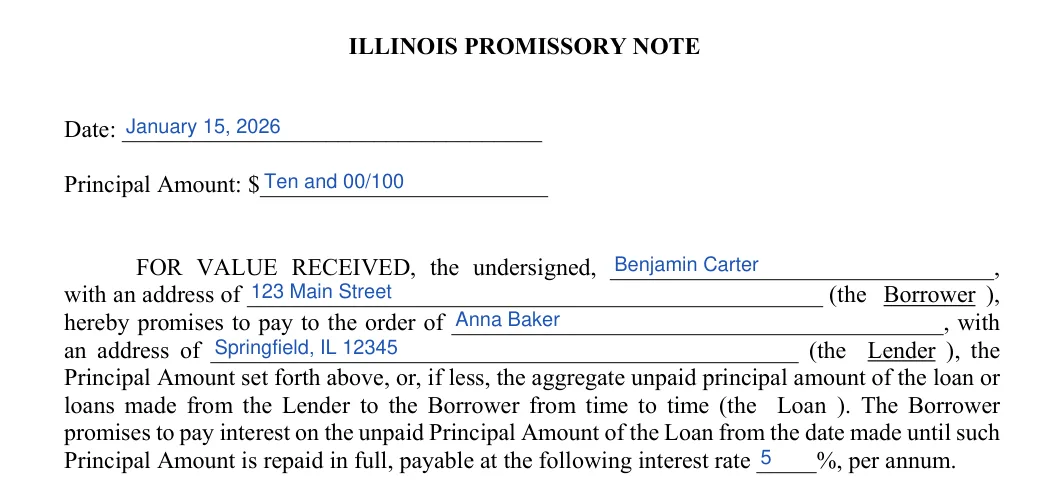
  1. Date, amount, parties and interest rate (page 1). Enter the date and the principal amount at the top. Then write the borrower's name and address and the lender's name and address. Last, enter the interest rate as a percentage per year.
    Illinois promissory note: ILLINOIS PROMISSORY NOTE, filled with sample entries
    Step 1: sample entries, not a real document.
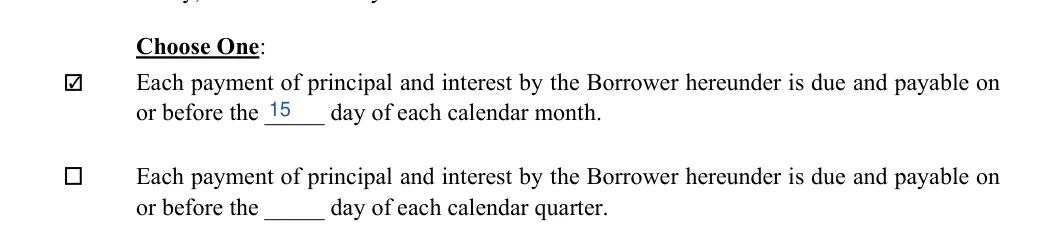
  2. Choose the payment due day (page 1). Tick one box: payments due on a set day of each calendar month, or on a set day of each calendar quarter. Write the day number on the line of the box you ticked.
    Illinois promissory note: Choose One, filled with sample entries
    Step 2: sample entries, not a real document.
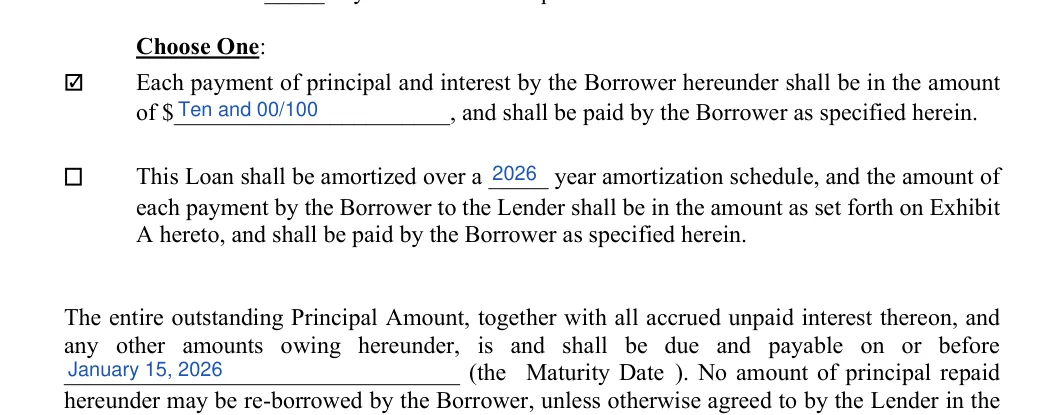
  3. Choose the payment amount and set the maturity date (page 1). Tick a fixed payment amount and enter the dollars, or tick an amortization schedule and enter the number of years. With a schedule, the payment amounts are set out on Exhibit A. Then write the maturity date, the day the whole balance is due.
    Illinois promissory note: Choose One, filled with sample entries
    Step 3: sample entries, not a real document.
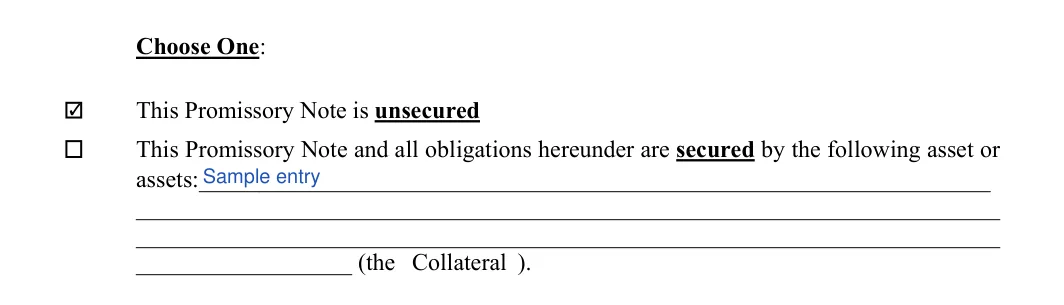
  4. Choose unsecured or secured (page 2). Tick unsecured, or tick secured and list the asset or assets on the collateral lines. The rest of page 2 is printed text, so there is nothing else to fill in.
    Illinois promissory note: Choose One, filled with sample entries
    Step 4: sample entries, not a real document.
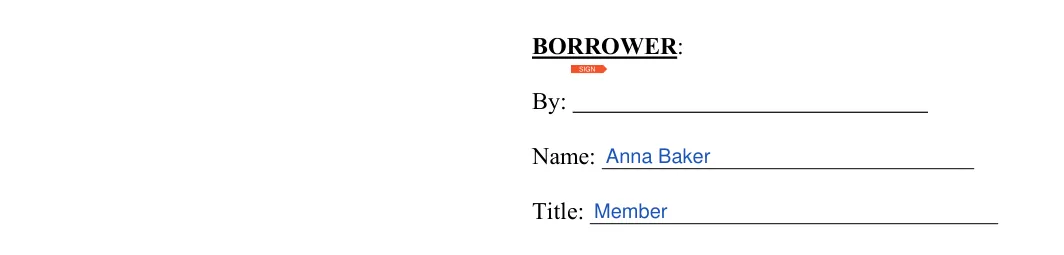
  5. Borrower signature block (page 3). The borrower signs on the By line and prints the name and title.
    Illinois promissory note: BORROWER, filled with sample entries
    Step 5: sample entries, not a real document.
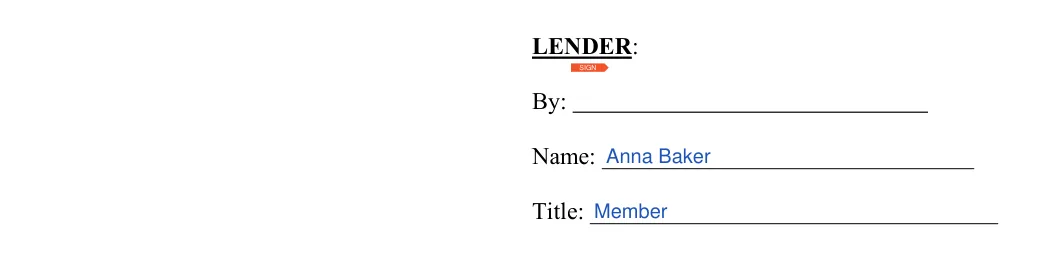
  6. Lender signature block (page 3). The lender signs on the By line and prints the name and title.
    Illinois promissory note: LENDER, filled with sample entries
    Step 6: sample entries, not a real document.

Frequently Asked Questions

Questions about an Illinois promissory note usually come down to the interest rate and what happens if a lender charges too much. The answers below cover the 9% ceiling, the other limits in the Interest Act and what the document needs.

Is a 30% interest rate illegal?

A written contract may stipulate an annual percentage rate of 9%, or any less sum, so 30% is far above the general ceiling.[1.2] Some credit follows its own rule, such as the 1 1/2% per month ceiling on revolving credit.[1.3] A lender who knowingly contracts for or receives unlawful interest can owe the borrower twice the total of the interest, discount and charges, plus attorney's fees and court costs.[1.6]

Yes. In a written contract the parties may agree to an annual percentage rate of 9%, or any less sum. The maximum rate of interest that may lawfully be contracted for is determined by the law in force at the time the contract is made.[1.2]

What are Usury Laws and Maximum Interest Rates?

Usury law decides whether the interest a note may charge is capped, and at what rate. In Illinois, the Interest Act sets these limits:

  • 9% per year, or any less sum, in a written contract.[1.2]
  • 9% per year on the entire principal of an installment loan.[1.5]
  • 1 1/2% per month on revolving credit.[1.3]
  • 6% per annum for a service member during military service.[1.4]
  • A penalty of twice the interest, discount and charges for a lender who knowingly charges unlawful interest.[1.6]

What are the requirements for a promissory note in Illinois?

The Illinois statute covered on this page limits the interest a note may charge, so the first requirement is a rate within those limits. A written note may stipulate 9%, or any less sum.[1.2] On an installment loan, interest is computed on the entire principal from the date of the loan to the last installment.[1.5] Interest is counted by calendar months, and a day under a month is a thirtieth part of a month.[1.8]

In practice, a note also names the borrower and the lender, the sum lent, the repayment schedule and the due date. The borrower signs it.

General information, not legal or tax advice.

seal of illinois state
Other Illinois Forms
Interested in more Illinois documents? We provide free forms and straightforward personalization experience to everyone who prefers less hassle when facing papers.

Sources

The rules on this page come from the Illinois Interest Act, 815 ILCS 205. Each bracketed number in the text points to the section listed below, so you can check the statute's own wording yourself.

  1. Illinois Compiled Statutes 815 ILCS 205/2 to 815 ILCS 205/10.
    • 1.1 815 ILCS 205/2
    • 1.2 815 ILCS 205/4
    • 1.3 815 ILCS 205/4.2
    • 1.4 815 ILCS 205/4.05
    • 1.5 815 ILCS 205/4A
    • 1.6 815 ILCS 205/6
    • 1.7 815 ILCS 205/7
    • 1.8 815 ILCS 205/10
Published: Aug 24, 2022
Jennifer M. Settles
Jennifer M. Settles
Author & Attorney
With over 25 years of experience as a business and transactional attorney, Jennifer has mastered the craft of closing highly successful deals for her clients. Through her wide-ranging expertise in commercial contracts, real estate transactions, M&A and corporate law, Jennifer secures results that are second-to-none.