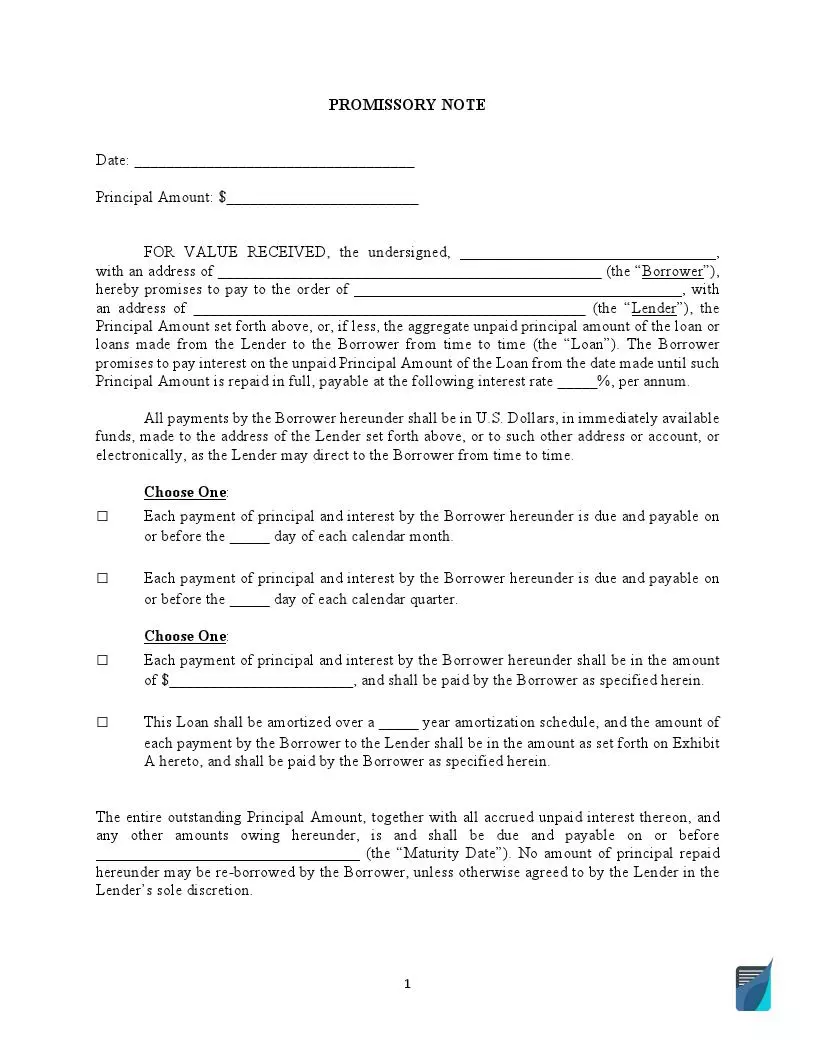
A promissory note is a written promise to pay back a specific amount of money on a set date or on demand. The person who receives the money is the borrower, and the person who provides it is the lender. This free promissory note template lets you record the amount, the interest, and the repayment plan.
Last Updated: October 2026. This guide is reviewed and updated regularly to reflect current law. If you notice an error or outdated information, please contact us.
A promissory note sets out the terms of the debt, such as:
Use a promissory note whenever one person lends money to another and the repayment should be written down. The note is a record of the amount due. It holds the borrower to the agreed terms and gives the lender proof of the debt. Agreeing on the terms in advance also helps the parties avoid later disputes.
A promissory note template is commonly used for:
A promissory note is a short document in which the borrower promises to repay a loan. A loan agreement is longer and spells out more terms. Both record the amount, the interest, and the repayment plan, but a loan agreement goes further into the duties of each party.
A promissory note is either secured or unsecured. A secured note is backed by collateral, such as a house or a car, that the lender may claim if the borrower stops paying. An unsecured note has no collateral, so the lender relies on the borrower's promise to pay.
Secured: A secured promissory note names collateral, such as real estate or a vehicle, as protection against non-payment. Its terms usually let the lender claim that property if the borrower defaults.
Unsecured: An unsecured promissory note names no collateral. If the borrower stops paying, the lender usually has to sue to collect the loan. In a bankruptcy, the lender typically has no priority over other unsecured creditors.
There is also a promissory note for a car sale, designed for vehicle purchases. It records the promise to pay a car loan and the key details of the sale.
A promissory note should name the people involved, the amount borrowed, the interest, and the repayment plan. It should also cover any collateral, a co-signer if there is one, what happens on default, and the signatures. Agree on each item below before you write the note.
All the numbers for the repayment structure should be written in the note itself. A promissory note should state three numbers:
To calculate them, you need the principal amount, the repayment period, and the interest rate. The example below shows a simple method with sample numbers.
Example: A borrower takes a $6,000 loan at a 10% annual interest rate for six months. The loan is repaid in quarterly installments. These are sample figures only.
First find the annual interest amount, because the rate is annual. Divide it by 12 to get the monthly interest amount. Then multiply the monthly interest amount by the number of months in the loan period.
For the example above, the calculation is:
To find the final total payment, add the principal loan amount and the total interest.
For the example above, the calculation is:
Final total payment = 6,000 + 300 = 6,300
To find each installment, divide the final total payment by the number of installments.
In the example, the loan lasts six months and is paid quarterly, once every three months. That makes two installments, because 6/3 = 2. Each installment is 6,300 divided by 2, which is 3,150.
So the loan is repaid in two installments of $3,150, one every three months, and the total final payment is $6,300.
If the installments were monthly instead, the final total payment would be divided by six. The loan would then be repaid in six installments of $1,050 each.
If you are not sure which interest rate to charge, compare current market rates for personal loans. Then check the limit that applies to you, because most states cap the rate by statute. The cap and its exceptions differ by state, and some states let a written agreement set a higher rate.
The state table below lists each state's general rate. Your state page has more detail. Check both before you write a rate into your note.
Watch the cap. Charging more than your state allows can cost the lender the interest or more. The cap depends on the state and the loan, so check it before you set a rate.
A promissory note can arrange repayment in several ways, and the right choice depends on the size of the loan and how long the borrower needs. Five structures are common. The note should state clearly which one the parties chose.
Payments are usually applied to the interest first and then to the principal, unless the note says otherwise.
The note should say what happens when a payment is late. A late fee is usually a flat amount or a percentage of the payment, and limits vary by state. The lender can send a demand letter about the missed payment. The note should also say how many days late counts as a default.
With a secured note, the lender may claim the collateral as the loan contract allows. This often means going to court first.
With an unsecured note, the lender can seek repayment in court, and small claims court may fit smaller amounts. Small claims limits vary by state.
The table shows, for each state, the general interest rate cap or the legal rate that applies when a note names none, plus the law behind it. Many states allow a higher rate in a written agreement or for certain lenders, and rates change over time. Check your state page before you rely on a figure.
| STATE | MAX. RATES | STATE LAW |
| Alabama | 8% – for written contracts; 6% – for verbal agreements | Alabama Code, Section 8-8-1 |
| Alaska | 10.5% legal rate (on money after it is due), contract limit of 10% or 5% above the 12th Federal Reserve District rate, whichever is greater (no limit if the principal is more than $25,000) | Alaska Statutes, Section 45.45.010 |
| Arizona | No limit – for loan agreements in writing; 10% per annum – if not in writing | Arizona Revised Statutes, Section 44-1201 |
| Arkansas | 17% | Arkansas Annotated Code, Section 4-57-104 |
| California | 10% – for personal, family, or household purposes; For any other loans – allowable rate is the higher of 10% or 5% over amount charged by the Federal Reserve Bank of San Francisco | California Constitution, Article XV |
| Colorado | 8% legal rate of interest, 45% general usury limit, 12% for consumer loans other than supervised loans | Colorado Revised Statutes, Sections 5-12-101, 5-12-103 and 5-2-201 |
| Connecticut | 12% | Connecticut Revised Statutes, Chapter 673, Section 37-4 |
| Delaware | 5% over Federal Reserve discount rate | Delaware Code, Title 6, Section 2301 |
| Florida | 18% – general usury limit; 25% – if loan is over $500,000 | Florida Statutes, Section 687.03 |
| Georgia | 7% if no written contract sets the rate, no more than 16% per year if the loan is $3,000 or less, and charging more than 5% per month is a misdemeanor, except for licensed pawnbrokers | Georgia Code, Sections 7-4-2 and 7-4-18 |
| Hawaii | 10% if no written contract, 12% maximum on consumer credit other than credit card agreements and on home business loans (24% for regulated financial institutions), 10% on judgments | Hawaii Revised Statutes, Sections 478-2 to 478-4 |
| Idaho | 12% legal rate of interest (if no written contract sets a different rate), 5% plus a base rate set each year by the state treasurer on court judgments | Idaho Statutes, Section 28-22-104 |
| Illinois | 9% – general usury limit | Illinois Compiled Statutes, Chapter 815, Section 205/4 |
| Indiana | 8% – if no agreement; 25% – for consumer loans other than supervised loans | Indiana Code, Sections 24-4.6-1-102 and 24-4.5-3-201 |
| Iowa | 5% (if otherwise agreed upon in writing, maximum is set by Iowa Superintendent of Banking) | Iowa Code, Section 535.2 |
| Kansas | 10% – legal rate of interest; 15% – general usury limit | Kansas Statute, Sections 16-201 and 16-207 |
| Kentucky | 8% – legal rate of interest; general usury limit – 4% greater than Federal Reserve rate or 19%, whichever is less | Kentucky Revised Statutes, Section 360.010 |
| Louisiana | 12% – general usury rate | Louisiana Revised Statutes, Section 9:3500 |
| Maine | 6% – legal interest rate (unless otherwise stated in an agreement) | Maine Revised Statutes, Title 9-B, Section 432 |
| Maryland | 6% limit without a written agreement, 8% limit with a written agreement signed by the borrower (up to 24% on some unsecured loans that meet statutory conditions) | Maryland Annotated Code, Commercial Law, Sections 12–102 and 12–103 |
| Massachusetts | 6% – legal interest rate (unless a written contract exists); over 20% is considered criminally usurious | Massachusetts General Laws, Chapter 107, Section 3; and Chapter 271, Section 49 |
| Michigan | 7% – if a written contract; otherwise – 5% | Michigan Compiled Laws, Section 438.31 |
| Minnesota | 6% – legal rate of interest; 8% – usury limit | Minnesota Statutes, Section 334.01 |
| Mississippi | 8% legal rate of interest – 8%, “Contract rate” – 10% or 5% above Federal Reserve rate, whichever is greater | Mississippi Annotated Code, Section 75-17-1 |
| Missouri | 10% | Missouri Revised Statutes, Section 408.030 |
| Montana | 15% or 6% above the rate of Federal Reserve System, whichever is greater | Montana Annotated Code, Section 31-1-107 |
| Nebraska | 16% | Nebraska Revised Statutes, Section 45-101.03 |
| Nevada | Without agreement – current prime rate of the largest Nevada bank plus 2 percentage points; no usury limit | Nevada Revised Statutes, Sections 99.040 and 99.050 |
| New Hampshire | 10% legal rate for business transactions (unless otherwise agreed in writing) | New Hampshire Revised Statutes, Section 336:1 |
| New Jersey | 6% – without a written contract; 16% – with a written contract | New Jersey Statutes, Section 31:1-1 |
| New Mexico | 15%- if no written contract | New Mexico Annotated Statutes, Section 56-8-3 |
| New York | 16% general usury limit | New York Consolidated Laws, GOB Section 5-501; and BNK Section 14-A |
| North Carolina | 8% – legal rate of interest (but consumers and creditors can contract for a higher rate) | North Carolina General Statutes, Section 24-1 |
| North Dakota | 6% – legal rate of interest; max. contract rate – 5.5% higher than current cost of money and can’t be less than 7% | North Dakota Century Code, Sections 47-14-05 and 47-14-09 |
| Ohio | 8% – if a written contract | Ohio Revised Code, Section 1343.01 |
| Oklahoma | 6% (unless otherwise agreed between parties) | Oklahoma Statutes, Section 15-266 |
| Oregon | 9% – legal interest rate (but other conditions apply to business and agricultural loans) | Oregon Revised Statutes, Section 82.010 |
| Pennsylvania | 6% maximum lawful rate for loans of $50,000 or less (does not apply to business loans or unsecured loans over $35,000) | Pennsylvania Consolidated Statutes, Title 41, Section 201 |
| Rhode Island | 21% (but alternate rate of 9% + domestic prime rate may be applied) | Rhode Island General Laws, Section 6-26-2 |
| South Carolina | 8.75% legal rate of interest, 6% maximum without a written contract (a written contract may set any rate unless other law limits it) | South Carolina Code of Laws, Section 34-31-20 |
| South Dakota | No limit – if a written agreement; 12% – if no agreement | South Dakota Codified Laws, Sections 54-3-4 and 54-3-16 |
| Tennessee | 10% (unless otherwise expressed in contract or by law) | Tennessee Code Annotated, Section 47-14-103 |
| Texas | 10% (unless otherwise stated in contract law) | Texas Statutes, Finance Code, Section 302.001 |
| Utah | 10% (unless otherwise agreed between parties in a written contract) | Utah Code, Section 15-1-1 |
| Vermont | 12% (exceptions in certain circumstances may apply) | Vermont Statutes, Title 9, Section 41a |
| Virginia | 6% – legal rate of interest; 12% – with a contract | Virginia Code, Sections 6.2-301 and 6.2-303 |
| Washington | 12% or 4% points above average bill rate for 26-week treasury bills | Washington Revised Code, Section 19.52.020 |
| West Virginia | 6% – legal interest rate; 8% – with a written agreement | West Virginia Code, Section 47-6-5 |
| Wisconsin | 5% legal rate of interest (the 12% maximum rate does not apply to loans made on or after November 1, 1981, and other statutes set rates for some loans) | Wisconsin Statutes and Annotations, Section 138.04 |
| Wyoming | 7% – if no agreement | Wyoming Statutes, Section 40-14-106 |
Creating a promissory note takes five steps. You agree on the terms, check the other party, settle any collateral and co-signer, write the note, and release the loan once it is repaid. With our free form and instructions, you can complete the note quickly, or let our document builder guide you step by step.
1. Mutual Agreement

Before writing the note, the parties should sit down and agree on all the terms. This way each party understands and accepts the same terms. They should cover:
2. Background Check

It is wise to check the other party's background. Useful checks include:
Equifax, Experian, and TransUnion are well-known credit reporting agencies.
3. Collateral and Co-signer

Identify the collateral and the co-signer if you decide to include them. Discuss the value of the asset offered as security. Tell the co-signer all the terms and get that person's consent beforehand.
4. Writing the Promissory Note

Once the earlier steps are done, the parties should meet, write, and sign the note. The lender gives the loan money to the borrower after signing. For detailed guidance on filling out FormsPal's promissory note template, see the next section.
5. Loan Release

After the borrower has paid on time and as the note requires, the lender should sign a loan release form. The release form confirms that repayment was made as agreed. It records that the borrower owes nothing further under the note.
A promissory note template is filled out in six short steps, from the basic details to the signatures. The steps below use a sample loan of $6,000 at 10% for six months, repaid quarterly. These are example numbers only, so use the figures you and the other party agreed on.
Step 1: Enter the Basic Information
In the first line, enter the complete date, including the day, month, and year. For example, it can be written as November 11, 2020.
Next, enter the principal amount, which is the original amount of the loan without interest. Enter it in both words and numbers. In our example, this is $6,000, written as $6,000 (six thousand U.S. dollars).
In the next paragraph, enter the full names and addresses of the borrower and the lender, including house number, street, city, and state. For example, the lender can be James Fuller at 22 Boulevard Street, Anytown, ST 00000.
Lastly, enter the interest rate. In our example, we enter 10%. Use the rate you and the other party agreed on, and check it against your state's limit.

Step 2: Select a Quarterly or Monthly Payment Date
Decide whether installments will be made quarterly or monthly. A calendar year has four quarters of 3 months, or 90-92 days, each. These are January-March (Q1), April-June (Q2), July-September (Q3), and October-December (Q4).
For monthly payments, select the first option and enter the date on which each installment is due. A date in the last week of a month is typically selected. For example, you can enter the 25th day of each calendar month.
For quarterly payments, select the second option and enter the date of each quarter on which the installment is due. Usually, a date in the last week of the last month of a quarter is selected. For example, you can enter the 85th day of each calendar quarter. You can also enter "last day" or "second to last day" of each calendar quarter.

Step 3: Select a Payment Plan
Decide whether the borrower will pay in regular equal installments of principal and interest or in amortized payments over a period of time.
For equal installments of principal and interest, select the first option. If you chose monthly payments in the previous step, enter $1,050 (the calculation is explained above). If you chose quarterly payments, enter $3,150.
To amortize the loan, enter the number of years of the amortization in the second option. You can use an online calculator to prepare an amortization schedule. Attach the schedule to the promissory note.
Enter the maturity date, which is the final date by which the total payment, including principal and interest, should be made.

Step 4: Select the Type of Note, Secured or Unsecured
If the borrower has not provided any collateral, select the first option.
If the note is secured with collateral from the borrower, select the second option and enter all the details of the asset.

Step 5: Select the Governing Law State
Select the governing law state. This is usually the state where the lender lives. If you are not sure which state to choose, ask a local attorney.

Step 6: Signature
The borrower and the lender should sign together. If there are multiple parties, all of them should sign the note. Some people also have an impartial third party sign as a witness, and whether that is needed depends on the state. Lastly, include your full signature, full name, and title.

These are the questions people ask most about promissory notes, from enforcement problems to transfers. The rules differ by state, so treat the answers as general information and check your state page for details.
A promissory note can be invalid or hard to enforce when it is written carelessly or breaks a rule in your state. Common problems include:
A promissory note is also a contract. The parties need to be adults of sound mind, and the purpose of the loan must be lawful.
Often, yes. Many lenders can sell or transfer a note. A lender who wants cash sooner can sell the note at a discount to a note-buying company. Notes can also be passed between family members and friends to offset another loan.
The rules on transfers differ by state, so keep good records of the note. A note meant to be transferable usually says "payable to order" or "payable to bearer."
Yes, there can be more than one lender or borrower. If so, write the names and other identifying details of all of them in the note.
A demand promissory note is one where payment is due when the lender asks for it. It has no maturity date written in it. Many lenders give the borrower reasonable notice before asking for payment, and the note may set a notice period.
A master promissory note (MPN) is the agreement a student signs with the U.S. Department of Education before taking a federal student loan. By signing it, the student accepts the terms of the loans it covers.
A debt settlement agreement resolves an outstanding debt between a debtor and a creditor. When the debtor cannot pay the full amount, the parties can agree on a smaller sum.
This can help the debtor clear the debt and avoid legal action. The creditor limits the loss, avoids the cost of a lawyer, and gets paid sooner than through a court order.
The free promissory note form on this page covers the loan amount, the interest, the repayment schedule, any collateral, and the signatures. You can fill it in online and print it, or download it as a PDF or Word file and complete it by hand.
General information, not legal or tax advice.