
A letter of intent is a broad agreement that acts as a basis for a further formal binding agreement. Use a letter of intent template to set out the main terms of a deal, a job or a school application before the final paperwork starts. Download the free template below as a PDF, or create your own online in a few minutes.
Last Updated: October 2026. This guide is reviewed and updated regularly to reflect current law. If you notice an error or outdated information, please contact us.
Build Your Document
Answer a few simple questions to make your document in minutes
Save and Print
Save progress and finish on any device, download and print anytime
Sign and Use
Your valid, lawyer-approved document is ready
Letters of intent vary based on the relations they help establish between parties. In a purchase, the letter helps both sides agree on the main terms before a fuller contract is drafted. In a school or job application, the letter is aimed at improving the applicant’s chances of being enrolled or hired. Pick the type that matches your situation below.
A business letter of intent is a financial document that an individual, the investor, makes to inform another party, the company, about the monetary contribution they are about to make. Such a letter of intent might imply making a financial investment in order to get partial ownership in a business, become a partner, or acquire the real estate of a company.
In case the parties are the investor and the owner of the investment, they should create a letter of intent including the next information:
A letter of intent to purchase can also be used between parties when a buyer is aiming at purchasing products from a seller before they craft a formal purchase agreement. The letter might include a specified amount of time the seller will have to decide whether they accept or refuse the buyer’s offer. The product in question might be real estate, stock, part of a business, etc.
The document should describe the type of asset that is about to be bought, its amount, and specifics. Other details of the deal are usually described in an advanced purchase agreement.
A letter of intent to sue might also apply to conflict resolution between parties and can be used by a potential plaintiff to notify the prospective defendant about their intent to file against them in court. In such a case, the document should tell what action of the defendant is considered an unlawful act and set a certain time period that can be used to solve the conflict before starting the court proceeding.
In a school letter of intent, an applicant tries to persuade the committee that they deserve to get enrolled in the school or college. The letter should tell about their strengths and skills that might contribute to the educational community. It should also reveal their academic achievements as well as extracurricular accomplishments. It generally goes along with an application for enrollment and sets the tone for all of the documents submitted by an applicant.
In such a letter, you need to write:
A job letter of intent is aimed at increasing an applicant’s chances of being hired by showing their skills and work experience that make them a perfect fit for the position they are applying for. It usually goes with a cover letter but those two documents slightly differ. A letter of intent is a letter that is focused on the considered position and concentrates rather on the hiring company than on the position. Skills required for the job are described more generally here than in a cover letter.
This is a relatively simple document that includes:
A letter of intent to vacate outlines the wish of the tenant to terminate the rental agreement. The letter should be sent in a period set by the state which is most often a period of 30 days. The document should be sent via certified mail with a return receipt. The proof of service will let the tenant prove that the letter was delivered to the landlord in case they decide to ignore the tenant’s request.
Whether a letter of intent is binding or not will depend on the agreement between parties. If they decide to make the document binding, it means that if there is a conflict between the parties and they want to bring a case to the court, the latter will deem the document enforceable and will help resolve the conflict.
In the majority of cases, such a document is non-binding, but if the parties don’t set it explicitly in the letter of intent, the court might consider it a legally binding contract that will be enforceable for both parties. Usually, such a document sets a time period after which it loses its force if the parties sign a legally binding contract till that time.
If a letter of intent has a clause stating that it is non-binding, it is an unenforceable contract then. It means that it cannot be contested in the court by any of the parties.
Quite often, a letter of intent is a document implying that the parties desire to record some preliminary discussions in it to make sure that they are both on the same page. By doing this, they show that they don’t want to commit to a binding contract yet. This is how parties might consciously choose to make a letter of intent nonbinding.
Before you send a letter of intent, ask yourself these questions:
A letter of intent requires less effort than an actual binding contract, but parties still have to follow certain steps to create an enforceable document establishing a certain type of relations between parties.
The first step in creating a letter of intent is deciding whether parties want to make a binding or a non-binding agreement. Then, they should determine the main details of the document, including the product or service that is about to be purchased/provided, the sum that should be paid for it, when the payment should be made, etc.
When parties are sure they have talked out all of the important details of the future deal, they have all the information to write a letter of intent.
It would be smart to find a free letter of intent template before drafting a customized document that would describe the specifics of your relations with the other party. You can find a free letter of intent on our website and use it to create either binding or non-binding documents.
Please note that if you are going to create a binding document, the terms should be the same as in a future advanced contract. If you decide to craft a non-binding letter of intent, it would be enough to include only the most important terms such as an item/service and the purchase price.
A short letter of intent often has these parts:
Parties can complete a transaction in 2 ways: by finalizing it with a letter of intent or creating a binding purchase agreement that would replace the preceding document.
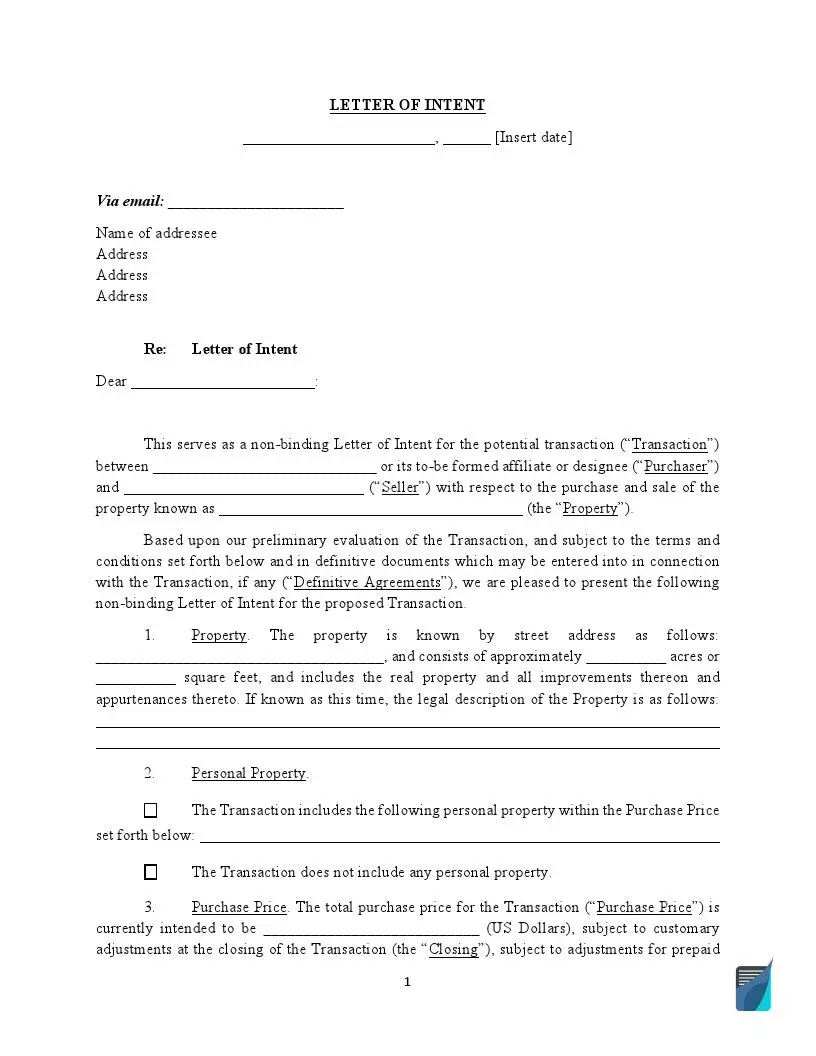
Purchase letters of intent are aimed at fixing the terms of a future purchase. The template on this page is built for buying property, and its parts run in the same order as the steps below. Fill in the blanks from top to bottom, and check each box that applies to your deal.
The screenshots under each step show the FormsPal Letter of Intent (LOI) template filled with sample entries in blue, so you can see where each answer goes. The names, addresses, dates and amounts are examples only.
Date and addressee email
Enter the day and month, then the year, on the date line under the LETTER OF INTENT heading. Add the addressee's email after "Via email".

Salutation (Re / Dear)
Type the addressee's name in the "Dear" line. The "Re: Letter of Intent" line is already printed.

Purchaser, Seller and property name
In the opening paragraph, enter the Purchaser, the Seller and the property the Transaction concerns ("known as").

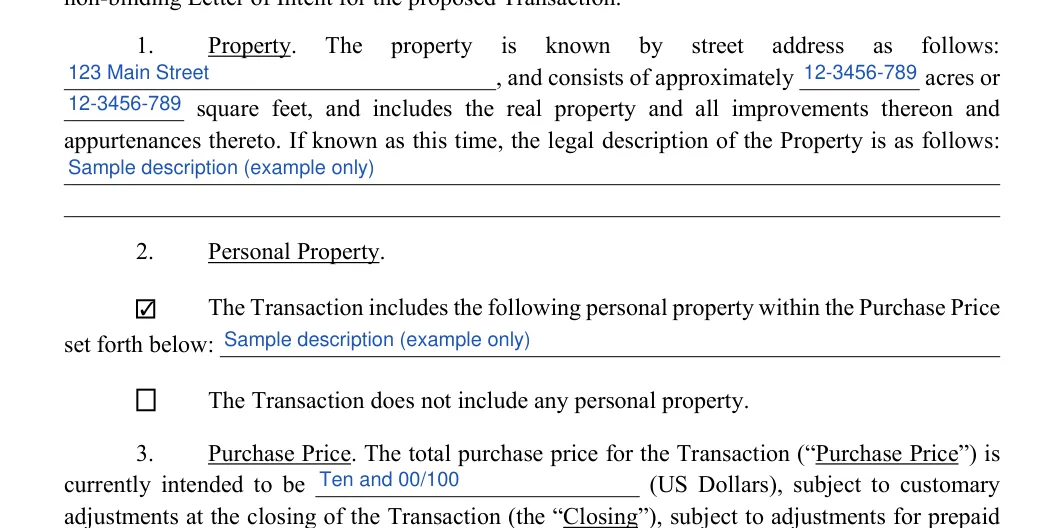
Sections 1 to 3: property, personal property, purchase price
Enter the street address, approximate acres or square feet, and the legal description if known. Under Personal Property, check either the box listing items included (and list them) or the box saying none is included. Then enter the Purchase Price in US dollars.
Gross acres assumption (optional)
If the price assumes a set acreage, check the box and enter the gross acres. Leave it blank otherwise.

Section 4: earnest money deposit and escrow agent
Enter the Deposit amount in dollars and the name of the Escrow Agent who will hold it.

Section 5: exclusivity period
To make the deal exclusive to the Purchaser, check the first box and enter the length of the Exclusivity Period, marking months or years.

Section 5: no exclusivity
To keep the deal non-exclusive until the Definitive Agreements are signed, check the second box instead and leave the period blank.

Section 6: feasibility period
To give the Purchaser a feasibility period, check the box and enter its length, marking days or months.

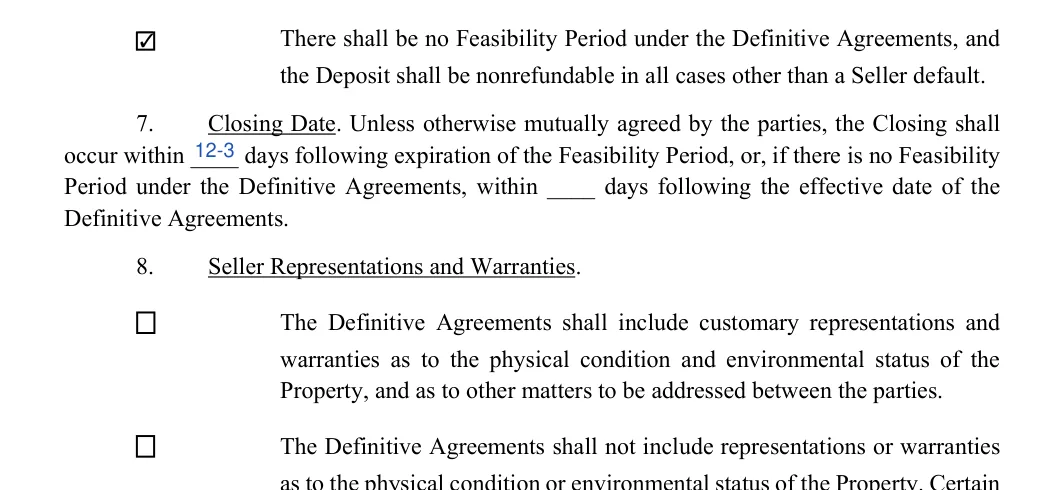
Sections 6 to 8: no feasibility, closing date, seller warranties
Check the no-feasibility box if that applies. In Section 7 enter the closing days after the Feasibility Period, or the days after the effective date of the Definitive Agreements if there is none. In Section 8 check one of the two boxes on representations and warranties.
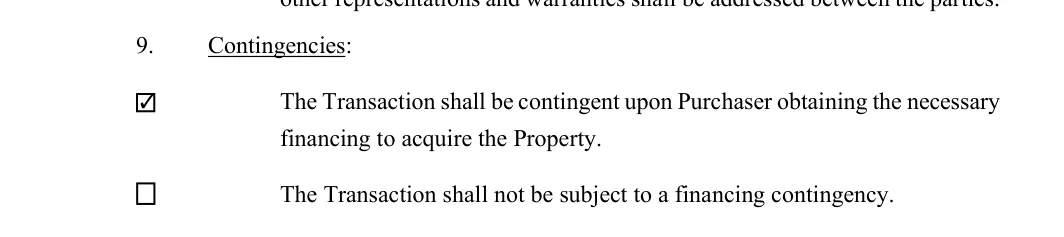
Section 9: contingencies
Check one box: the Transaction is contingent on the Purchaser obtaining financing, or it is not subject to a financing contingency.
Section 12: governing law
Enter the state you want named for the governing law. Confidentiality, Non-Binding and Severability (Sections 10, 11, 13) are printed text with nothing to fill.

Reply-by date and signing party
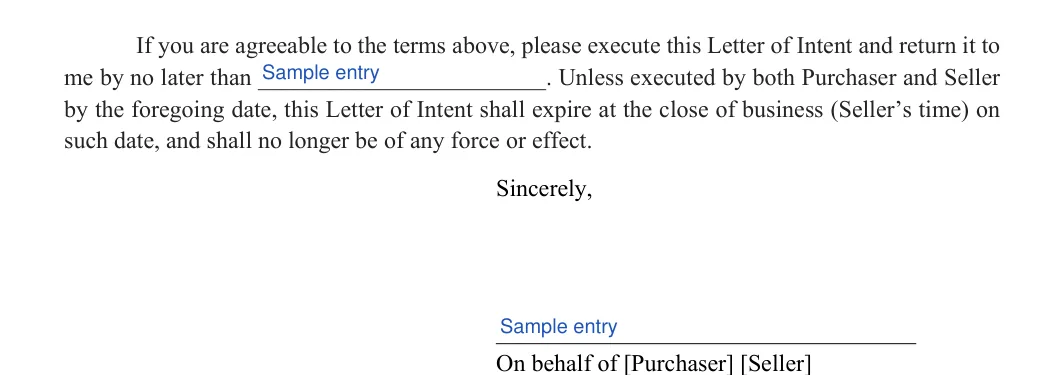
Enter the last date for signing and returning the letter. After "On behalf of" name the Purchaser or the Seller sending the letter.
Agreement date line
Enter the day and month on the "this ___ day of ____" line under the agreed-to heading. The form prints the year 2021 on that line, so check it before using the form.

Signature block (By, Name, Title)
The other party signs on the By line, then prints their name and title below it.

If you need a different type of letter, use our online document builder. You can also fill in and edit the downloaded PDF with the FormsPal PDF editor.
Use the two sample letters below as a model for layout and tone. They are resignation letters, so change the wording to fit your own letter of intent. Replace every blank with your own details and keep the letter short.
Tips for adapting a sample:
Below is a standard resignation letter sample. Of course, the reasons for resignation may differ depending on each situation. Therefore, you are free to adjust and customize the given template to your specific circumstances and liking.
____________ (the author’s full legal name)
____________ (mailing address)
____________ (city, state, and ZIP code)
____________ (the author’s contact phone number)
____________ (E-mail address)
____________ (current calendar date)
____________ (business title of the addressee)
____________ (business office address, including city, state, and ZIP code)
Dear ______________,
I have taken on a job offer at another organization (name it if necessary) and am willing to resign from my position at _____________ (indicate the full legal name of the organization you are currently working for). Therefore, please accept this letter as my formal notification to terminate the employment as of ___________ (insert the date of your last working day).
Let me thank you for the experiences and opportunities I was lucky to obtain during my time here. I will forever cherish the acquaintances I have made and the new skills I have learned. Please let me know if I could be of help during the transition period.
Kindest regards,
_____________ (the author’s signature)
_____________ (the author’s printed name)
When writing an electronic resignation letter, one must still stick to the official language and the norms used in official correspondence. Below is a standard email resignation letter template written in a friendly and polite manner. You can use it as a starting point and adjust it to your personal needs and preferences. When composing a resignation letter, keep in mind that you will most probably require recommendations from your former employee.
Subject title: Two Weeks’ Notice/Resignation Letter – ____________ (the author’s name)
Dear ___________,
I am writing to inform you that I will no longer be able to work at ___________ (enter the organization’s full business name). Please accept this message as a formal notice of my resignation and consider __________ (fill in the alleged resignation date) as my last day of work.
Let me personally express my gratitude for your solid yet wise and sensitive leadership and support. Furthermore, I appreciate the faith and trust you have had in me over the past ___ years that I have worked in the company. It was indeed an honor to be a ________ (insert the company’s business title) employee and part of such an incredible team as yours. With all sincerity, I can say that I will forever cherish the experience and the opportunities that ________ (enter the company’s title) opened before me.
I hope my resignation will not cause too much inconvenience for either you or the company. On my part, I have accumulated all the necessary information regarding the ongoing projects and am willing to help my successor blend into the working process quickly. Do not hesitate to contact me if you need my assistance with business matters. You may find my personal email address and phone number below:
_______________ (enter your phone number, if applicable)
_______________ (enter your personal email address, if applicable)
Kindest regards.
Yours sincerely,
_____________ (type in the author’s name)
A letter of intent records the main terms of a deal, a job interest or a school application before the final paperwork. Most questions are about which type to pick, how to fill in the template and what to do with the finished letter.
People use a letter of intent to record the main terms of a deal before the final contract is drafted. The same name is used for a letter that supports a job or school application. Pick the type that fits your situation in the Types section above.
The PDF is a letter of intent for buying property. For a job, school or rental move-out, open the matching sample page linked in the Types section above.
Yes. Select Create My Document at the top of the page and answer a few simple questions. You can also download the PDF and complete it by hand.
A cover letter walks through your skills for a role. A job letter of intent puts the focus on the position and the hiring company, and it describes skills more generally.
After signing, take these small steps:
General information, not legal or tax advice.
