
A school letter of intent is a short letter you send to a school’s admissions committee. It explains why you want to join a program and what you would bring to it. Use this letter of intent template to set the tone for your application and show your goals and accomplishments. Before you start writing, list the achievements that help you stand out from other applicants.
Last Updated: October 2026. This guide is reviewed and updated regularly to reflect current law. If you notice an error or outdated information, please contact us.
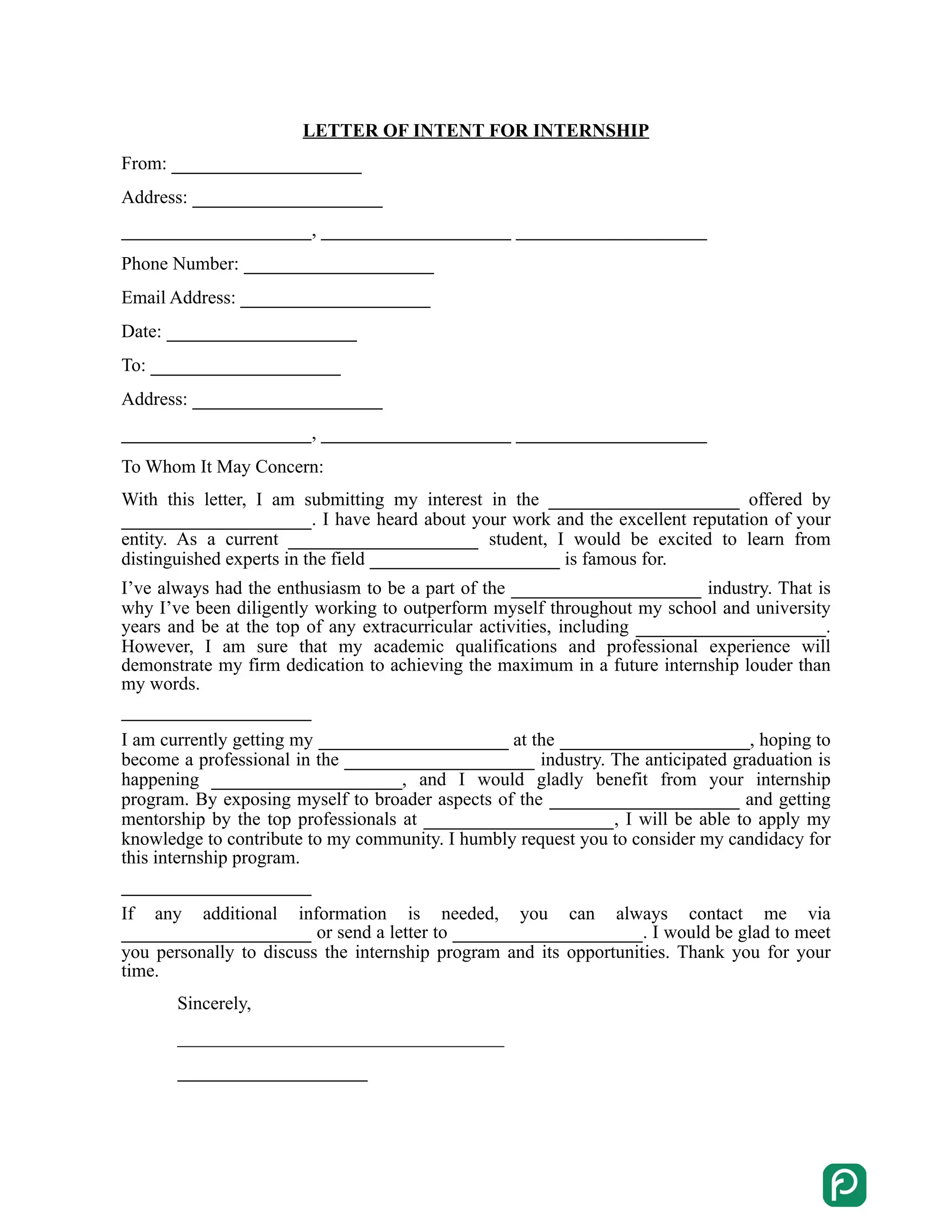
Build Your Document
Answer a few simple questions to make your document in minutes
Save and Print
Save progress and finish on any device, download and print anytime
Sign and Use
Your valid, lawyer-approved document is ready
A school letter of intent tells the admissions committee why you want to attend and what you would add to the school community. There is no standard format, and the details change from one program or school to the next. In general, a strong letter covers the points below.
A clear, specific letter gives the committee a reason to remember you. A letter that could be sent to any school rarely does that. You can see a full example in the sample letter below, which shows the style and phrases to use.
Good letters are built from facts you already know, so collect the details before you write a single sentence. Having everything in one place makes the draft faster and helps you avoid mistakes in names, dates and titles. Start with the items below.
Once you have these details, the five steps below turn into a simple fill-in exercise. You can then spend your time on the part that matters most, which is explaining why you are a good fit.
This kind of letter is short and should grab the reader’s attention from the first lines. Work through the five steps below in order. They follow the layout of a standard business letter, from your contact details to your signature.
The first sentence sets the tone for everything that follows. Here are three ways to open a letter, all written for a fictional school. Adapt the wording so it reflects your own academic background and goals.
If you would like a customized letter, use our online document builder. It asks a set of questions about you and your goals, and it produces a polished sample letter of intent in just a few minutes.
Reviewers read many letters, so clarity and focus matter more than fancy words. These practical tips help you write a letter that sounds like you and stays easy to read from the first line to the last.
The basic structure stays the same, but the emphasis changes with the goal. Pick the version that matches your situation, then adjust the key points so they speak to that reader. The Type-specific Forms list near the top of this page has a dedicated guide for each case below.
Small slips can weaken an otherwise strong letter of intent. Check your draft against the list below before you send it, and fix anything that sounds familiar. Most of these problems take only a few minutes to repair.
A professional layout shows respect for the reader and keeps your message easy to follow. Choose a clean, readable font, leave comfortable margins and use the formal letter layout from the steps above. Then run through this short checklist before you send the letter.
Keep a signed copy of the final letter. It is useful if you need to refer back to it during an interview or a follow-up conversation.
These documents look alike, but each one has a different job. A letter of intent explains why you want to join a specific school. Use the table below to see how it differs from a personal statement, a cover letter and a recommendation letter.
| Document | Who writes it | Main purpose |
|---|---|---|
| Letter of intent | You | Shows your interest in a specific school or program and what you would contribute |
| Personal statement | You | Tells a wider story about your background, interests and motivation |
| Cover letter | You | Introduces your application or resume and points to your key qualifications |
| Recommendation letter | Someone who knows you | Describes your strengths from an outside point of view |
Schools sometimes use these terms in different ways. Read the application instructions and use the format the school asks for.
The sample below shows how the steps above come together in one letter. The applicant introduces herself, shares her background, explains why she chose the school and closes politely. Use it as a guide for structure and tone, and replace every detail with your own.
From: Elisa Morris
82 Briarwood St.
Houston, TX 77081
Phone number: +1334557668
April 4, 2021
To: The Dean of Studies
Texas A&M University Baylor College of Dentistry
3302 Gaston Ave, Dallas, TX 75246
Dear Sir/Madam,
I am Elisa Morris, and I am applying for a dental school this fall season. I have a Bachelor of Science in Biochemistry and have been a high-achieving student intending to pursue a career in dentistry. I believe that I have the drive and patience to become a successful dentist.
During a year of working in the dental office as a dental assistant, I gained valuable dental techniques and processes. Some of my duties were preparing equipment and doing basic check-ups. Furthermore, I had to build rapport with clients, which helped me improve my organizational and communication skills. Throughout my work there, I was able to show high performance, which can be proved by my supervisor in the letter of recommendation she kindly provided.
I believe that Texas A&M University Baylor College of Dentistry is exactly the type of school that will help me master the skills necessary for becoming a professional in the dental field. Most of all, I appreciate that your dental school curriculum involves an abundance of hands-on practice that surely helps prepare the best experts in dentistry.
Thank you for your time and consideration. I look forward to hearing from you.
Sincerely,
Elisa Morris
Not every applicant has a long record to share. This shorter sample shows how a transfer student can keep a letter focused. Replace the names, school and details with your own.
Dear Ms. Carter,
My name is Anna Baker, and I am applying to transfer to Riverside University this fall. I am finishing my second year of business studies at Lakeview Community College, where I have kept a strong GPA while working part time.
I chose Riverside University because of its small seminars and its student-run consulting club. I have led two team projects at Lakeview, and I would like to bring that teamwork to your campus. Your finance track would help me reach my goal of becoming a financial analyst.
Thank you for reading my letter. I would be glad to share my transcript or answer any questions.
Respectfully,
Anna Baker
123 Main Street, Springfield
anna.baker@example.com
Aim for one page. A short letter with focused paragraphs is easier for the committee to read. If the school gives its own instructions for length or format, follow those first.
A letter of intent focuses on why you want to join a particular school or program. A personal statement tells a wider story about your background, interests and motivation. Some schools ask for both, so read the application instructions carefully.
Address it to the person in charge of admissions, such as the dean of studies or an admissions director. You can find the name in a few places:
If you still cannot find a name, use a respectful greeting such as “Dear Admissions Committee.”
Yes. A template gives you a clear layout and sample phrases. Then you add your own goals, strengths and reasons for choosing the school so the letter sounds like you. Our online document builder walks you through each part with simple questions.
It is better to tailor each letter. Change the school name, the course of study and the reasons you give for choosing it. Committees can tell when a letter was written for a different school, and a personal detail shows real interest.
Use a formal but friendly tone. Write in your own voice, keep sentences clear and avoid slang or exaggerated praise. Aim to sound confident and sincere, as if you were speaking to the reviewers in person.
If your GPA is strong, a brief mention helps. Place it next to the achievements it supports, such as a degree in a relevant field. If it is lower, focus on other strengths, such as projects, work experience and recommendations.
Keep a copy and note the date you sent it. If you do not hear back after a reasonable time, send a short and polite follow-up to the school office. Thank the reader again and ask whether they need any additional information.
General information, not legal or tax advice.
