
A residency letter of intent (LOI) is a letter sent to a residency program director as part of post-interview communication to attend the desired program. It follows your rank order list of the programs you would like to attend. The school letter of intent, in this case, is your chance to name your top program and tell its directors why you want it. Learn more about this in our full article.
Last Updated: October 2026. This guide is reviewed and updated regularly to reflect current law. If you notice an error or outdated information, please contact us.
Build Your Document
Answer a few simple questions to make your document in minutes
Save and Print
Save progress and finish on any device, download and print anytime
Sign and Use
Your valid, lawyer-approved document is ready
A well-written residency LOI increases the chances of matching your top-choice program. As we have said, it is not an imperative part of applying to residencies, but taking your time to create one will never hurt.
It will show that you have put your best efforts to increase your chances of being ranked highly with your residency application. Not all medical residency programs will take a LOI into consideration, but you never know whether your dream program is among them.
Interesting statistics — a 2014 survey of directors of one of the USA residency programs showed that you increase your chances of being ranked highly with your residency application by almost 30% if you accompany it with a good residency LOI.
Yes, you can receive a match without a letter of intent. An outstanding application and a successful interview are surefire ways to become a resident at a desired medical residency program. Essentially, your letter helps you stand out from other applicants who are at about the same level in the program’s ranking but failed to take their chance and write a good letter of intent.
However, you should be confident about your application and interview to ensure that your LOI actually increases your chances. If you haven’t done well at previous stages, even the best letter of intent is unlikely to make much difference.
A residency letter of intent gives you room to:
A residency letter of intent is short and follows a simple order. You begin with contact details, state your purpose, explain why the program is your top choice, and close with a confident thank-you. Follow the four steps below to build your own letter.
Add the contact details.
Start with your name and address in the top left corner. Add the date beneath it.
Under the date, list the program director's name, title and the address of the medical facility where they work.
Write the opening.
Greet the program director with a respectful line such as "Dear Dr. [Last name]," and say why you are writing. In our case, the purpose is to show your strong interest in the residency program.
This section might reveal that you were impressed by your visit to the medical facility when you had an interview, and in this letter, you want to tell why you think you would be a good fit for the program.
Explain the benefits of the program.
Next, say why you consider this program the right residency for you. Be specific about what makes it your top choice.
Good reasons include research opportunities, a flexible curriculum, matching research interests, a good location, or the range of experiences the program offers. You can spread them over several paragraphs. Keep the whole letter to one page, about 250 to 270 words.
Close the letter.
End by saying that you want to attend the program and plan to rank it first on your list. Add a confident statement that you would be a good fit, and show that both you and the program would benefit if you become a resident.
Finish with the word "Sincerely" and your name.
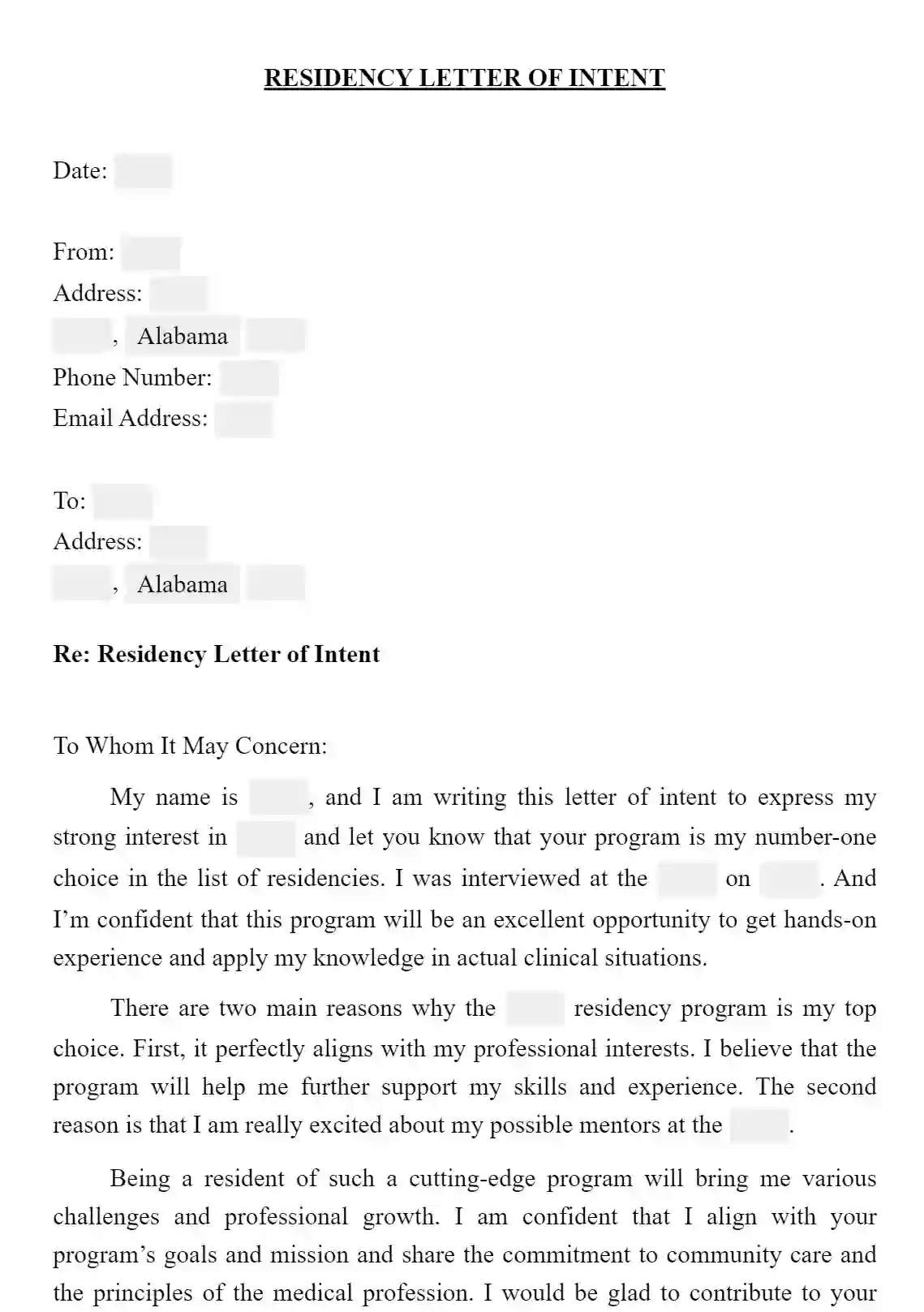
Not sure how the finished letter looks? Read the sample below, or select Create My Document at the top of this page to build your own online.
Use this sample as a guide for your own letter. Swap in your name, the program and your reasons, and keep the same order: contact details, opening, reasons, update and thank-you. The names, address and dates below are made up.
From: Jonas Jones
47 Rockledge St. Pasadena, TX 77506
Email: jonas.jones@example.com
Phone number: +1555444786
To: Dr. Eric Johnson
Program Director
The Johns Hopkins University School of Medicine
Baltimore, Maryland
Dear Dr. Johnson,
My name is Jonas Jones. I was honored to be interviewed about the Endocrinology Residency Program you offer on February 25, 2021, and share my goals with renowned Dr. Brown. I am writing this letter of intent to express my strong interest in the program and let you know that your program is my number-one choice in my list of residencies. Given the opportunity to join it, I will gladly accept the offer. With this letter, I would also like to update you on my recent activities.
There are two main reasons why The Johns Hopkins University School of Medicine residency program is my top choice. The first reason is that it perfectly aligns with my professional interests. The program will help me further support them by creating a new generation of drugs for patients with endocrine disorders. The second reason is that I am really excited about my possible mentors at The Johns Hopkins University School of Medicine. I would be honored to get involved in the projects supervised by reputed Dr. Brown and Dr. Grisley.
What excites me when I think about the residency program is facing various challenges and professional growth when being a resident of such a cutting-edge program. I am confident that I align with your program’s goals and mission and share the commitment to community care and the principles of the medical profession.
Furthermore, I would be glad to contribute to your programs’ reputation using my research experience in endocrine disorders. Finally, it would be a great honor for me to be given a chance to complete the final stages of my training at The Johns Hopkins University School of Medicine.
Regarding some updates to my application materials, I would like to tell you that I was recently invited to participate in the American Association of Clinical Endocrinologists’ (AACE) 30th Annual Scientific & Clinical Congress. There, I will have a chance to present my latest publication in thyroid disorders.
Thank you for your consideration. For any additional information, please contact me at my email or phone number.
Sincerely,
Jonas Jones
Here is what makes this sample easy to follow:
The first two sentences set the tone for the whole letter. They tell the reader who you are, which program you mean and that it is your first choice. Here are three openings you can adapt to your own situation.
Pick the opening that sounds most like you, then replace the program name and the details with your own. Read it out loud to hear whether it sounds like something you would actually say.
A personal letter shows that you did your homework. Instead of general praise, point to details that only this program can offer. Three kinds of detail work well, and each takes only a sentence or two.
If you met a faculty member during your interview, say so. Mention a research project, clinic or teaching style that stood out and explain how it fits your goals. One concrete detail is worth more than several general compliments.
Link your past experience to what the program does. If you worked in a research lab, volunteered at a community clinic or led a student group, say how that experience prepares you for the work you would do as a resident.
Add one short update, such as a new publication, a poster or a finished rotation. Keep it to a sentence or two so the letter stays focused on your interest in the program.
These phrases give you a starting point when the words do not come easily. Change the details so each one is true for you, and drop any that do not sound like your voice.
Sometimes a short email is the better fit than a full letter. This version says the same things in about a hundred words, so you can send it quickly and keep the reader's attention.
Subject: Letter of Intent: Jonas Jones, Endocrinology Residency
Dear Dr. Johnson,
Thank you for interviewing me for the Endocrinology Residency Program at The Johns Hopkins University School of Medicine. After meeting your faculty and residents, I am certain that your program is my first choice, and I plan to rank it first.
I am especially drawn to the program's work on endocrine disorders and to the chance to learn from Dr. Brown and Dr. Grisley. My research experience in thyroid disorders would let me contribute to your team from the start.
Thank you for your consideration. You can reach me at jonas.jones@example.com.
Sincerely,
Jonas Jones
A strong residency letter of intent is specific, short and sincere. It names the program, explains your reasons in your own words and stays on one page. Use these tips to polish your draft before you send it.
Weak letters often share the same few problems. They sound generic, repeat the application, or run too long. Check your draft against the list below and fix anything that applies before you send it.
A letter of interest and a letter of intent look alike, but they say different things. A letter of interest tells a program that you like it. A letter of intent tells one program that it is your first choice. The table below shows the main differences.
| Letter of interest | Letter of intent | |
|---|---|---|
| What it says | You like the program and want to be considered | The program is your first choice |
| Programs you write to | Several programs | One program |
| Tone | Warm and curious | Confident and specific |
| Main goal | Share your enthusiasm | State your final preference |
Once your letter is ready, send it in a way that is easy for the program to open and read. Keep the message simple and make sure your name and the name of the program are easy to find.
Take five minutes for a last review before you hit send. Check each item below, and give the letter one more careful read if you cannot answer yes to all of them.
Once the letter is on its way, the best next step is patience. Keep your communication with the program professional and brief, and put your energy into the rest of your application.
Address it to the program director. Check the program's website for the correct name and title, and write them exactly as they appear there. If you cannot find a name, call the program office and ask who should receive your letter.
Keep it to one page, about 250 to 270 words. A short letter is easier to read and easier to remember.
Write a separate letter for each program. Name the program, the faculty or research areas that interest you, and your reasons for wanting to train there.
Select Create My Document at the top of this page and answer a few questions. You can then save your progress, download the letter and print it.
General information, not legal or tax advice.
