
A bill of sale is a legal document that records a private sale of property between a buyer and a seller. It serves as proof of purchase, like a receipt, and can also carry extra terms, like a purchase agreement.
Last Updated: October 2026. This guide is reviewed and updated regularly to reflect current law. If you notice an error or outdated information, please contact us.
We provide fillable bill of sale templates for every type of property and every US state. Download a free template in PDF or Word format, or choose your state or property type from the lists above. You can also use our document builder to create a custom bill of sale step by step.
A bill of sale acts as a receipt and documents a sales transaction. It proves that an item passed from the seller to the buyer. A bill of sale contains the essential information about the sale and the condition of the personal property being sold. It is often used in car, motorcycle, watercraft, and gun deals.
Many states ask for this document during vehicle registration and title transfer.
After you complete a bill of sale, make sure both parties sign it and keep a copy. A signed copy gives each side a written record of the sale.
A bill of sale relies on a few terms that carry real consequences, including as-is and VIN. The list below defines each one in plain words so you can fill out the form correctly and understand what both parties agree to by signing.
The contents of a bill of sale vary with the type of property you sell. The main property categories are motor vehicles, animals, and personal property. The payment terms and ownership conditions add a second split, because a bill of sale is either absolute or conditional.
Typical items in each property category:
A bill of sale is called absolute when the buyer pays the whole amount at the time of the private sale. No warranties or ownership conditions are specified, so neither party owes the other anything after the transaction.
Example: If you buy a used vehicle in “as-is” condition and pay for it fully during the vehicle transfer, the seller will draft an absolute bill of sale.
Every bill of sale form here is absolute until you add special instructions, which you can do in any template we offer.
A bill of sale is called conditional if the seller sets special conditions for the payment or ownership of the item being sold.
Example 1: You want to buy a used car and pay for it in installments. You keep the right to own the car only if you pay each installment as the bill of sale states. If you miss payments, the seller may be able to take the car back.
Example 2: You want to buy a kitten, but the seller will give it to you only once it reaches the age of six months. You can fill out a bill of sale with such a condition beforehand and receive the kitten once this condition is met.
A bill of sale is worth using when you sell personal property of significant value. It matters most when you do not know the other party well, for instance when buying or selling online. The document provides a layer of security for both parties. Common cases include:
Sometimes you do not need a bill of sale, or a different document fits better. Such cases include:
Business or stock sales. Selling a business is usually much more complicated than selling a car. We recommend a business purchase agreement instead, which is more flexible and gives both parties more protection. For stocks, you can use a stocks purchase agreement template.
Real estate sales. Selling a house or apartment involves a lot of paperwork, and a bill of sale is not enough for such a complex transaction. A real estate purchase agreement covers most aspects of the sale, and numerous addendum forms can supplement it if needed.
Inexpensive things. You can create a bill of sale for any personal property transaction, but for many people, selling a toaster or an old carpet is not worth the extra paperwork.
A bill of sale works best when it is accurate and complete. A thorough form serves as evidence that ownership changed hands and as a reference if a dispute comes up later. If you draft one yourself, include the following:
This walkthrough uses our free motor vehicle bill of sale template, the same form the document builder creates. Each step below matches one part of the form, so you can follow along whether you fill in the PDF or Word file yourself or use the builder.
Programs like Microsoft Word, Adobe PDF, or OpenDocument Text let you edit and print downloadable templates. Fill in the blanks to create a bill of sale yourself. You can download our free template in Adobe PDF or Microsoft Word (DOCX) format.
You can also create a personalized bill of sale with our document builder. Start by clicking the "Create My Document" button.
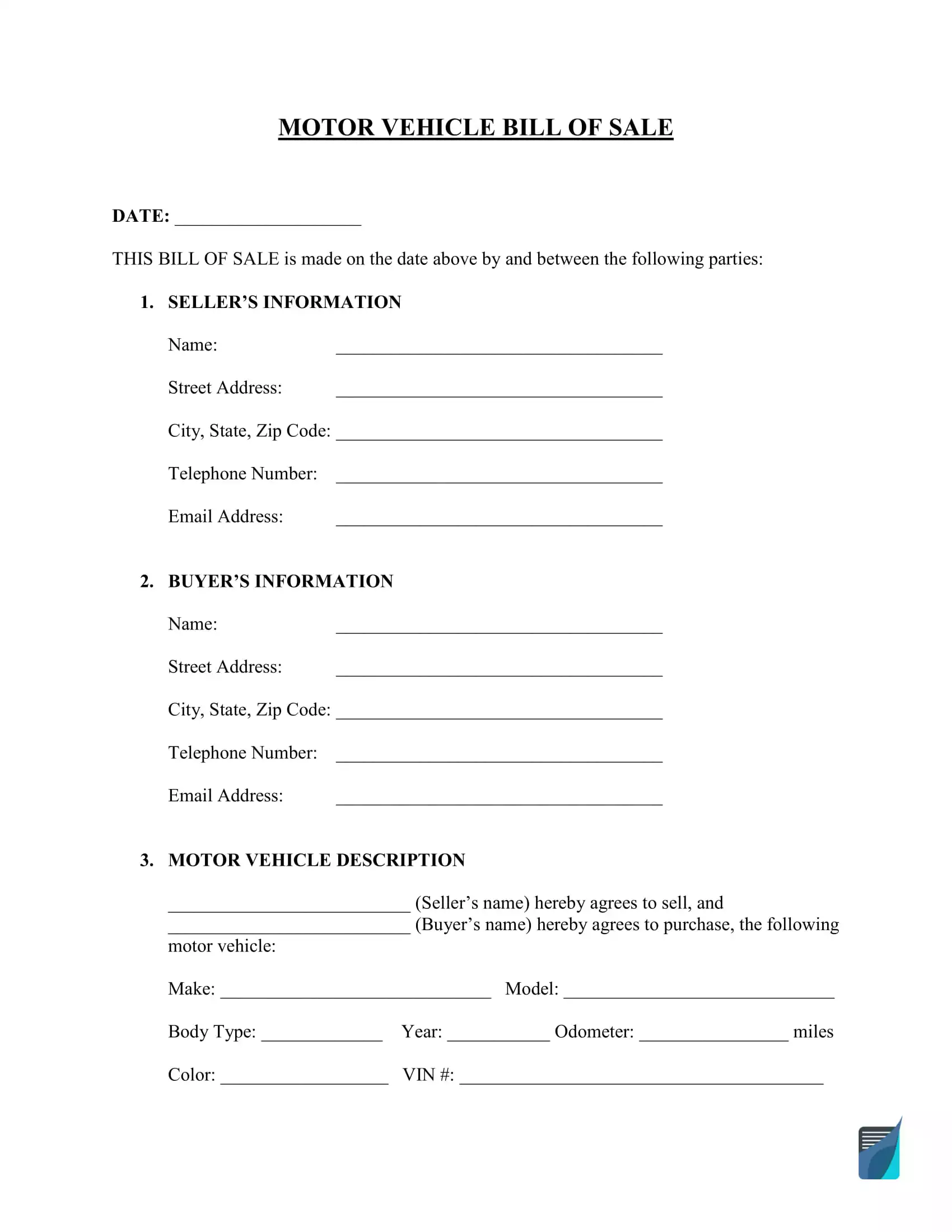
Below are detailed instructions on how to write a bill of sale using our free printable template for a vehicle deal.
Start by typing in the transaction date and the buyer and seller’s full names, addresses, and contact details. The contact details are optional but recommended.

Write down the vehicle's make, model, body type, color, year, odometer reading, and 17-character vehicle identification number (VIN). Together, these details identify one specific vehicle.

Choose the transaction type: full payment, payment in parts, trade-in, or gift. For a sale, enter the total selling price of the vehicle and how the buyer will pay: cash, check, money order, or another method.
Our bill of sale template offers an option to pay in parts if the buyer does not have enough funds. If you choose it, enter the amount of the first payment (deposit) and the date by which the buyer must pay the rest.

A promissory note for a car is often a better fit for a vehicle purchase paid in installments, because it sets out the repayment terms in detail. Consider it first if you plan to pay in parts.
If you are trading, describe the trade-in vehicle offered by the buyer with all the details from the previous step.
The first checkbox states that the municipal, county, state, and sales taxes related to the item or motor vehicle are included in the price. Whether any tax applies depends on your state and the type of property, so check with your state's tax or motor vehicle office.
The second checkbox states that the buyer pays all related taxes.

Leave an additional spot open for any extra terms and conditions. For instance, if the vehicle being traded includes floor mats or other accessories, use that space to list them below the VIN and sales tax information.
Many motor vehicle sales call for an Odometer Disclosure Statement, and our template includes one. It confirms that both the buyer and the seller knew the vehicle's actual mileage at the time of the sale. The first three entries are simple:
Then, you need to choose one of the three statements:
The second option implies that the reading rolled over the 99,999 miles mark on a five-digit odometer or the 999,999 miles mark on a six-digit odometer.
Option three means the rightful owner of the vehicle doesn’t know if the mileage is correct because the odometer has been replaced or broken.

Our template includes a Certificate of Acknowledgement at the bottom of the document. A notary public completes this part during the item transfer or document signing.
It is also recommended that both parties keep a copy of the finalized bill of sale for any future procedures that might need it.

Most states do not require a bill of sale to be notarized, but a few ask for notarization in certain situations, such as a vehicle title transfer. The table below shows how six states handle it and what to expect elsewhere. Rules change, so confirm the current rule with your state's motor vehicle office or on your state page.
| State | Notarization Required? | Notes |
|---|---|---|
| Louisiana | Yes, required | Needed to title and register a used vehicle |
| Maryland | Sometimes | Only for some used vehicle sales priced far below book value |
| Montana | Not required | No state law requires a bill of sale to be notarized |
| Nebraska | Not for ordinary sales | Only an unusual transfer without a title runs on a notarized form |
| New Hampshire | Not required | No state law requires a bill of sale to be notarized |
| West Virginia | Conditional | Notarized bill of sale only when the price is below 50 percent of NADA clean loan value, and the title assignment is sworn |
| All other states | Varies | Many states do not require it, and some require it in certain cases |
Even where notarization is optional, a notary adds protection. The notary confirms who signed and when, so a notarized bill of sale is harder for either side to dispute later.
A simple bill of sale is a one-page form that covers only the essentials. It lists the buyer and seller full names, a description of the item, the purchase price, the date of sale, and both signatures. It omits optional fields like odometer disclosure, installment payment schedules, or trade-in details. Use a simple bill of sale for straightforward cash sales of personal property such as furniture, electronics, tools, or equipment.
Yes, in general. A bill of sale does not need an attorney to serve as a valid record of a sale. If it identifies the parties, the item, the price, and the date, and both parties sign, a free template is generally accepted. Some states add requirements such as notarization or a state form, so check your state's page.
Yes, in general. Many states accept a handwritten bill of sale that holds the essential details: the buyer and seller names and addresses, a description of the item (plus the VIN for a vehicle), the price, the date, and the seller's signature. A typed template is easier to read and helps you avoid leaving something out.
To create a homemade bill of sale, write or type the following on a plain piece of paper:
If your state requires notarization, have a notary witness the signing. You can also download our free template above so no field is missed.
For most people, PDF is the best choice because it looks the same on every device and printer and prevents accidental edits after completion. Word (DOCX) is better if you need to customize the template, for example by adding extra terms or adjusting fields for a non-vehicle transaction. Both formats are free to download on this page.
It depends on your state, so check your state page or motor vehicle office first. Some states ask for a bill of sale when you title or register a vehicle, and others treat it as optional. Even where it is optional, it records the date, the price, and the buyer. Without one, a seller may lack written proof of when the vehicle changed hands.
A bill of sale alone is not proof of ownership, only of a sales transaction. For vehicles, ownership is established by the certificate of title issued by your state. A bill of sale supports the title transfer and records the agreed purchase price. For items that do not have a title, such as furniture, electronics, or pets, a bill of sale is typically the primary documentation of the ownership transfer.
General information, not legal or tax advice.
