
A cat bill of sale is a written receipt that records the sale of a cat or kitten between a seller and a buyer. This bill of sale form must be available at the moment when the customer provides money for the purchase of an animal. After the cat or kitten has been bought, the previous owner does not bear liability for any future expenses. This legal document should come with the signature of the witness(es) provided by a state notary.
Last Updated: October 2026. This guide is reviewed and updated regularly to reflect current law. If you notice an error or outdated information, please contact us.
Some people mistakenly believe that a kitten bill of sale and an adoption agreement are the same things. The goal of any bill of sale is the provision of transaction proof including such vital information as who the seller is, who the purchaser is, the item/service/creature being sold, and the settled price. It serves as the major legal paper that records the detailed data of the sale.
In the meantime, the primary purpose of the adoption contract is to ascertain that the animal will be in a safe home. Such agreements often contain these points:
Adoption agreements also often guarantee that if the pet is in danger, the previous owner will be endowed with the right to regain ownership of the cat. This documentation may indicate information about what is required from the seller, for instance ensuring special vaccinations before the sale, deworming, and a veterinary health certificate.
The current owner of the pet writes a sales agreement by mixing vital details of the bill of sale and adoption contract. Any legal paper that you put your signature on when buying or adopting a cat or kitten — a bill of sale form, adoption documentation, or a pet sale agreement — is legally binding.
So, why would one use such a document? The kitten bill of sale form is required to make the transaction lawful and obliging between the previous owner of the pet and the buyer. It establishes the rules and conditions of agreements, provides a full description of the cat put up for sale, specifies the purchase cost, and indicates the personal information of both parties.
In essence, it represents a payment receipt that secures the buyer and seller from a possible scam, disagreements, or other issues occurring during the sale. This bill of sale works as the defining document for proving ownership, which is critical when the purchaser presents cash for a kitten that is not yet ready to leave its current place of stay. Such a paper protects the rights of both parties of the deal.
| Document Name | Cat Bill of Sale Form |
| Other Name | Kitten Bill of Sale |
| Avg. Time to Fill Out | 8 minutes |
| # of Fillable Fields | 58 |
| Available Formats | Adobe PDF; Microsoft Word |
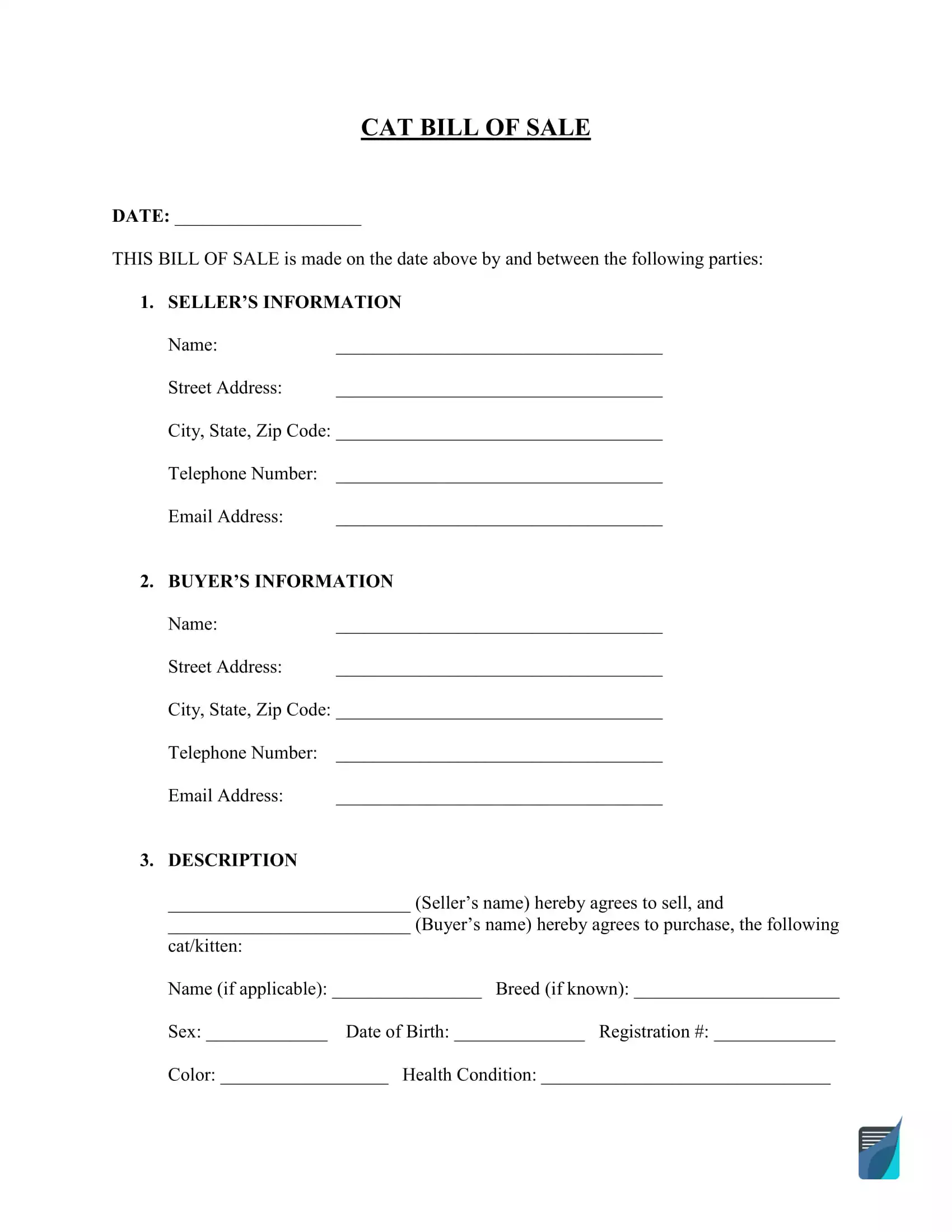
The cat bill of sale form, just like any other legal documentation, might be quite complicated. Taking that fact into account, we offer a bill of sale form that you can easily download from our website and use to sell a cat or kitten. Our forms are fillable and accessible in the most widespread formats supported by Microsoft Word and PDF readers. Hence, you may quickly add any relevant information and crucial details of your sale and print out the completed document.
Besides that, you can create a highly customized form of a kitten bill of sale using our step-by-step builder.
Have these points ready before you fill in the form or meet a lawyer:
You can contact a lawyer specializing in bill of sale forms. However, even a brief consultation on the topic wouldn’t be free. Competent lawyers can prepare a top-quality document for you, saving you from the need to write it on your own. In case you have decided to address a law firm for assistance, bear in mind that you will have to figure out specific points of your future sale contract beforehand.
Once you have learned all of the specifics of such a bill of sale, now it is time to get ready to sell your pet. Adhere to our instructions below to be sure that you have finished preparations before helping your cat find a new home.
Step 1. Get the Necessary Details

Write down all essential information concerning the kitten – its breed, age, vaccinations, if it has been neutered, its state of health, and other crucial details that a new owner should know. To determine the price, look up similar advertisements in your region.
Step 2. Advertise

Contact your family, friends, and close acquaintances to let them know that you have a cat for sale. Do not forget to publish advertisements on social networks and bulletin boards. You may also try the following pet sale platforms where you can sell your pet to a reliable purchaser:
Step 3. Ask Prospective Customers Vital Questions

As soon as you have several customers, ask them to see the cat in person (or its parents, if the kitten has not yet been born). Ask every potential buyer a few simple questions such as why he or she wants to buy this cat and what environment they have in their home. Another great idea would be to do a house check. It will help you be more confident that you are giving your pet to a responsible and loving family.
Step 4. Complete a Bill of Sale

After agreeing on the price with the chosen buyer, complete a cat bill of sale to protect both parties of the deal. Make sure to add the following details to this document:
Step 5. Notarize the Document

When the feline bill of sale is filled out, money is paid, and the ownership is passed, get the form signed by a public notary to finalize the sale.
The filling guide is intended around the cat (kitten) bill of sale form created by us. But, it is best to opt for the official document when it’s provided by the local governmental bodies.
Step 1: Specify the date when the document is created.

Step 2: Provide the information of both parties (seller and purchaser):

Step 3: Insert the specific infection about the cat or kitten that will change the owner according to this document:

Step 4: At this point, you should choose the way you will get money for the deal.
This part also involves providing the date of the purchase and the overall amount approved by all parties of the transfer. After that’s been performed, you need to indicate the way of transaction:
The next step is deciding on the way of payment:

Step 5: Check the miscellaneous terms.
This part normally contains the “as-is” paragraph that means the cat is purchased with no warranty and the seller is not liable for any issues with the animal after the deal.

Think twice before you agree to an as-is clause. In 16 of the 18 states FormsPal's verified state data covers, a rule sets a time limit for a buyer to claim a remedy if the animal is ill.
The limit runs from 7 to 21 days in the 13 states that count in days. It runs from 7 to 14 business days in the 2 states that count in business days.
In 2 of the 18 states covered, an agreement that waives the buyer's rights under the state's pet sale law is void. Each state words its rules differently, so read your own state's rules before you sign.
Step 6: Now, the document has to be signed.
The buyer’s signature is generally not necessary. However, you will be more protected from legal complications if both parties sign the cat bill of sale form. As an extra safety measure, you can have one or two people attest the process and sign the form.

Step 7: Use the assistance of a notary public
Notarization is generally not mandatory, but it is an excellent option to introduce another layer of legal safety to your transaction. After that, it is prudent for both parties to keep an original or a copied version of the document.

These answers cover what sellers and buyers ask most often when they sell a cat or kitten with a bill of sale. Each one shows what FormsPal's verified state data says across the 18 states it covers, and what to write in your bill of sale. Read your own state's rules before you sign.
In 8 of the 18 states FormsPal's verified state data covers, a rule sets a minimum age for selling a kitten. The minimum is from 7 to 8 weeks, depending on the state. Mind that a kitten can be sold when it is 2-3 months old depending on whether their mother’s milk represents their primary food source.
The rule depends on the state. FormsPal's verified state data covers 18 states, and it shows these rules:
Write the cat's health condition and any vaccinations in the bill of sale.
In 14 of the 18 states FormsPal's verified state data covers, a seller must give the buyer a written notice of the buyer's rights. In 13 of the 18 states covered, a seller must also give the buyer a written disclosure about the animal. In 2 of the 18 states covered, the seller must post a notice of those rights where buyers can see it.
In 14 of the 18 states FormsPal's verified state data covers, a rule gives the buyer a refund or a replacement if the animal is ill or has a congenital defect. Other rules cover the amount and the timing:
The congenital defect limit runs from 10 to 180 days in the 3 states that count in days. It is 6 months in the 2 states that count in months and 1 year in the 5 states that count in years. Count the days from the sale date with the deadline calculator.
Yes. Download the PDF or Word file above and type your details into it. You can fill in and sign the PDF with the online PDF editor, then print one copy for the seller and one for the buyer.
General information, not legal or tax advice.
