
A livestock bill of sale is a document used during a sale or purchase of farm animals. These include chicken, cows, sheep, pigs, horses, and other domestic animals. When the buyer and seller come to a consensus, the bill of sale document will act as a binding contract of the deal. It provides evidence that the transfer will occur at a particular date, the cost of the livestock, as well as the payment details.
Last Updated: October 2026. This guide is reviewed and updated regularly to reflect current law. If you notice an error or outdated information, please contact us.
Whether you want to sell or buy a goat or any other animal, it is paramount to use a livestock bill of sale. The document protects the interests of both parties in the agreement in case of fallout. It is a binding form that shows proof of transaction, date of sale, names, and signatures of all parties involved.
Hence, it compels each person to keep their end of the deal without malice. It also prevents liability issues from the new owner after the animal has been sold.
The details on the form allow the transaction to happen seamlessly without any issues. After the buyer verifies that the livestock is indeed what is in the agreement, the transfer can occur without either party feeling shortchanged.
| Document Name | Livestock Bill of Sale Form |
| Other Names | Cattle Bill of Sale, Animal Bill of Sale |
| Avg. Time to Fill Out | 15 minutes |
| # of Fillable Fields | 86 |
| Available Formats | Adobe PDF; Microsoft Word |
It is challenging to compose a livestock bill of sale, especially for first-timers. With all of the legal jargon and contract terminologies, you may be confused about where to start. That is why we offer customized bill of sale templates on our website. You have two options:
You also have an option to contact lawyers on how to conduct your sale or purchase. Although it is costly, you will get a high-quality document. Each law firm has its price, and if you are on a budget, you will have to scout for a reasonable deal. It might be cumbersome, plus you will have to reveal too much information such as your physical address and other private details.
So, take advantage of the online livestock bill of sale and proceed to look for prospective buyers.
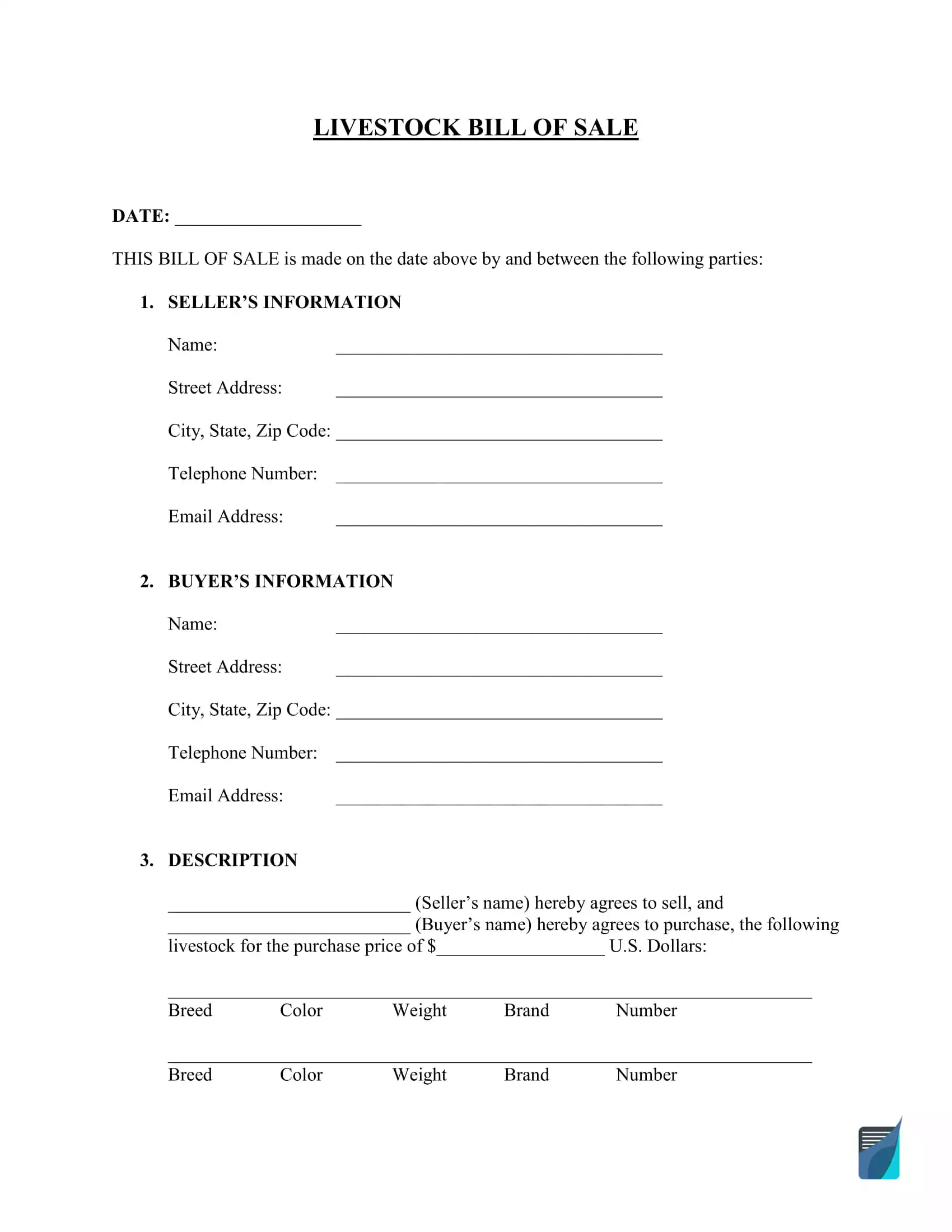
You can sell livestock at a public auction or by word of mouth. If you have no idea how to fill out an animal bill of sale, follow our step by step guide below:
Step 1. Describe the Livestock

Make a detailed description of the animal. Include the type of breed, the color, weight, vaccination history, and health details, plus any additional information that a prospective buyer needs to know. Take good pictures, if possible, and be honest about the condition of the livestock.
Step 2. Set the Price of Your Animals

Come up with a reasonable price for the animal considering the current market price. Do not exaggerate since you might chase away prospective buyers.
Step 3. Offer Your Livestock for Sale

Here, you need to know where and how you will sell your animal. Is it a public auction, private farm sale, or a local arrangement with the buyer? Whatever your decision, ensure that your bill of sale is ready.
Step 4. Meet With Potential Buyers

Arrange an official meeting with the prospective buyer and proceed with negotiations. If there is a consensus, plan for an inspection after the signing the livestock bill of sale below.
The sale agreement allows the seller to carry out a health inspection with a professional veterinary officer to ascertain the current state of the animal. This typically happens after signing the agreement or before the sale date. If the animal is in good condition, the deal will be made as per the agreement and payments finalized in the presence of witnesses and a legal representative.
Step 5. Complete a Livestock Bill of Sale Template

Here are the details in the bill of sale:
Sale Date
You can get a certificate of acknowledgment from a legal representative as insurance of the new ownership.
A livestock sale can involve more than a signed form. In the 41 states FormsPal's verified state data covers, the same few topics come up: proof of ownership, brand papers, transport papers, and veterinary papers.
A signed bill of sale is a simple way to keep that proof ready.
If your animals carry a brand, write it on the bill of sale.
The completing guide is intended around the bill of sale for livestock template created by our company. Nonetheless, you should opt for the official document when it’s available from your local authorities.
Step 1: Specify the document’s creation date.

Step 2: Provide the particulars of each party (purchaser and seller):

Step 3: Enter the detailed information about the livestock you’re selling:

Step 4: Indicate the transaction method and total price.
Enter the sale date and write the overall amount that must be paid for the livestock. You must also mark the sale method the purchaser will use:
The next step is choosing the kind of payment:

Step 5: Livestock Health Representations
Read and check all that apply

Step 6: Read the miscellaneous provisions.
This provision points that the seller is the owner and that there are no outstanding liens or debts of any kind on the animals. It also states that the information is filled out as accurately and to the best of the seller’s knowledge.
This provision points that the buyer is now fully responsible for any and all future activities of the livestock.

Step 7: Place your signature(s) in the corresponding fields.
The buyer is generally not requested to sign the form. Nonetheless, it’s recommended to have the bill of sale signed by all parties. You could also have one or several witnesses confirm the transaction.

Step 8: Have a notary public certify the form
In this way, you’ll have even more legal protection. But, this is normally entirely elective.

Here is a made-up sale that shows how the details fit together. Anna Baker sells 12 black Angus heifers to Ben Carter at her ranch on 123 Main Street. Each animal weighs about 650 pounds, wears an ear tag numbered 101 to 112, and carries the Baker Ranch brand.
Your own sale will look different, but each of these items has a line on the template.
Problems with a livestock sale often start with a form that is missing detail. A few small habits keep your paperwork clear and useful if a question comes up later. Check your document against this list before you sign.
Give both the buyer and the seller a signed copy once the document is complete. You can save the PDF or Word file and print as many copies as you need.
Read the finished form before anyone signs. A wrong breed, brand, or number of animals is hard to fix once the animals have left the farm.
In 2 of the 41 states FormsPal's verified state data covers, a witness or notarization is required for a livestock sale. Meanwhile, 3 of the 41 states covered have no statute on witness or notarization. The FormsPal template has space for witness signatures and a notary acknowledgment, so you can add them for extra protection.
Ask your state department of agriculture or the office of the state veterinarian. They can tell you which brand, transport, or veterinary papers apply before you sell or move animals. A local livestock market or county extension office can also point you in the right direction.
About 15 minutes. The template has 86 fillable fields. You can complete it online or download it as a PDF or Word file.
Yes. List each animal or group of animals on the form with the number of animals, breed, color, weight, and brand. Use a separate document if the livestock go to different buyers.
A good entry lists:
The more exact the entry, the easier it is to show later which livestock was sold.
General information, not legal or tax advice.
