
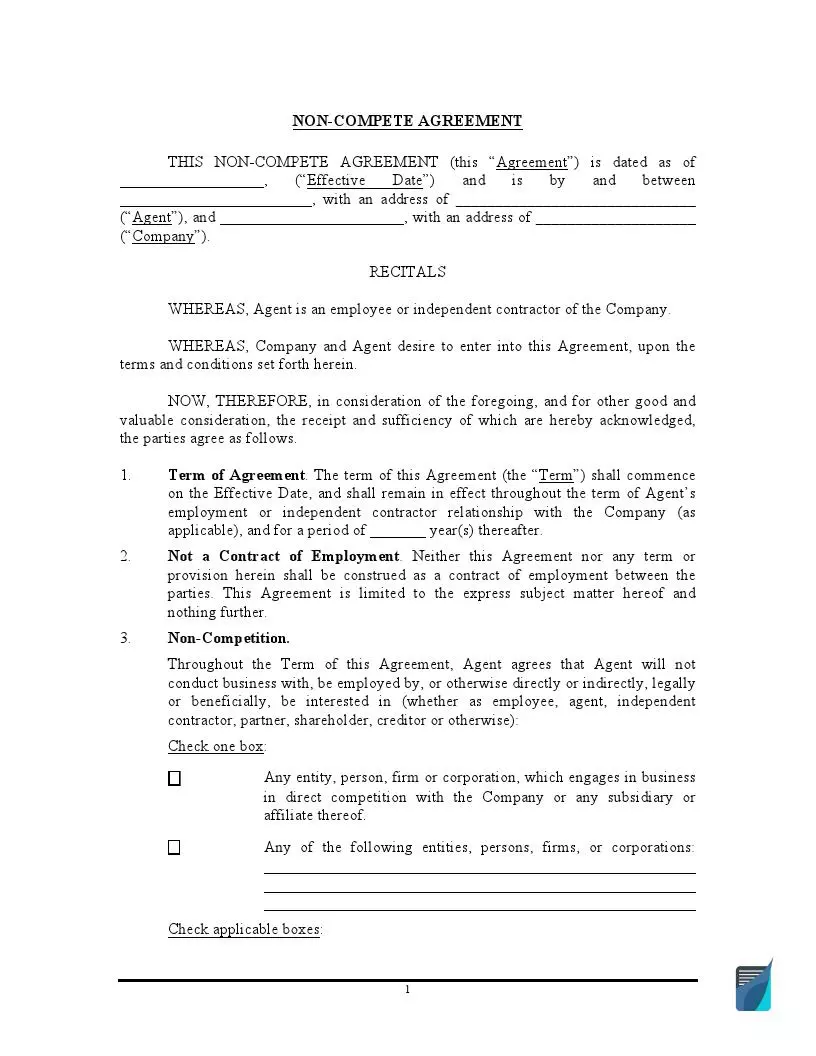
A non-compete agreement is a document that prevents an individual or entity from competing with another party. The most common use of a non-compete agreement is when hiring a new employee.
Last Updated: October 2026. This guide is reviewed and updated regularly to reflect current law. If you notice an error or outdated information, please contact us.
Build Your Document
Answer a few simple questions to make your document in minutes
Save and Print
Save progress and finish on any device, download and print anytime
Sign and Use
Your valid, lawyer-approved document is ready
Employees often learn confidential information on the job, such as client lists, pricing, or technical methods. A non-compete agreement limits what a person may do with that knowledge after leaving. For example, it can bar them from joining a rival or starting a similar business for a set period and within a set area. How far a court will enforce that limit depends on the state.
A non-compete agreement can cover an employee, an independent contractor, or a person released from an earlier restriction. Each relationship has its own purpose and its own wording, so pick the version that matches the working relationship you have.
An independent contractor non-compete agreement is signed between a contractor and a business. The business uses it to keep the contractor from competing, both during the engagement and for a limited time after it ends. It usually covers:
An employee non-compete agreement is signed at the start of employment and protects the company's trade secrets and other protected business information. It stops a new employee from using that information against the company after moving to a new workplace or starting their own business.
A release agreement is a separate legal document that waives the original non-compete agreement. Once it is signed, the person can work for a competitor, start a new business, or work independently without the earlier restriction.
It depends on the state. Rules on non-compete agreements are set mostly at the state level, and the states do not agree. Some states void most covenants not to compete. Others enforce one only when it is reasonable in time, area, and scope.
A few states set special limits for certain groups, such as health care workers or lower-paid employees. The state table below shows the general attitude in each state.
Agreements of this kind are usually grouped into four related types:
Non-compete agreements appear in any field where staff pick up information that a competitor would value, such as client relationships, pricing, or technical know-how. Three common examples are the financial industry, insurance companies, and the IT field.
Hedge funds, asset managers, and other investment firms often use these agreements. Their key employees tend to have wide financial knowledge, and a former employer would not want it to follow them to a rival.
An insurance company pays an employee to sell or administer insurance programs, and that employee helps win the company's clients. A non-compete agreement keeps the employee from joining a competitor or starting a rival business and using what they learned about those clients.
The IT industry has grown quickly, and non-compete agreements are a regular topic there. Take a backend developer who builds how a company's database interacts with the browser. The agreement protects the company from that developer using the same know-how at a competitor, or in a new business, for a specified period.
Across these fields, the information an employer most often wants to protect includes:
Non-compete agreements vary from industry to industry. To get a template that reflects your interests, use our free online document builder. The agreement you create is easy to download as a PDF and print.
Before you use a non-compete agreement to protect business information from competitors, weigh the points below. Each one affects whether a court is likely to enforce the agreement, and each is easier to settle before anyone signs.
Keep it narrow. Whatever your state's rule, a covenant that reaches further than the employer's legitimate business interest is the one most likely to be refused. Tie the activity, the time, and the territory to what you actually need to protect.
Our free non-compete agreement template covers the standard legal provisions. Adapt the template to your state and your employment setup, then have it reviewed before anyone signs.
The table below shows each state's general attitude toward non-compete agreements and the main state law that governs them. The rules differ by state. Some states void most covenants, some enforce reasonable ones, and some limit them for certain workers or industries. Use the table as a starting point, and read your state's law before you rely on an agreement.
| STATE | General Attitude | STATE LAW |
| Alabama | Void unless within the statute's exceptions. Employee covenants are allowed with reasonable time and place limits, and two years or less is presumed reasonable | Alabama Code, Section 8-1-190 |
| Alaska | No general statute | No Statute |
| Arizona | NCA are generally enforceable as long as they are reasonable (Valley Medical Specialists v. Farber, 1999). Broadcast employers may not require a noncompete clause | Arizona Revised Statutes, Section 23-494 |
| Arkansas | NCA are generally enforceable as long as they are reasonable | Arkansas Annotated Code, Section 4-75-101 |
| California | NCA are not enforceable | California Business and Professions Code, Section 16600 |
| Colorado | Void unless within the statute's exceptions | Colorado Revised Statutes, Section 8-2-113 |
| Connecticut | No general statute. Statutes cover physicians, security guards, broadcast employees and home care workers | Connecticut Revised Statutes, Chapter 557, Sections 31-50a and 31-50b; and Chapter 370, Section 20-14p |
| Delaware | No general statute. Physician covenants are void on termination | Delaware Code, Title 6, Section 2707 |
| Florida | Courts generally favor NCA | Florida Statutes, Section 542.335 |
| Georgia | NCA are generally enforceable as long as they are reasonable | Georgia Code, Title 13, Chapter 8, Article 4 |
| Hawaii | Only the covenants the statute lists are lawful, such as an employee's trade-secret covenant for a reasonably necessary time. Technology business employees may not be bound at all | Hawaii Revised Statutes, Section 480-4 |
| Idaho | NCA are generally enforceable as long as they are reasonable, for key employees and key independent contractors | Idaho Statutes, Sections 44-2701 to 44-2704 |
| Illinois | Allowed only above the Freedom to Work Act's earnings threshold and on its conditions | Illinois Compiled Statutes, Chapter 820, Act 90 (Freedom to Work Act) |
| Indiana | No general statute. Physician non-competes are regulated and partly banned | Indiana Code, Chapter 25-22.5-5.5 |
| Iowa | No general statute. Agreements restricting licensed mental health professionals are barred | Iowa Code, Sections 147.161 and 523H.8 |
| Kansas | NCA are generally enforceable as long as they are reasonable | Kansas Statutes Annotated, Section 50-163 |
| Kentucky | Courts require consideration beyond continued employment (Charles T. Creech, Inc. v. Brown, 2014) | No general statute. Kentucky Revised Statutes, Section 216.724 (health care staffing agencies) |
| Louisiana | Void unless within the statute's exceptions | Louisiana Revised Statutes, Section 23:921 |
| Maine | Courts generally disfavor NCA | Maine Revised Statutes, Title 26, Section 599-A |
| Maryland | Void for low-wage, most direct-care health and veterinary employees. One year and ten miles for higher-paid health care employees | Maryland Code, Labor and Employment, Section 3-716 |
| Massachusetts | Enforceable only if the agreement meets the statute's minimum requirements | Massachusetts General Laws, Ch. 149, Sec. 24L |
| Michigan | NCA are generally enforceable as long as they are reasonable | Michigan Compiled Laws, Section 445.774a |
| Minnesota | NCA are not enforceable (with limited exceptions) | Minnesota Statutes, Section 181.988 |
| Mississippi | No general statute | No Statute |
| Missouri | NCA are enforceable when they protect trade secrets or customer contacts and are reasonable in time and area (Whelan Security Co. v. Kennebrew, 2012) | Missouri Revised Statutes, Section 431.202 (non-solicitation covenants) |
| Montana | Void except on a sale of a business or a partnership dissolution | Montana Annotated Code, Sections 28-2-703 to 28-2-705 and 28-2-724 |
| Nebraska | NCA are generally enforceable as long as they are reasonable | No general statute. Nebraska Revised Statutes, Section 87-404 (franchise covenants) |
| Nevada | NCA are generally enforceable as long as they are reasonable | Nevada Revised Statutes, Section 613.195 |
| New Hampshire | Void for low-wage employees. Unenforceable unless a copy was given before the offer was accepted | New Hampshire Revised Statutes, Sections 275:70 and 275:70-a |
| New Jersey | Domestic workers and charter school employees may not be bound | No general statute. New Jersey Statutes, Sections 34:11-71 (domestic workers) and 18A:36A-14a (charter school employees) |
| New Mexico | No general statute. Health care practitioner non-competes are unenforceable once the agreement or employment ends | New Mexico Statutes Annotated, Sections 24A-4-1 to 24A-4-5 (formerly 24-1I-1 to 24-1I-5) |
| New York | NCA are enforceable when reasonable (BDO Seidman v. Hirshberg, 1999). Broadcast employees may not be bound | New York Labor Law, Section 202-K |
| North Carolina | Courts generally disfavor NCA | North Carolina General Statutes, Section 75-4 |
| North Dakota | NCA are not enforceable (with limited exceptions) | North Dakota Century Code, Section 9-08-06 |
| Ohio | NCA are generally enforceable as long as they are reasonable | No Statute |
| Oklahoma | NCA are not enforceable, except a limit on soliciting established customers | Oklahoma Statutes, Sections 15-217 to 15-219A |
| Oregon | Void unless the statute's conditions are met, with a 12-month maximum | Oregon Revised Statutes, Section 653.295 |
| Pennsylvania | Courts generally disfavor NCA (Hess v. Gebhard & Co., 2002). Health care practitioner non-competes are void, except one of up to a year when the employer did not dismiss the practitioner | No general statute. Pennsylvania Act 74 of 2024 (health care practitioners) |
| Rhode Island | Unenforceable against nonexempt, student, under-19 and low-wage workers, and against physicians | Rhode Island General Laws, Section 5-37-33; and Chapter 28-59 |
| South Carolina | Courts generally disfavor NCA (Milliken & Co. v. Morin, 2012) | No general statute. South Carolina Code, Sections 56-15-70 and 56-16-120 (dealer franchises) |
| South Dakota | Enforceable up to two years after termination within a specified area | South Dakota Codified Laws, Sections 53-9-8 to 53-9-12 |
| Tennessee | No general statute. Health care provider restrictions are reasonable within two years and ten miles | Tennessee Code Annotated, Section 63-1-148 |
| Texas | NCA are generally enforceable as long as they are reasonable | Texas Statutes, Business and Commerce Code, Sections 15.50 to 15.52 |
| Utah | NCA are allowed for up to one year after employment ends, and a longer one is void. New non-competes with health care workers and veterinarians are barred | Utah Code, Sections 34-51-101 to 34-51-301 |
| Vermont | Barbering and cosmetology schools may not require a non-compete as a condition of training | No general statute. Vermont Statutes, Title 26, Section 281(c) (barbering and cosmetology schools) |
| Virginia | Courts generally disfavor NCA (Preferred Systems Solutions v. GP Consulting, 2012). Barred for low-wage employees and health care professionals | Virginia Code, Section 40.1-28.7:8 |
| Washington | Void unless the statute's conditions are met | Washington Revised Code, Chapter 49.62 |
| West Virginia | NCA are generally enforceable as long as they are reasonable (Wood v. Acordia of West Virginia, 2005). Physician covenants are limited to one year and thirty miles | West Virginia Code, Section 47-11E-2 |
| Wisconsin | Enforceable only if reasonably necessary. An unreasonable restraint is void entirely | Wisconsin Statutes and Annotations, Section 103.465 |
| Wyoming | NCA are not enforceable (with limited exceptions) | Wyoming Statutes Annotated, Section 1-23-108 |
A non-compete agreement can include a clause that ends it under set circumstances, such as a buyout or a change in role. Without such a clause, an employee who signed an enforceable agreement is generally bound by its terms. Disagreeing with a term does not cancel the agreement on its own.
If you disagree with a provision, start by talking to the employer about the unclear or overbroad wording and how to fix it. If negotiation fails, you can challenge the agreement in court, ideally with a lawyer's advice. Common grounds people raise include:
Whether any of these grounds succeeds depends on the state and the facts. Some states void most non-compete agreements outright, so ask a lawyer in your state before you act.
A non-compete agreement follows a standard order of parts. Fill them in one at a time and keep each part specific, because specific terms are easier to enforce and harder to dispute. Our free online builder walks you through the same sequence, and the finished template is ready to print and sign.
General information, not legal or tax advice.
