
A Hawaii non-compete agreement is a written contract in which a worker promises not to compete with a company, or work for a competitor, for a set time. An employer often uses it to protect trade secrets and other confidential information. Hawaii prohibits noncompete and nonsolicit clauses in the contracts of employment of employees of a technology business.[1.5] You can build a free non compete agreement with the builder below or download the PDF template.
Last Updated: October 2026. This guide is reviewed and updated regularly to reflect current Hawaii law. If you notice an error or outdated information, please contact us.
Build Your Document
Answer a few simple questions to make your document in minutes
Save and Print
Save progress and finish on any device, download and print anytime
Sign and Use
Your valid, lawyer-approved document is ready
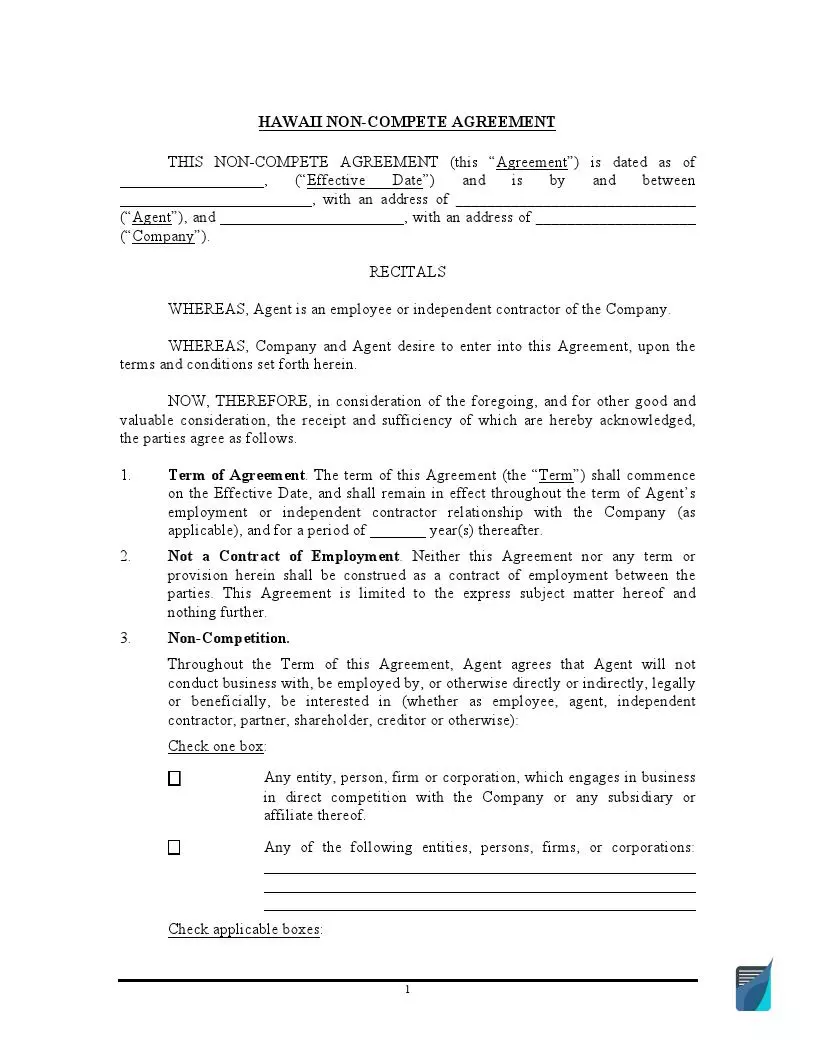
A Hawaii non compete agreement template sets what a worker may not do for a competitor and for how long. The Hawaii form puts the main terms in sections 1 to 3. You fill in the blanks and tick the boxes that match your arrangement.
A non-compete agreement is a promise not to compete. In the Hawaii template, the worker, called the Agent, promises not to do business with, work for, or own part of a competing business of the Company. An employer usually has a clear purpose, such as protecting trade secrets or confidential information. An employee who understands that purpose can judge whether the restriction fits the job.
Section 1 starts the agreement on the Effective Date. It stays in effect while the person works for the company as an employee or independent contractor, and for the number of years you enter after that.
Section 3 bars the person from doing business with, working for, or holding an interest in a competing business. The form gives you these choices:
The template names two parties and the date the agreement takes effect. The Hawaii non compete form calls the worker the Agent and the hiring business the Company. Enter each party's name and address and the Effective Date at the top of page 1.
The recitals on page 1 state that the Agent is an employee or independent contractor of the Company. The last page has a signature block for each party, with lines for By, Printed Name, and Title. Each employee or contractor should read every section of the non compete agreement before signing. To fill in the downloaded PDF on screen, use our PDF editor.
Five more sections complete the non compete agreement. They say the form is not a contract of employment, protect the company's staff and customers, and cover general terms. They also let a court adjust a restriction that is too broad and pick Hawaii law. These sections are already written in the template.
Most problems with a non compete agreement start with a form that was filled in too fast. Check the points below before anyone signs, and keep a signed copy for each party.
Whether a non-compete agreement is legal in Hawaii depends on the covenant. Under Section 480-4 of the Hawaii Revised Statutes (Haw. Rev. Stat.), subsection (a) makes every contract in restraint of trade or commerce in the State, or in any section of the State, illegal.[1.1] Subsection (c) lists restrictive covenants that are lawful when they are ancillary to a legitimate purpose and do not substantially lessen competition or tend to create a monopoly.[1.2]
Subsection (c) says:
It shall be lawful for a person to enter into any of the following restrictive covenants or agreements ancillary to a legitimate purpose not violative of this chapter, unless the effect thereof may be substantially to lessen competition or to tend to create a monopoly in any line of commerce in any section of the State
Two of the covenants listed in subsection (c) are:
Subsection (c) also allows an employee's covenant not to use the employer's trade secrets in competition with the employer, during or after the job. It may last only as long as reasonably necessary to protect the employer and may not impose undue hardship on the employee.[1.6]
Chapter 480 of the Hawaii Revised Statutes, which covers monopolies and restraint of trade, also declares unfair methods of competition and unfair or deceptive acts or practices in the conduct of any trade or commerce unlawful (Section 480-2). The non-compete rules themselves are in Section 480-4.[2.1]
Employees of a technology business have their own rule in subsection (d). It prohibits a noncompete clause or a nonsolicit clause in any contract of employment relating to an employee of a technology business. The clause is void and of no force and effect.[1.5]
The questions below cover how Hawaii treats non-compete agreements under Section 480-4. Each answer follows the text of the statute, so you can check it against the source. For your own situation, ask a Hawaii attorney.
A covenant not to compete has only the force the law gives it. Where the law voids the restraint, the agreement is unenforceable. Where the law permits it, the restraint is enforceable only on the conditions the law attaches.[1.2]
Some are and some are not. A noncompete clause in the contract of employment of an employee of a technology business is void and of no force and effect.[1.5] A covenant tied to the sale of a business, or between partners, is allowed within a reasonable area and a reasonable period of time.[1.3]
General information, not legal or tax advice.

