
A Hawaii lease agreement is a written contract between a landlord and a tenant. It sets the rent, the security deposit, the term of the tenancy, and each party's duties for a rental property in the state. Hawaii landlords and tenants use it for houses, apartments, condos, and rooms. Its terms are governed mainly by Chapter 521 of the Hawaii Revised Statutes, with disclosure rules in Chapter 481M. Build your own Hawaii lease agreement PDF below, or read on for the state's deposit, notice, and payment rules.
Last Updated: September 2026. This guide is reviewed and updated regularly to reflect current Hawaii law. If you notice an error or outdated information, please contact us.
Build Your Document
Answer a few simple questions to make your document in minutes
Save and Print
Save progress and finish on any device, download and print anytime
Sign and Use
Your valid, lawyer-approved document is ready
Hawaii's landlord-tenant rules appear in Chapter 521 of the Hawaii Revised Statutes, known as the Residential Landlord-Tenant Code. Chapter 490 covers commercial leases separately. These rules set the maximum security deposit, the deadline to return it, the notice needed to end a tenancy, and limits on what a landlord can charge or require. The sections below explain what Hawaii law requires for a residential lease, so both tenants and landlords know what to expect from the property.
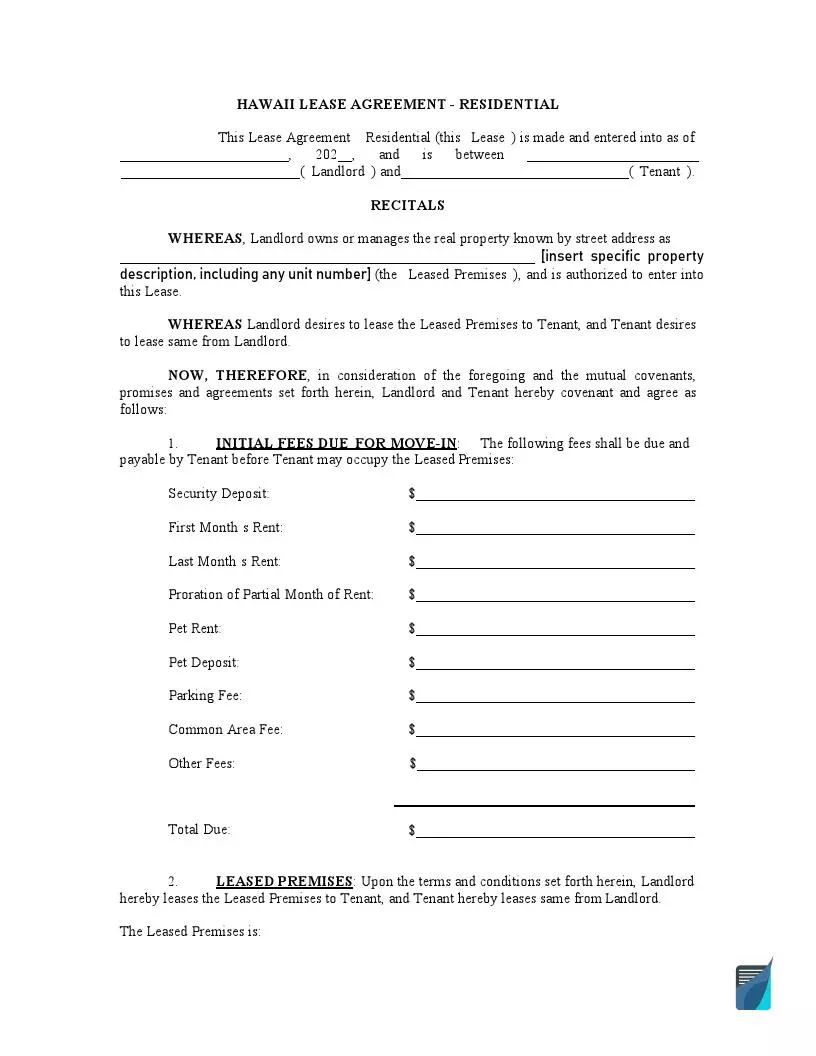
Under Hawaii law, a security deposit cannot exceed one month's rent. If the landlord and tenant agree in writing to let a pet live at the rental property, they may also agree to a separate pet deposit. That additional amount cannot exceed one month's rent either. At the start of the tenancy, the landlord may not require or accept any other payment beyond the first month's rent and the security deposit.[1.2]
In practice, this means a landlord could ask for up to two months' rent upfront. One month is the standard deposit, and, only if you agree to it in writing, up to one more month can be a pet deposit.
The landlord must return the security deposit, or whatever remains after lawful deductions, no later than fourteen days after the tenancy ends. A landlord who misses that fourteen-day deadline loses the right to keep any part of the deposit and must return the entire amount.[1.2]
To keep any part of the deposit within that window, the landlord must send the tenant a written, itemized notice listing each deduction, with evidence such as receipts, invoices, or repair estimates. This written notice is not required when the tenant wrongfully quit the unit.[1.1]
The statute adds a few more rules about a withheld deposit:[1.2]
Hawaii law sets separate notice periods for ending a lease, depending on who is giving notice and how often rent is paid. A landlord ending a month-to-month tenancy must give the tenant at least forty-five days' written notice. A tenant ending that same tenancy must give the landlord at least twenty-eight days' written notice instead. A week-to-week tenancy needs only ten days' notice from either side.[2]
The same law also treats an unexplained absence as ending the tenancy. If a tenant is away from the rental property for twenty days or more in a row without written notice to the landlord, the law treats the tenancy as over. The tenant is considered to have wrongfully quit the unit.[1.2]
Not the same as an eviction notice. The forty-five day period above is the notice a landlord must give to end a month-to-month tenancy without cause. It is not a court eviction filing.
State law also limits certain payment and ownership-transfer practices. A landlord cannot require a postdated check or any other postdated negotiable instrument to pay rent. If the property changes owners, the new landlord must give each tenant written notice of the security deposit amount credited to them within twenty days of taking over.[1.2]
Before the tenant moves in, the landlord must inventory the unit and record in writing its condition and any furnishings or appliances provided. Landlord and tenant both sign that record, and each tenant gets a copy (Section 521-42 of the Hawaii Revised Statutes).[3.1]
In writing, at or before move-in, the landlord must give the tenant the name and address of the property manager and of the owner or the owner's agent for notices and rent. The landlord must also give tenants its general excise tax number so they can claim the low-income tax credit (Section 521-43).[3.2]
Except in an emergency or where it is impracticable, the landlord must give the tenant at least two days' notice before entering and may enter only during reasonable hours (Section 521-53).[3.3]
Under federal law (42 U.S.C. 4852d), for housing built before 1978 the landlord must disclose any known lead-based paint or lead hazards and give the tenant the EPA lead hazard pamphlet before the lease binds the tenant. The disclosure is attached to or written into the lease.[4.1]
There are various types of rental agreements because every rental deal is different. In some cases, you need a template for an apartment lease, while other cases require a contract for a commercial lease, and so on. In Hawaii, you may use one of at least eight types of this agreement:
Because the templates and lease conditions are different, before starting to create a lease agreement, make sure that you choose the correct contract template. Many landlords also use a rental application to screen tenants before signing any of these agreements.
| Document Name | Hawaii Rental Lease Agreement Form |
| Other Names | HI Rental Lease, Hawaii Residential Lease Agreement |
| Relevant Laws | Hawaii Revised Statutes, Chapter 521 |
| Security Deposit Amount | One month’s rent, plus up to one more month's rent for an agreed pet deposit |
| Security Deposit Return | Fourteen (14) days from termination date |
| Avg. Time to Fill Out | 18 minutes |
| # of Fillable Fields | 119 |
| Available Formats | Adobe PDF |
Yes. At the start of a Hawaii tenancy, the landlord can require the first month's rent and a security deposit, but no other payment. The security deposit itself cannot exceed one month's rent, plus an optional agreed amount for a pet.[1.2]
A Hawaii landlord must return the security deposit, or the part left after lawful deductions, no later than fourteen days after the tenancy ends. Missing that deadline without sending the required itemized notice means the landlord must return the entire deposit.[1.2]
The forty-five day notice is the advance written notice a landlord must give a tenant to end a month-to-month tenancy in Hawaii. A tenant ending that same tenancy owes the landlord at least twenty-eight days' notice instead. Neither is a court eviction filing.[2]

General information, not legal or tax advice.
